

Maitre HANANA ABDERRAHIM
Cabinet Me. Maitre HANANA ABDERRAHIM•Rabat
Business LawFamily LawReal Estate Law+16
French · Arabic
Direct contact only
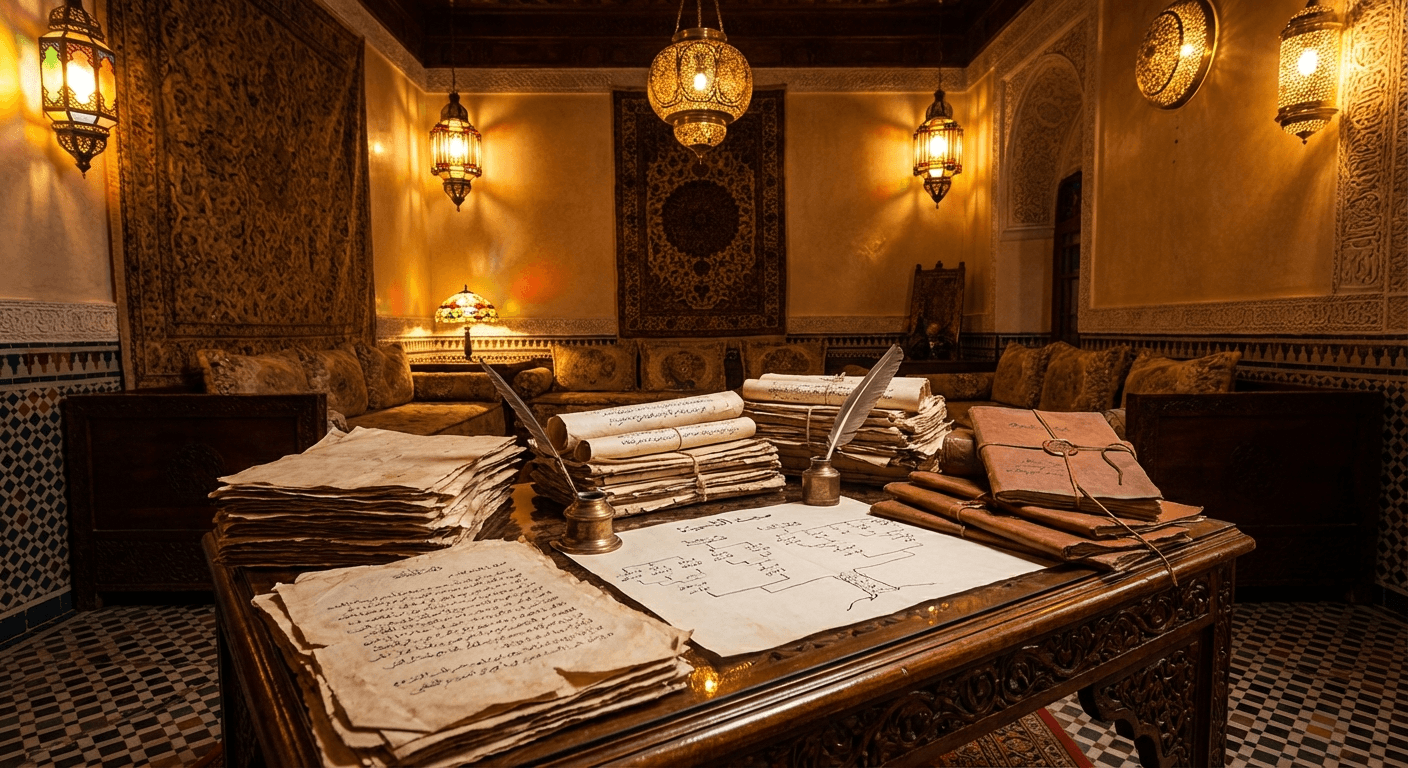
Understand Moroccan inheritance rules, the calculation of hereditary shares, and the steps to follow under the Family Code (Moudawana)
Hicham Ouazzani
Legal Editor — Criminal Law
Need a Family Law lawyer?
Browse verified profiles near you
Calculate the inheritance shares of your case
Spouse, children, parents, siblings — exact Moudawana fractions, free.
Moroccan inheritance law is based on the provisions of Book VI of the Family Code (Moudawana), promulgated by Dahir No. 1-04-22 of 3 February 2004. This legal framework follows the tradition of Maliki Islamic jurisprudence, the predominant school of law in Morocco, while incorporating certain modern legislative adaptations. Articles 321 to 395 of the Moudawana govern all matters relating to succession, the calculation of shares, impediments to inheritance, and the rules of division.
The Moroccan inheritance system is distinguished by its mixed nature. On the one hand, it relies on the Quranic rules of fard (fixed shares reserved for certain heirs) and ta'sib (residuary devolution). On the other hand, it incorporates mechanisms derived from Moroccan notarial and judicial practice. The result is a precise and mathematical system where each heir receives a specific share based on their relationship to the deceased, their gender, and the presence or absence of other heirs.
Succession opens upon the death of a person, or by judicial decision in cases of declaration of death or prolonged absence. Article 325 of the Moudawana specifies that succession covers the deceased's estate after payment of funeral expenses, debts, and execution of the will within the limit of the disposable third. These priority deductions reduce the estate available for distribution among heirs.
In 2026, Moroccan inheritance law is the subject of significant social debate, particularly regarding gender equality in succession. Several voices in civil society call for reform of the division rules, while others believe the current system, rooted in Islamic tradition, provides appropriate protection for each category of heir. Legal practitioners must navigate between these currents while strictly applying the positive law in force.
Moroccan inheritance law classifies heirs into three distinct categories. The first is that of heirs with fixed shares, or ashab al-furud (fard heirs). These individuals are entitled to a determined fraction of the estate as set by the Quran and Sunna. The fixed shares provided for are: one half (1/2), one quarter (1/4), one eighth (1/8), two thirds (2/3), one third (1/3), and one sixth (1/6). Among fard heirs are the wife, husband, daughter, son's daughter, mother, father (in certain cases), grandmother, full sister, paternal sister, and uterine brother.
The second category is the 'asaba (residuary or agnatic) heirs. These heirs receive what remains of the estate after the fixed shares have been allocated. In the absence of fard heirs, they inherit the entire estate. There are three sub-categories: 'asaba bi nafsih (residuary in his own right, such as the son, full brother, paternal uncle), 'asaba bi ghayrih (residuary through another, such as the daughter in the presence of a son), and 'asaba ma' ghayrih (residuary with another, such as the full sister in the presence of a daughter).
The third category, dhawil arham (cognate relatives), only inherit in the total absence of fard and 'asaba heirs. This category includes the children of the daughter, children of the sister, maternal uncle, and paternal aunt. Article 371 of the Moudawana provides that, when there are no fard or 'asaba heirs, the estate passes to dhawil arham according to a priority order defined by law.
The mechanism of hajb (exclusion) plays a central role in determining effective heirs. An heir may be fully excluded (hajb hirman) or have their share reduced (hajb nuqsan) by the presence of a closer relative. For example, the full brother is excluded by the deceased's son, and grandchildren through a son are partially excluded by direct children. Mastery of hajb rules is essential for any inheritance calculation.
Lawyers at your service
Verified profiles, members of Moroccan bar associations — call or message them directly from their page

A lawyer at the Casablanca Bar, I practise mainly in business law and in high-stakes litigation (commercial, tax, real estate and employment), with a practice geared towards strategy and results. I assist executives, investors and financial institutions at every stage of the case: risk analysis, legal structuring, negotiation and litigation management. My approach is both rigorous and operational, with a clear objective: to secure your interests and optimise your chances of success. What sets me apart: a strong results-driven culture, constant responsiveness and the ability to handle complex cases with an overall strategic vision. I pay particular attention to the quality of drafting and to the construction of the argument, both decisive in the outcome of disputes.

Our law firm assists and defends individuals, professionals and companies in their legal and litigation matters. Together with my associates, we practise mainly in criminal law, civil law, business law and commercial law, favouring a rigorous, responsive approach tailored to each case. Our commitment: to provide every client with attentive listening, precise legal advice and an effective defence of their rights and interests, both in negotiations and before the courts.
The surviving spouse holds an important place in succession. The husband receives half the estate if the deceased wife left no descendant, and one quarter if there is a descendant. The wife receives one quarter if the deceased husband has no descendant, and one eighth if there is one. Where there are multiple wives, they share this portion equally. It is important to note that the default matrimonial regime in Morocco is separation of property, although spouses may agree on a regime for sharing acquired assets in a document annexed to the marriage certificate (Article 49 of the Moudawana).
The deceased's children are the principal heirs. An only son inherits the entire residue by ta'sib after fixed shares. An only daughter receives one half as fard. Two or more daughters share two thirds. In the presence of a son and a daughter, the classical Islamic rule applies: the male receives double the female's share. This is the principle of "li dhakari mithlu hazz al-unthayayn" from Quranic verse 4:11. This rule is the subject of intense debate in Morocco in 2026 but remains fully applicable under positive law.
The deceased's parents also have inheritance rights. The father receives one sixth as fard in the presence of a male descendant, or one sixth as fard plus the residue by ta'sib if there are only female descendants. The mother receives one sixth in the presence of a descendant or two or more siblings, and one third in their absence. The special case of "masala gharawiyya" arises when the heirs are limited to the spouse and both parents: here, the mother receives one third of the residue (not one third of the total estate).
The deceased's siblings only inherit in the absence of a male descendant and father. A single full sister receives one half; two or more full sisters receive two thirds. The full brother inherits by ta'sib. Uterine siblings are entitled to one sixth (one sibling) or one third (two or more), but are excluded by the father, son, and grandson. These rules of exclusion and competition between heirs make inheritance calculations particularly complex, often requiring specialist intervention.
The will, or wasiyya, is governed by Articles 277 to 320 of the Moudawana. The testator may bequeath up to one third of their estate to persons who are not legal heirs. Beyond one third, the bequest is subject to the approval of the heirs. This disposable third rule is a fundamental principle of Islamic inheritance law, designed to protect the rights of compulsory heirs. The testator also cannot bequeath to an heir unless the other heirs consent.
The will must be drawn up by an adoul or notary and registered with the family court. It may cover movable or immovable property, the enjoyment of property (usufruct), or monetary sums. The will takes effect upon the death of the testator and may be revoked at any time during their lifetime. In practice, many Moroccans are unaware of the possibility of making a will, or consider that inheritance law sufficiently organises the devolution of their estate.
Tanzil is a mechanism specific to Moroccan law that allows the testator to provide inheritance for a grandchild whose parent (child of the testator) predeceased the testator. Article 315 of the Moudawana organises tanzil by permitting the testator to bequeath to their orphaned grandchildren a share equivalent to what their predeceased parent would have received, within the limit of the disposable third. This mechanism is also called "obligatory bequest" in some Arab legal systems.
In the absence of a will providing for tanzil, the Moudawana provides a statutory tanzil mechanism for orphaned grandchildren (Article 369). They are entitled to a share of their grandparent's estate equivalent to their predeceased parent's share, within the limit of one third. If this share exceeds one third, the heirs may accept or refuse the excess. This provision constitutes a social justice measure aimed at protecting orphaned grandchildren who, without tanzil, would be excluded from the succession.
The succession procedure in Morocco begins with obtaining the death certificate from the civil registry. This first step is essential as the death certificate conditions all subsequent formalities. The heirs must then have the certificate of heirs, or irad al-irtha, drawn up by two sworn adoul at the notarial section of the family court. This document identifies the heirs, specifies their relationship to the deceased, and determines their respective shares.
Establishing the certificate of heirs requires the presentation of several documents: the death certificate, the heirs' civil status documents (birth certificates, marriage certificate), a certificate of residence, and the testimony of twelve witnesses who know the deceased's family. The adoul then draft the certificate, which is ratified by the judge in charge of notarial matters (qadi al-tawthiq). The cost of this procedure is regulated and relatively accessible.
Once the certificate of heirs is established, the heirs may proceed to divide the estate. Division may be amicable, by agreement among all heirs, or judicial, by referring the matter to the court in case of disagreement. For real property, division requires registration with the land registry. The heirs must also pay registration duties and transfer fees. In 2026, registration duties on direct-line successions are set at a favourable rate designed to facilitate wealth transmission.
The role of the notary (adoul or modern notary) is central in succession proceedings. It extends beyond drafting documents: the notary advises heirs on their rights, verifies the completeness of the estate inventory, and ensures the division complies with the Moudawana rules. In complex cases involving real property, company shares, or assets abroad, the involvement of a lawyer specialising in succession law is strongly recommended.
The question of succession for foreigners in Morocco is governed by conflict of laws rules. In principle, the national law of the deceased applies to movable succession, while the law of the property's location applies to immovable succession. However, Article 332 of the Moudawana sets an important restriction: difference of religion constitutes an impediment to inheritance. A non-Muslim cannot inherit from a Muslim and vice versa, except through a will within the limit of one third.
For mixed couples (one Muslim and one non-Muslim spouse), this rule can have considerable financial consequences. The non-Muslim spouse does not inherit from their deceased Muslim partner, which can lead to situations of hardship. In such cases, practitioners advise the use of alternative wealth protection mechanisms: life insurance, inter vivos gifts between spouses, creation of a real estate company, or a will within the authorised one-third limit.
Moroccans residing abroad (MRE) who own property in Morocco are subject to Moroccan inheritance law for their immovable assets located in Morocco. For movable assets, the applicable law depends on the deceased's domicile. This duality of regimes can create complex situations when the deceased owns property in several countries. Bilateral conventions concluded by Morocco with certain European countries attempt to harmonise these rules, but gaps remain.
A particular case deserves attention: collective lands and soulaliyate lands. These lands, governed by the Dahir of 26 February 2019, follow specific devolution rules that do not fall under classical inheritance law. Rights of use over these lands are transmitted according to community customs and are subject to the approval of the guardianship council. Since the 2019 reform, women have equal access to rights over soulaliyate lands, a significant advancement in equality.
Moroccan inheritance law has been the subject of intense discussion for several years, and the debate intensified in 2026 following the recommendations of the Special Commission on the New Development Model. The central question concerns gender equality in succession. The Quranic principle whereby the son receives double the daughter's share (ta'sib) is challenged by feminist movements and progressive intellectuals who advocate for reform guaranteeing equal shares.
Supporters of the status quo advance several arguments: the current system forms a coherent whole where the woman's smaller share is offset by other financial obligations falling on the man (nafaqa, dowry, conjugal home). They emphasise that the 2004 Moudawana reform already brought major advances in women's rights, and that inheritance rules fall within the domain of categorical religious texts (qat'iyy) that are not subject to interpretation (ijtihad).
In terms of case law, certain recent decisions by Moroccan courts have shown interpretive boldness. Judges have granted female heirs more favourable shares by using creative legal mechanisms, such as reclassifying certain assets as the couple's jointly acquired property. These decisions remain marginal, however, and are sometimes overturned on appeal or cassation.
Independent of the equality debate, practical reforms are expected in 2026: digitisation of the succession procedure, creation of a national register of wills, and improved coordination between adoul, modern notaries, and the land registry. These technical reforms, less controversial, would contribute to streamlining the succession process and reducing division timelines, which can currently extend over several years in contentious cases.
Need a Family Law lawyer?
Browse verified profiles near you
Directory of specialized lawyers in Morocco
Estate division in Morocco is complex and requires sharp legal expertise. Find a specialist lawyer on AvocatLib to assist you with your inheritance and succession matters.
Find an inheritance law attorneyEverything you need to know about divorce procedures in Morocco: types of divorce, steps, required documents, and timelines.
15 min readFamilyUnderstanding child custody rules in Morocco: attribution, conditions, child support, and visitation rights.
11 min readBusinessPractical guide to creating your limited liability company in Morocco. Capital, bylaws, registration, and legal obligations.
12 min read