
Introduction: a legal reality many Moroccan workers and families still do not know
A new death involving a Moroccan seasonal worker in Spain has once again forced a difficult question back into public debate: what are the real legal rights of Moroccan seasonal workers in Spain, beyond the promises made at recruitment time? Every year, roughly 15,000 to 20,000 Moroccan workers travel to Spain under the contratación en origen system, and a large majority are women recruited for agricultural work, especially in Huelva’s strawberry fields. Their migration is not an abstract policy issue. It is a family strategy, a source of income, and, very often, a sacrifice made with dignity.
In my practice in Agadir, I have met families who did not even know that their daughter, wife or sister had a right to medical coverage from the very first day of work in Spain. I have also seen returned workers who discovered too late that salary claims in Spain are subject to a strict one-year limitation period. That gap between the law on paper and the reality in the field is not a small technical problem. It has financial, social and human consequences.
This article is written for workers, relatives, students and employers who want clarity. Not vague reassurance. Not slogans. Concrete rights, concrete procedures, concrete deadlines. The legal thread running through this subject is the bilateral Morocco-Spain framework: migration cooperation agreements, Spanish labor law, the social security convention of 8 November 1979, and the Moroccan institutions that intervene before departure and after return, especially ANAPEC, the Moroccan labor administration, the consular network and the CNSS.
Concretely, if you are asking whether a Moroccan seasonal worker in Spain must receive a written contract, whether housing must meet minimum standards, whether a pregnant worker can be dismissed, whether workplace injuries are covered, whether unpaid wages can still be claimed after returning to Morocco, or whether seasonal contributions in Spain count for retirement in Morocco, this article is for you.
And let us be frank. The law does provide real protections. But those protections only work if the worker knows they exist, keeps documents, reacts quickly and, where necessary, seeks help from the right institutions: the Inspección de Trabajo y Seguridad Social, the Spanish social courts, Moroccan consulates, ANAPEC, and specialized lawyers in Morocco or Spain. That is why information matters. In this field, legal ignorance is expensive.
The death that put the issue back on the table
Recent tragedies involving Moroccan women working in Spain have revived scrutiny of transport conditions, housing, workplace safety and employer accountability. Public emotion is understandable, but emotion alone does not protect anyone. Rights do. Procedures do. Evidence does. And this is where many families feel abandoned, because they often hear after the fact that there was insurance, a mutual accident fund, a pension right, or a complaint mechanism they had never been told about.
Why this article is addressed to workers and families
If your relative is leaving through the recrutement saisonnier ANAPEC Espagne process, or if she has already returned from Huelva, Almería or another agricultural region, you need to understand one essential point: a Moroccan seasonal worker lawfully recruited for Spain is not outside the law, and is not left without protection. She is covered by Spanish labor law, Spanish social security rules, and by the bilateral legal architecture linking Morocco and Spain. The problem is that these rights are too often poorly explained, weakly enforced, or claimed too late.
The bilateral legal framework: what the Morocco-Spain system actually says
The 2001 migration cooperation agreement and its limits
The starting point is the Agreement on Cooperation in the Field of Migration between Morocco and Spain signed on 25 July 2001, later complemented by practical arrangements including a 2006 memorandum on the concerted management of migration flows. This framework made organized labor mobility possible on a larger scale. It is the legal and political basis behind the programme de travail saisonnier Huelva Maroc that many Moroccan workers know through ANAPEC campaigns.
On the Moroccan side, mobility is also framed by Dahir n° 1-03-194 of 11 November 2003 promulgating Law n° 02-03 relating to the entry and stay of foreigners in Morocco and to irregular emigration and immigration. While Law 02-03 is often discussed in relation to migration control, it also matters here because it forms part of the legal environment governing labor migration and the role of public institutions.
There is, however, a structural weakness that has concerned me for years: the bilateral framework organizes recruitment, but it does not create a strong sanction mechanism directly enforceable against abusive employers in Spain. In clear terms, the agreement facilitates the movement of workers, but when rights are violated, the worker must usually rely on ordinary Spanish labor law procedures, labor inspection, or judicial action. That is a major design flaw. The 2001 agreement was real progress, but its lack of a binding sanctions architecture remains a serious limitation.
ANAPEC’s role in seasonal recruitment: official procedure and reality on the ground
The Moroccan institution at the center of this process is ANAPEC, whose missions and organization are governed by Decree n° 2-04-513 of 21 May 2004. Officially, registration for seasonal recruitment in Spain is free of charge. That point deserves emphasis: the official cost to the worker is zero. Anyone asking for money to “facilitate” selection is acting illegally.
The standard procedure generally includes registration with a local ANAPEC agency, submission of documents, selection interviews, pre-departure orientation and contract signature before departure. In practice, selection criteria have often favored women from rural areas, especially mothers with minor children, because Spanish employers and recruitment authorities have historically considered them more likely to return to Morocco at the end of the season. Whether one agrees with that logic or not, it has shaped the program for years.
Workers are also expected to attend pre-departure sessions. These should explain the contract, working conditions, health coverage, return obligations and complaint channels. Unfortunately, the quality of this information varies. Some workers leave with a reasonably clear understanding of their rights. Others leave with almost none.
Practical rule: ANAPEC recruitment for Spain is free. If an intermediary requests payment for registration, selection or contract access, that is a red flag and should be reported to ANAPEC’s headquarters in Rabat.
What Spanish law provides for foreign seasonal workers
Once the worker is lawfully recruited and admitted to Spain, the applicable legal framework is primarily Spanish. Two texts are central. First, Real Decreto Legislativo 2/2015, which approves the Estatuto de los Trabajadores, the basic Spanish labor statute. Second, Royal Decree 557/2011, the regulation implementing Spain’s immigration law, which governs the rights and conditions of foreign workers legally employed in Spain.
This matters because a Moroccan seasonal worker in Spain is not protected by a special “reduced” labor law. She is, in principle, protected by the ordinary Spanish rules applicable to employees, together with the agricultural collective agreement applicable in the relevant province. That includes rules on written contracts, wages, occupational safety, social security registration, working time, maternity protection and salary claims.
The seasonal work contract: what to read before signing
Mandatory clauses under Spanish labor law
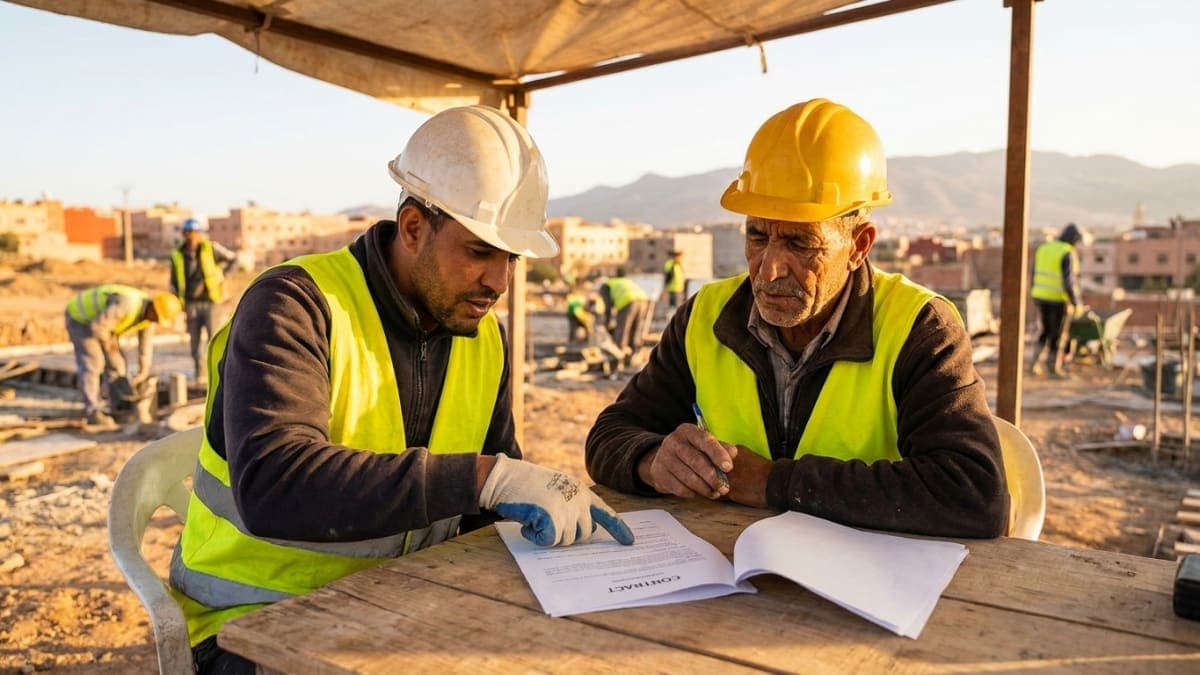
The seasonal contract between Morocco and Spain is not a mere travel formality. It is the core legal document. Under article 8 of the Estatuto de los Trabajadores, employment contracts may require written form, and in this context a written contract is standard and essential. Before departure, the worker should know at least the contract duration, the employer’s identity, the workplace, the category of work, pay, working hours, housing conditions if provided, and return arrangements.
Article 8 of the Estatuto de los Trabajadores makes written documentation of employment conditions central, especially where the nature of the job, the term and the employment relationship require proof and clarity.
Concretely, a worker should check these points before signing: the exact start and end date; whether the wage is monthly, daily or hourly; the applicable collective agreement; whether overtime is possible and how it is paid; whether accommodation is provided; whether transport deductions are mentioned; and whether return transport is organized by the employer or otherwise addressed. If one of these elements is missing, the risk of later abuse increases sharply.
In practice, Moroccan labor authorities often insist that workers understand what they sign. Ideally, the contract or at least an explanatory version should be available in Arabic or Darija. This is not always done properly. And that is where abuses begin.
The trap of vague contracts: what happens in real life
I handled a case involving a worker from Beni Mellal who had signed a contract stating only “accommodation provided,” without any detail. She arrived in Spain and found herself in overcrowded housing with poor sanitation and no hot water. Legally, the absence of precise contractual wording made the dispute harder, not impossible, but harder. That is the problem with vague drafting. It benefits the stronger party.
Frequent trap: workers are sometimes asked to sign documents in Spanish they do not understand. I have seen “receipts” that were in fact acknowledgments of payment designed to weaken future wage claims. Never sign a Spanish-language document without a translation or trusted explanation. That warning may sound basic, but it is one of the most important in this entire field.
ATTENTION: Never sign a document in Spanish unless you know exactly what it says. A paper presented as a transport receipt or attendance form may contain a waiver or a salary acknowledgment.
Wages, renewal and the return requirement
For 2024, Spain’s Salario Mínimo Interprofesional (SMI) is 1,134 euros gross per month. However, in agriculture, actual pay often follows the provincial collective agreement, the Convenio Colectivo del Campo. In Huelva, where most Moroccan seasonal workers are employed, there are specific rates for agricultural tasks such as strawberry picking. The legal rule is simple: the employer cannot pay below the applicable legal minimum, whether assessed monthly or by reference to the collective agreement’s hourly or daily scale.
As for deductions, they cannot be arbitrary. If the employer deducts for housing or transport, this must be contractually stated and proportionate. As a practical benchmark, deductions exceeding 30% of wages are highly problematic and should be challenged immediately.
Renewal raises another recurring question. There is no strict legal cap in Spanish law on the number of seasonal renewals under this migration channel, but the entire contratación en origen system is built around one central condition: the worker must return to Morocco between seasons. Failure to return can lead to exclusion from future recruitment and visa difficulties. In practice, employers often prefer trabajadores repetidores, repeat workers who complied with the return obligation in previous years.
A more technical but important point comes from article 15 of the Estatuto de los Trabajadores, which regulates temporary employment and abusive succession of contracts. In some situations, repeated fixed-term contracts over time may support a claim that the worker should be recognized as indefinite. This right is theoretically relevant, though rarely invoked successfully in the seasonal migration context because of the specific immigration and return structure of the program.
Core legal rights of Moroccan agricultural workers in Spain
Work rights: wages, hours, rest and safety
The first right is obvious, yet still too often violated: the right to be paid in full and on time. Salary must be paid regularly, usually monthly, and reflected in a payslip. The worker may receive the payslip in Spanish, but can ask for help understanding it. If the number of hours worked does not match the amount paid, the discrepancy should be documented immediately.
Working time is also regulated. Spanish labor law sets a general framework of 40 hours per week and typically 8 hours per day, subject to sectoral organization and collective agreements. Agricultural work is demanding and may involve peak periods, but overtime must still be compensated according to the applicable rules. If the employer systematically imposes extra hours without payment, that is not “normal field practice.” It is a labor violation.
Occupational safety is governed by Ley 31/1995 de Prevención de Riesgos Laborales. This law obliges employers to assess risks, provide protective equipment and train workers appropriately. In agricultural settings, this includes gloves, masks where pesticides are involved, safe tools, transport safety and basic prevention measures.
Article 19 of the Estatuto de los Trabajadores recognizes the worker’s right to effective protection in matters of health and safety at work.
That article matters a great deal. It is often cited in disputes involving unsafe transport, lack of protective equipment or dangerous working conditions. If a worker is forced to work without basic protection, especially around chemicals or dangerous machinery, the employer may face administrative sanctions and civil or criminal consequences depending on the severity.
Health coverage and workplace accidents
From the first day of lawful employment, the worker should be registered with the Seguridad Social. This means access to healthcare coverage and protection against workplace accidents through the employer’s mutual insurance body, commonly called the mutua. In plain English: if a Moroccan seasonal worker is legally hired in Spain, she is not supposed to be uninsured.
In case of a work accident, the employer must declare it promptly. As a practical rule, the declaration should be made within five working days. The worker is entitled to full medical care and, in case of temporary incapacity, daily benefits generally amounting to 75% of the reference salary from the day after the accident. If permanent disability remains, additional compensation or pension rights may arise.
If the accident causes death, the family in Morocco may have rights to survivor benefits such as widow’s or orphan’s pensions under Spanish social security rules. This is one of the most underclaimed rights I encounter. Families often focus, understandably, on funeral arrangements and grief, while no one tells them that the deceased had been paying into a system that may owe benefits to dependents.
Where the accident is serious, the Moroccan consulate should be contacted immediately. Not because the consulate replaces Spanish legal procedures, but because it can assist with coordination, documentation and communication with the family.
Housing rights: what “accommodation provided” legally means
When the employer provides accommodation, that accommodation must meet minimum standards of habitability. Potable water, functional sanitation, electricity, reasonable hygiene, sufficient space and basic dignity are not luxuries. They are part of lawful housing conditions. Overcrowded barracks without hot water or proper sanitary facilities may amount to a violation of labor and health regulations.
Workers in Huelva and other agricultural areas have repeatedly reported poor housing conditions. Some of these reports have been documented by civil society groups such as Jornaleras de Huelva en Lucha and ATTAC Andalucía. The legal route in such cases is usually a complaint to the Inspección de Trabajo y Seguridad Social. Evidence is essential: photographs, videos, witness statements and copies of contract clauses relating to accommodation.
Practical warning: If housing is part of the contract, photograph the premises as soon as you arrive. Those images may later become decisive evidence.
Specific rights of women seasonal workers
This issue cannot be treated as gender-neutral, because the workforce is not gender-neutral. Women represent the majority of Moroccan seasonal workers in Huelva. That means the legal analysis must include maternity, sexual harassment, transport vulnerability, family separation and dependency on employer-provided housing.
Under Spanish law, a pregnant worker cannot lawfully be dismissed because of pregnancy. Such dismissal is generally considered null. A seasonal worker who becomes pregnant does not lose her labor rights because her contract is temporary. She may be entitled to maternity protection, and where the legal conditions are met, to 16 weeks of maternity leave paid at 100% by the Spanish social security system.
Spanish case law has repeatedly treated pregnancy-based dismissal as null for violating fundamental rights. The practical consequence is strong: reinstatement or compensation, depending on the procedural context and the worker’s situation. If a pregnant worker is pressured to sign a “voluntary departure” paper, she should refuse and seek immediate advice.
Huelva: why this region matters and how abuses are reported
The legal significance of Huelva
About 90% of Moroccan seasonal agricultural contracts in Spain are linked to Huelva, especially the strawberry campaign from roughly January to June. This concentration creates a very specific legal geography. If you are researching the programme de travail saisonnier Huelva Maroc, you are really looking at a regional labor system with recurring issues, recurring employers, recurring transport routes and recurring patterns of abuse.
The most frequently reported violations are unpaid overtime, illegal deductions, intimidation against complainants, degrading housing and, in some cases, moral or sexual harassment. Not every employer violates the law, of course. Many respect the rules. But enough abuses have been documented over the years to justify vigilance from the first day of the season.
How to complain in Spain: institutions, deadlines and costs
The first route is the Inspección de Trabajo y Seguridad Social. Complaints can be filed free of charge, and collective or supported complaints may reduce the fear of retaliation. Processing may take approximately 30 to 90 days, sometimes longer depending on the province and the complexity of the case.
The second route is the criminal route, through the Guardia Civil or the Policía Nacional, where there are allegations of assault, coercion, sexual harassment, threats or trafficking-related conduct.
The third route is the labor court route before the Juzgado de lo Social. Salary claims, dismissal disputes and certain labor rights cases are heard there. A salary claim may take 6 to 18 months depending on the court’s workload. That may sound slow, but for substantial unpaid wages it remains an important remedy.
Spanish trade unions, especially CCOO and UGT, also play a practical role. They often provide orientation, help gather evidence and refer workers to lawyers. Their migrant worker sections can be far more accessible on the ground than many workers expect.
Article 59 of the Estatuto de los Trabajadores: wage claims generally prescribe after one year. If you wait too long after returning to Morocco, the claim may be lost.
I once advised a woman from Khouribga who contacted me two years after her return, hoping to recover unpaid overtime. Legally, the claim was already time-barred. These deadlines are not theoretical. They can erase months of work.
The role of the Moroccan consulate
The Moroccan consulate in Seville or the consular services covering Huelva may intervene for assistance and mediation. The legal basis for consular assistance lies in article 36 of the Vienna Convention on Consular Relations. In practice, effectiveness varies. I have seen salary arrears resolved through consular pressure within a few weeks. I have also seen files stagnate. So yes, the consulate can help, but it should not be treated as the only remedy.
Return and repatriation: rights, obligations and frequent disputes
Return to Morocco at the end of the contract
The obligation to return to Morocco at the end of the seasonal contract is both a contractual and immigration condition of the program. It is the backbone of the recruitment model. This is why the notion of “guaranteed return” is so central in the accord bilatéral Maroc Espagne travail system. A worker who does not return may lose access to future recruitment and face visa complications later.
This return obligation protects the temporary nature of the program, but it can also create vulnerability. Some workers fear reporting abuse because they think a complaint will jeopardize future selection. That fear is real. It should not exist in a well-designed system, but it does.
Medical repatriation and serious illness
If a worker suffers a grave illness or severe workplace injury, medical transport may in some circumstances be covered or coordinated through the Spanish system, especially where the mutua is involved and repatriation is medically justified. In practice, families often need to insist, document and seek both consular and legal support. The system is not always proactive.
Death abroad: who pays for repatriation of the body?
This is one of the most painful and misunderstood questions. Repatriating a body from Spain to Morocco typically costs between 3,000 and 6,000 euros. Contrary to what many families assume, the employer does not automatically have a general legal duty to pay these costs. If the death is work-related, the employer’s accident insurance structure or the relevant mutua may have to intervene. If there is private insurance, that policy may cover the cost. In other situations, the family may need support from Moroccan consular services and social assistance funds.
The Moroccan authorities responsible for citizens abroad, through the Ministry in charge of Moroccans Residing Abroad and the Direction des Affaires Consulaires et Sociales, may in some cases provide partial assistance. The consulate should be contacted immediately to coordinate the death certificate, transport authorization and sanitary documentation.
At the same time, the family should ask a second question that is too often forgotten in the shock of the moment: was the deceased covered for survivor benefits under Spanish social security? In work-related deaths especially, widow’s and orphan’s benefits may exist. Do not close the file after the funeral.
Special legal protection for Moroccan women seasonal workers
A particularly vulnerable profile
Women make up roughly 70% to 80% of Moroccan seasonal workers in Huelva. The recruitment model itself has, for years, targeted women with children, based on the assumption that they are more likely to return. That social engineering has legal consequences. It creates a workforce with family obligations, economic dependence and, too often, limited room to resist abuse.
It is difficult to accept that in 2024 many women still do not know they can challenge pregnancy discrimination, claim maternity benefits or denounce sexual harassment without automatically losing every right. This is not just a labor issue. It is a dignity issue.
Sexual harassment: legal qualification and remedies
Under Spanish criminal law, article 184 of the Spanish Penal Code criminalizes sexual harassment. Where the harasser abuses a position of authority, the consequences are more serious. In agricultural settings, this can involve a supervisor, team leader or employer who conditions work, transport, housing or renewal on sexual compliance.
A complaint may be filed in Spain, and in some cases action can still be initiated after return to Morocco through consular channels or by appointing a Spanish lawyer by notarized power of attorney. Criminal limitation periods vary depending on the seriousness of the offense, but the practical advice is simple: act quickly, preserve messages, save audio or text evidence if lawfully obtained, and seek union or legal support immediately.
On the Moroccan side, article 503-1 of the Moroccan Penal Code, introduced by Law 103-13 on violence against women, also defines sexual harassment. Its direct extraterritorial usefulness in events occurring in Spain is limited, because Spanish law will generally govern the offense, but the Moroccan legal framework still matters for support, awareness and institutional reaction.
Mothers’ rights, family benefits and maternity leave
Many Moroccan seasonal workers are mothers whose children remain in Morocco. Under the Convention on Social Security between Morocco and Spain signed on 8 November 1979, and the implementing coordination rules, some family-related benefits and the totalization of insurance periods may be relevant. In practice, very few families claim what they are entitled to.
I remember a mother of three from Béni Mellal who showed me years of Spanish payslips. She had been contributing while believing those deductions were lost money. She had never been informed that family-related rights and later retirement coordination might be claimed. After a retroactive administrative process, she recovered more than 2,000 euros. This is exactly why legal information matters.
As for maternity, a seasonal worker who is legally insured in Spain may be entitled to maternity benefits if the contribution conditions are met. The temporary nature of the contract does not erase basic social security rights. And if the employer terminates the contract because of pregnancy, that decision can be attacked as null.
What to do in case of exploitation or abuse: a practical step-by-step approach
Start by collecting evidence
The first rule is to build a file. Keep a copy of the contract. Photograph housing. Save WhatsApp messages with supervisors. Keep payslips. Keep bank records showing transfers. If overtime is unpaid, note the dates and hours in a notebook or phone. Ask trusted colleagues to confirm facts in writing, even informally. Without evidence, many valid complaints become difficult.
PIÈGE FRÉQUENT: workers often return to Morocco with no documents except a passport stamp. Keep your contract, payslips, social security number, health card, transport receipts and any medical certificates.
Remedies from Spain
If the abuse is ongoing in Spain, the worker can contact the Inspección de Trabajo, call the labor inspection hotline commonly referenced as 901 111 091, seek support from CCOO Andalucía or UGT, and in health emergencies contact local medical services or organizations such as Médicos del Mundo in Andalucía. Complaints to labor inspection are free. Union support may be free or low-cost depending on membership and circumstances.
Hiring a Spanish labor lawyer for a full case may cost roughly 800 to 2,500 euros, depending on complexity. Legal aid, the turno de oficio, may be available for low-income workers. That option is underused because many migrants wrongly assume legal assistance is automatically unaffordable.
Remedies after return to Morocco
Returning to Morocco does not always close the door. A worker may still contact ANAPEC, the Moroccan labor administration, the Spanish consulate for certain complaint transmissions, and a lawyer familiar with cross-border labor disputes. If the issue concerns salary arrears, however, remember the one-year limitation under article 59 of the Estatuto de los Trabajadores. Delay can destroy the case.
At the Moroccan level, reporting abusive employers or recruitment irregularities can also help feed exclusion mechanisms within the recruitment chain. In severe cases involving trafficking, unlawful confinement or organized exploitation, Moroccan criminal law may also become relevant, particularly under provisions relating to trafficking in persons and serious offenses under the Penal Code.
If you need legal orientation in Morocco after return, it may be useful to consult a labor lawyer in Casablanca, an employment lawyer in Agadir, or an immigration lawyer in Morocco familiar with cross-border worker protection. Women facing family-related consequences of abuse abroad may also need advice on the rights of Moroccan women abroad. In regional cases, a worker from Béni Mellal or Khouribga may prefer to speak with an attorney in Beni Mellal or an attorney in Khouribga before deciding whether to pursue a Spanish or Moroccan route.
Retirement, social security and rights you accumulate without realizing it
Your Spanish contributions may count later in Morocco
This is one of the least known rights in the entire system. The Morocco-Spain Social Security Convention of 8 November 1979, later supplemented by additional arrangements, allows the totalization of insurance periods. In simple terms, periods worked and contributed in Spain can be combined with Moroccan CNSS contribution periods for pension purposes.
To make this useful in practice, the worker should request proof of Spanish insurance periods, commonly referred to in practice through forms such as E-301 or equivalent attestations issued by the Tesorería General de la Seguridad Social. Those documents can then be used in dealings with the CNSS, particularly its international conventions services in Casablanca.
Under Dahir n° 1-68-184 of 20 October 1969 creating the CNSS, and the international coordination rules published by the CNSS, these foreign periods are not legally irrelevant. They are part of the worker’s social protection history. Yet fewer than 10% of eligible workers appear to pursue these rights effectively.
If you need orientation on this point, speaking to a specialist in Moroccan social security law can save years of confusion. A seasonal worker may think she only “worked a few months abroad,” while in legal terms she has accumulated pension-relevant periods that should not be lost.
Conclusion: knowing your rights is already a form of protection
If I had to summarize the five most ignored rights of Moroccan seasonal workers in Spain, they would be these: the right to a written contract before departure; the right to legal minimum pay under Spanish law and collective agreements; the right to health and accident coverage from day one; the right to decent housing when accommodation is provided; and the right to preserve social security periods for future pension claims.
For women, add two more that are absolutely central: protection against pregnancy-related dismissal and the right to complain about sexual harassment without being treated as if abuse were the price of employment. It is not. And it never becomes legal simply because the worker is poor, foreign or far from home.
Keep every document. Contract, payslips, health card, social security number, transport details, medical certificates, employer messages. These papers are not administrative clutter. They are the architecture of your legal protection.
These rights exist. They were negotiated by states, written into statutes, recognized by labor institutions and social security systems. The real problem is the distance between what the law says and what workers experience in the fields. My role, as a Moroccan legal practitioner and legal journalist, is to reduce that distance. Because these workers are not files. They are people carrying families, debts, hopes and dignity.
If your situation is urgent, seek advice quickly. In some cases, a timely consultation with an labor lawyer in Rabat or another practitioner experienced in cross-border labor disputes can make the difference between a preserved right and a lost one.

