
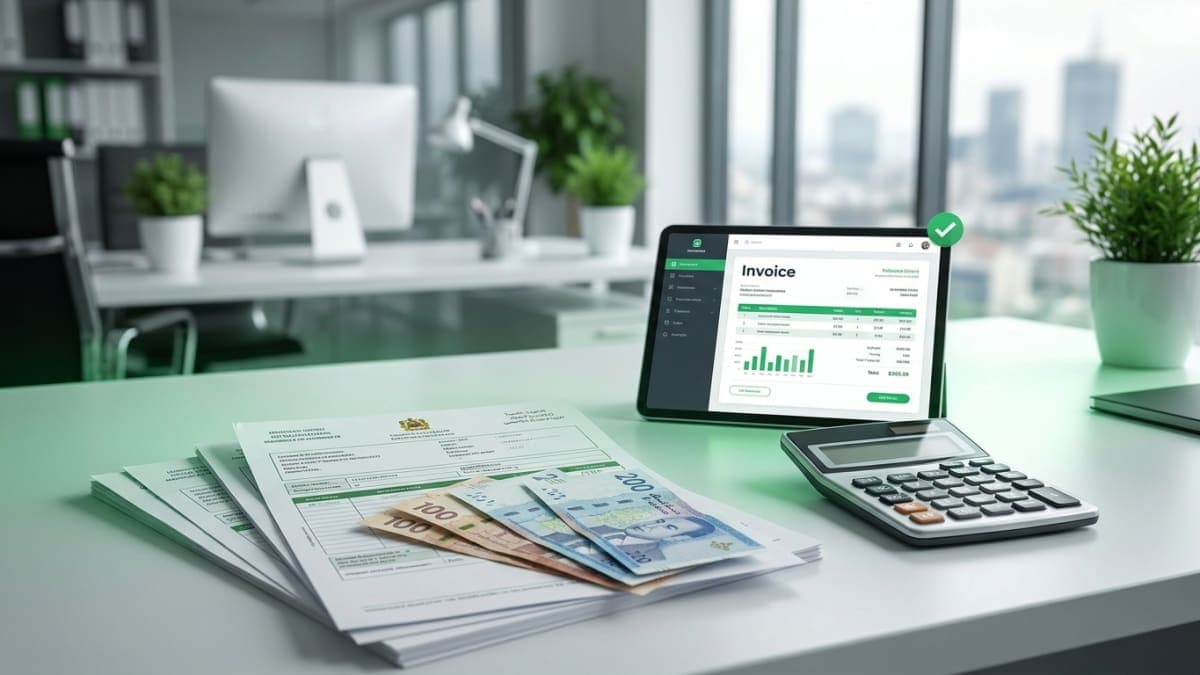
Introduction: Morocco’s tax system is entering a new digital phase
Electronic invoicing is no longer a distant administrative project. In Morocco, it has become a clear legal and fiscal direction, driven by the broader modernization of the tax administration and by the Direction Générale des Impôts (DGI). Since 2021, the Moroccan tax system has moved steadily toward dematerialization: online filing, online payment, digital tax services, and now the gradual rollout of electronic invoicing. For businesses, this is not a cosmetic reform. It changes how invoices are issued, transmitted, archived and, above all, how they are controlled.
The background is easy to understand. Morocco has long faced a significant VAT gap, regularly discussed in institutional reports and public debate, including work published by the Conseil Économique, Social et Environnemental (CESE). The tax administration’s objective is straightforward: improve traceability, reduce invoice fraud, limit undeclared transactions and reconcile invoices with VAT returns more effectively. Public comments reported in the business press, including statements attributed to Laila El Andaloussi on the role of e-invoicing in curbing fraud and the informal economy, fit squarely within that strategy.
For companies, the practical message is simple. Compliance is not optional. The principle has already been laid down by the Finance Law 2024. The exact deployment calendar and technical standards still depend on implementing regulations, but that should not create a false sense of safety. In Moroccan practice, businesses that wait for the very last ministerial order often discover too late that the technical, contractual and organizational work takes months, not days.
This article explains, in plain English but with the precision required by Moroccan law, what the reform means for companies. We will look at the legal framework, who is likely to be covered first, the technical obligations, the impact on VAT deduction, the sanctions for non-compliance, the cost of implementation for a Moroccan SME, and the practical steps to take now. In short: what Moroccan businesses must do, what risks they face if they do nothing, and how to prepare intelligently.
Why electronic invoicing is being imposed now in Morocco
The timing is not accidental. Morocco is aligning itself with an international movement already visible in Europe, Latin America, the Gulf and parts of Africa, where tax administrations increasingly require structured invoice data, digital signatures and centralized reporting. The DGI’s interest is obvious: once invoices become machine-readable and standardized, the administration can compare issued invoices, received invoices and VAT declarations much more efficiently. That means fewer blind spots.
There is also a local reality. Many Moroccan businesses still confuse a scanned invoice, or a PDF sent by email, with a legally compliant electronic invoice. Concretely, those are not the same thing. A PDF may be a digital file, yes, but it is not automatically an electronic invoice with full legal effect under Moroccan law. The distinction matters because VAT deduction, evidence in court, and tax audit outcomes may all depend on it.
What this reform changes in practice for companies
Until now, many companies could operate with mixed methods: paper invoices, PDFs by email, manual numbering, local storage on a hard disk, and loose internal controls. That model is becoming risky. Under the e-facture Maroc 2024 logic, businesses will need more than a template and an email address. They will need a compliant system capable of secure issuance, proper authentication, long-term archiving and, likely, connection to the DGI’s future platform.
That is why the issue is legal before it is technical. The software matters, of course. But the real question is whether your invoicing chain can withstand a tax audit before the tribunal administratif, a dispute over VAT deduction, or a review of documentary evidence before a Moroccan court.
Legal and regulatory framework: what Moroccan law already says
The Finance Law 2024 and the principle of mandatory e-invoicing
The turning point came with the Finance Law for the 2024 budget year, published in the Bulletin Officiel n°7254 bis of 29 December 2023. This text introduced the principle of mandatory electronic invoicing in Morocco. At the date of writing, however, the final operational calendar and technical modalities still depend on implementing measures from the Minister in charge of Finance and administrative guidance from the DGI. That uncertainty is real, and it should be stated honestly. In Moroccan tax law, this is common: Parliament sets the principle, then the administration specifies the mechanics.
So there are two legal truths that coexist. First, the obligation exists in principle. Second, its deployment remains progressive and regulated by subsequent texts. Businesses should understand both points at the same time.
The General Tax Code: invoicing obligations are not new
Even before the new digital shift, Moroccan tax law already imposed strict invoicing duties. The Code Général des Impôts (CGI), especially articles 145 and following, governs invoicing obligations for taxable persons. The content of the invoice remains legally central: identity of the supplier and customer where required, tax identification elements, date, invoice number, description of the transaction, taxable amount, VAT rate, VAT amount and total amount due.
The digital reform does not abolish those classic rules. It adds new layers: format, authenticity, integrity, traceability and retention. In other words, the legal substance of the invoice remains, but the technical environment changes significantly.
Article 145 of the CGI lays down the obligation to issue invoices in transactions falling within the tax scope, while related provisions specify the mandatory particulars and the documentary conditions relevant for tax control and VAT deduction.
For businesses, this means one thing: a beautiful digital workflow cannot cure a defective invoice. If the mandatory legal details are missing, the invoice remains irregular. Conversely, a complete invoice that is not transmitted and archived under lawful electronic conditions may also create problems.
Law n°53-05: the legal value of electronic documents in Morocco
The cornerstone for the legal validity of electronic invoicing in Morocco is Law n°53-05 relating to the electronic exchange of legal data, published in the Bulletin Officiel in 2006. This law is crucial because it recognizes the legal force of electronic documents under certain conditions. The key idea is not “digital equals valid.” The law is more demanding than that.
Article 417-1 of the Dahir formant Code des Obligations et des Contrats, as introduced by Law n°53-05, recognizes that an electronic writing has evidential value like paper writing, provided that the person from whom it emanates can be duly identified and that it is created and retained in conditions that guarantee its integrity.
This is the heart of the matter. A Moroccan electronic invoice has legal value if, and only if, three conditions can be demonstrated in practice: authenticity of the issuer, integrity of the document, and readability/accessibility over time. Those are not abstract words. During a tax audit or a court dispute, they are concrete evidentiary tests.
The implementing framework is completed by Decree n°2-08-518, which organizes application aspects of Law n°53-05, especially around secure electronic signature and certification services. This is where the role of approved certification providers becomes decisive.
Implementing texts are still expected
Attention, however: the legal principle is there, but businesses are still waiting for the detailed technical framework that will specify the rollout schedule, thresholds, accepted formats, reporting model and platform rules. That is why the phrase DGI facturation électronique conformité is already becoming a practical concern for finance teams, ERP managers and external accountants.
At this stage, the prudent legal approach is not to pretend that every detail is settled. It is to distinguish what is already fixed from what is still evolving. Already fixed: the legal recognition of electronic documents, the tax administration’s direction, the need for compliant invoicing, and the obligation to retain tax documents. Still evolving: who enters first, in what format, through which platform logic, and under which reporting sequence.
Equivalent legal force to paper, but only if conditions are met
This is the point many managers miss. In Morocco, an electronic invoice can have the same legal and tax force as a paper invoice. But that equivalence is conditional. If the file can be altered without trace, if the issuer cannot be securely identified, if the signature is not compliant, or if the archive cannot be retrieved years later, the document may lose evidential strength. In litigation before the tribunal de première instance, in a commercial dispute before the cour d’appel, or in tax proceedings, that weakness can become expensive very quickly.
Who is concerned and when? Scope and timeline of the obligation
Large companies will likely be targeted first
Everything indicates that Morocco will adopt a progressive rollout, most likely by turnover thresholds, as was done in other tax dematerialization reforms. Large enterprises are expected to be the first in line. That makes practical sense for the DGI: they generate high invoice volumes, significant VAT flows and usually have structured accounting systems capable of adapting faster.
For those companies, the upcoming obligation facture électronique PME Maroc debate may sound distant, but it is not. Large groups will pressure their suppliers to comply early, and once major buyers require structured electronic invoices, the rest of the chain follows.
SMEs and VSEs: more time, but not a free pass
Moroccan SMEs will probably benefit from a longer adaptation period. That is the likely policy direction, and it would be consistent with local administrative practice. Still, a delayed deadline does not mean low risk. Smaller businesses often have the weakest internal controls, the least integrated software and the most informal invoicing habits. In reality, they may need more preparation time than large companies.
I have seen this pattern before during the rollout of mandatory online VAT filing. Many perfectly serious Moroccan companies waited until the last weeks, thinking the transition would be simple. Then came the rush: accountants overwhelmed, software providers saturated, certificate requests delayed, internal teams improvising. Some filed late, some filed badly, and some were penalized. The same scenario can easily repeat itself with electronic invoicing.
Sectors likely to face early scrutiny
Some sectors are more exposed than others. The DGI is likely to prioritize areas where VAT leakage risks are traditionally higher or where invoice volumes are substantial: construction and public works, distribution, B2B services, import-export, wholesale trade and supply chains with multiple intermediaries. In those sectors, invoice traceability is essential because discrepancies between issued invoices, received invoices and declared VAT are easier to detect once systems become digital.
The phrase facture électronique B2B Maroc is therefore central. The reform is first and foremost about business-to-business transactions, where invoice data can be cross-checked at scale.
Liberal professions and auto-entrepreneurs: watch the implementing rules closely
What about lawyers, doctors, chartered accountants, consultants and other liberal professions? Legally, the broad tax logic suggests that any person or entity subject to professional income taxation or VAT may eventually be concerned. But whether all liberal professions will be included from the start, and whether some thresholds or exemptions will apply, remains to be clarified by implementing texts.
The same caution applies to auto-entrepreneurs. Morocco may decide on a simplified model for very small taxpayers, especially where invoice volume is low. For now, the prudent advice is to monitor the Bulletin Officiel, DGI circulars and professional bodies’ guidance rather than rely on assumptions.
Technical and functional obligations of a compliant electronic invoice
Mandatory invoice details remain mandatory
Let us start with a misconception. Electronic invoicing does not cancel the classic invoice requirements. A compliant invoice must still contain the legally required information: supplier identity, customer identity where applicable, date, sequential invoice number, description of goods or services, taxable base, VAT rate, VAT amount and total amount. If your software automates the process but omits key legal data, the invoice remains defective.
In plain terms, digital form does not excuse legal incompleteness.
A PDF by email is not automatically a valid electronic invoice
Here is the idea received that needs correcting. Many business owners think: “We already send invoices by email in PDF, so we are compliant.” No, not automatically. A PDF attachment may be a digital copy of a paper-era process, not a legally secure electronic invoice.
Under Moroccan law, the issue is not the file extension. The issue is whether the invoice guarantees issuer authenticity, document integrity and lawful retention. If the PDF can be modified without trace, if there is no compliant electronic signature, and if the archive is stored casually on a local laptop or an unstructured shared folder, the legal security is weak. This is why the notion of facture électronique valeur juridique Maroc must be understood properly.
Electronic signature and approved certification providers
A central compliance requirement is the use of a secure electronic signature consistent with Law n°53-05 and its implementing decree. In practice, companies should work with a Prestataire de Services de Certification électronique (PSCe) approved by the ANRT. The list of approved providers is maintained by the regulator and should always be checked before engagement.
The legal logic is simple: the signature is what links the invoice reliably to its issuer and helps guarantee that the document has not been altered. Without that, the evidential chain becomes fragile.
Typical annual costs for a signature certificate in Morocco vary depending on the provider and certificate type, but companies should generally expect a range of around 500 to 2,000 MAD per year per certificate. That is not the main cost of compliance, but it is a necessary building block.
Interoperability will be a decisive issue
Another major topic is interopérabilité systèmes facturation Maroc. This sounds technical, but the business impact is immediate. Interoperability means your invoicing system must be able to exchange data with your clients’ systems, your suppliers’ systems and the future DGI platform, even if everyone uses different software.
If your tool cannot export or receive invoices in the required structured format, your teams will end up retyping data manually. That destroys the benefits of digitalization and creates new compliance risks. The DGI is expected to rely on common standards, likely involving structured formats such as XML or possibly JSON, and the work of IMANOR on standardization is relevant here.
The future DGI platform: clearance or reporting?
One point still awaited concerns the operating model. Will Morocco adopt a clearance model, where the invoice must be validated by the DGI platform before being sent to the customer? Or a post-audit/reporting model, where invoices are issued first and reported electronically afterward? The difference is not theoretical. It changes workflow timing, customer delivery, ERP integration and internal controls.
For businesses, the practical consequence is clear: software purchased today should be capable of future connection by API to a centralized DGI environment. When discussing with vendors, this is one of the first questions to ask.
VAT and electronic invoicing: the real fiscal stakes
Why the DGI is so focused on invoice data
VAT is where electronic invoicing becomes strategically important. The administration’s real gain lies in cross-checking. Once invoices are digital, structured and traceable, the DGI can compare the invoice issued by supplier A with the invoice declared by customer B and with the VAT returns filed by both. The room for inconsistency narrows sharply.
This is why TVA facturation numérique entreprises marocaines is not just a compliance phrase. It is the fiscal core of the reform. A mismatch that might once have gone unnoticed for years can become visible almost immediately in a digital ecosystem.
VAT deduction depends on invoice regularity
Moroccan businesses should focus on one critical point: input VAT deduction is not protected if the invoice is irregular. If the invoice received from a supplier is missing mandatory particulars, lacks valid authentication, or does not meet the legal conditions for an electronic invoice, the DGI may reject the deduction during an audit.
That means the risk is not limited to the issuer. The recipient also bears exposure. A company that says, “My supplier sent me something by email, so I assumed it was fine,” may discover during a tax audit that the invoice is not compliant enough to support VAT recovery. The cash-flow impact can be immediate and severe.
Automatic reconciliation will increase anomaly detection
Once the system is operational, invoice-level data will likely be reconciled against VAT returns more systematically. This should help compliant businesses in some respects. For example, businesses with legitimate VAT credit positions may benefit from faster processing if documentary consistency becomes easier to verify digitally.
But the opposite is also true. Companies with unusual patterns, missing invoices, duplicate numbering, inconsistent rates or timing mismatches may trigger targeted scrutiny more easily. A modern tax administration does not need to inspect everyone physically. It can sort risks algorithmically.
A concrete example: a mid-sized Casablanca trading company
Take a Casablanca trading company with 150 B2B clients, 80 suppliers and around 300 invoices issued per month. Today, it may invoice through accounting software, export PDFs, email clients manually, and save copies on a server. Under the new model, that company will likely need structured invoice generation, compliant electronic signature, secure timestamping, archive indexing, and future API connectivity with the DGI platform.
Its finance department will also need better controls on incoming invoices. Why? Because VAT risk now exists on both sides. The company must ensure not only that its own invoices are compliant, but that supplier invoices can withstand DGI review as well.
Sanctions and legal risks in case of non-compliance
Fiscal penalties under the General Tax Code
The first level of risk is fiscal. Article 192 of the CGI provides penalties for failure to issue invoices or for invoicing irregularities. The exact application depends on the nature of the breach, but companies should not underestimate the cumulative effect. In tax matters, repeated documentary defects can quickly become costly.
Article 192 of the CGI provides financial penalties for breaches relating to invoicing obligations and documentary irregularities, without prejudice to additional tax reassessments where the irregularity affects the tax base or VAT deduction.
In practice, the penalty is often only the beginning. The much more serious consequence is that non-compliant invoices can contaminate the deductibility of expenses and VAT.
Rejection of deductible expenses and VAT credit
This is where many businesses feel the shock. During a tax audit, if invoices are found to be non-compliant, the DGI may reject the corresponding charges for corporate tax or income tax purposes and deny the related VAT deduction. That can produce a double effect: more tax due and less recoverable VAT.
For a company with thin margins, this can become a treasury crisis, not merely a legal inconvenience. That is why sanctions non-conformité facturation électronique Maroc should not be read narrowly as “fines.” The broader risk is tax reassessment.
Possible solidarity and fraud exposure
Another point often ignored is the risk of fiscal solidarity or at least shared exposure between the issuer and the recipient of an irregular invoice in certain circumstances, especially where the administration suspects artificial invoicing chains, false invoices or collusive practices. Moroccan tax practice is increasingly attentive to invoice ecosystems, not only isolated documents.
If the facts suggest deliberate fraud rather than simple technical non-compliance, matters can escalate beyond tax penalties. False invoicing, concealment or organized tax evasion may expose company managers to criminal liability under the tax framework and, depending on the facts, under broader penal rules.
How a DGI tax audit typically unfolds in practice
On the ground, a tax audit in Morocco usually begins with a formal notification. The company is informed of the control and asked to communicate accounting and tax documents. There is then an exchange phase, often including requests for invoices, journals, contracts, bank records and supporting documents. Meetings may follow with the company, its accountant, and sometimes legal counsel. A synthesis phase usually comes later, before any final reassessment position is formalized.
With electronic invoicing, this process will become more data-driven. The DGI will not wait to discover all inconsistencies manually. It will often begin from anomalies already spotted through digital cross-checking. In other words, the audit may start with the administration already holding a map of your weak points.
Voluntary regularization may still matter
Where irregularities are discovered internally, businesses should not simply hope they remain invisible. The CGI includes mechanisms of spontaneous regularization, notably around article 221 bis in the broader tax compliance logic. The exact usefulness depends on the issue, timing and procedural posture, but the principle is important: a company that corrects defects early is usually in a better position than one that waits for a formal audit.
Choosing compliant e-invoicing software in Morocco
What to check before buying a solution
The market is moving fast, and many vendors now claim they offer a logiciel facturation électronique certifié Maroc. Be careful with marketing language. At this stage, unless and until the DGI publishes a formal approval or homologation framework, the right approach is to test legal and technical criteria, not slogans.
A serious solution should be able to generate invoices with all mandatory legal fields, integrate a compliant electronic signature, preserve document integrity, ensure secure archiving, export data in structured formats likely to be accepted by the DGI, and connect through API to future reporting or clearance systems. It should also produce reliable audit trails.
Local and international solutions
Moroccan businesses will generally choose between local software publishers, regional integrators and international ERP solutions adapted to Moroccan tax requirements. Well-known accounting and ERP ecosystems active in Morocco, including local implementations of major brands and specialized invoicing tools, are all trying to position themselves. What matters is not whether the brand is Moroccan or foreign. What matters is whether the solution can meet Moroccan legal requirements under Law 53-05, the CGI and future DGI specifications.
It is also wise to involve your expert-comptable from the start. In practice, when the DGI asks questions during an audit, your accountant will be one of the first people called. If the finance team chooses a tool without considering accounting workflow, reconciliation logic and archive retrieval, trouble often appears later.
Real compliance costs for an SME
How much does implementation cost? For a Moroccan SME, a realistic annual budget for a SaaS e-invoicing solution often falls between 3,000 and 15,000 MAD, depending on volume, features and integrations. Add to that the electronic signature certificate, generally 500 to 2,000 MAD annually, plus setup, migration, interface development and staff training.
For a medium-sized SME, a full implementation can easily represent a total first-year effort of around 10,000 to 40,000 MAD. That range is broad because complexity varies enormously. A simple professional services firm issuing a few invoices a month does not face the same challenge as a distributor with multiple depots, dozens of sales users and ERP customization.
Cheap or free tools can look attractive, especially to smaller businesses. But very often, they are weak on legal archiving, signature compliance or structured data export. The apparent saving may become expensive if the system fails a tax audit.
Integration with existing ERP systems
For larger companies, the key challenge is integration. The invoicing module, ERP, accounting software, customer portal and archive environment must all communicate reliably. If they do not, users create workarounds. And workarounds are where compliance breaks down. A good project therefore needs legal review, IT mapping and accounting process validation together, not separately.
Practical action plan for Moroccan businesses
Step 1: audit your current invoicing flows
Before buying anything, map your existing processes. How many invoices do you issue per month? In what format? Who validates them? How are credit notes handled? How are supplier invoices received? Where are they stored? Which systems are involved? This first diagnostic often reveals hidden risks: duplicate numbering, manual corrections, missing customer identifiers, fragmented archives, or undocumented approval chains.
As for the délai mise en conformité facturation numérique Maroc, businesses should realistically plan a project of 3 to 9 months, depending on size and complexity. That is why starting now makes sense even before the final calendar is published.
Step 2: choose the right technical solution
Once the audit is done, choose a tool that matches your real needs. A very small business may need a light but compliant cloud solution. A larger company may need an ERP connector, advanced permissions, API capabilities and multi-entity management. Ask vendors pointed questions: Can the software integrate compliant electronic signature? Does it support structured formats? Is there a roadmap for DGI connectivity? How is archive integrity guaranteed over ten years?
Step 3: obtain electronic signature credentials
Do not leave the signature step to the last minute. Procedures with an ANRT-approved certification provider can take time, especially where corporate documentation, authorized signatories and identity verification are involved. A prudent timeline is 2 to 4 weeks, sometimes more depending on the provider and internal responsiveness.
Step 4: train teams, not just systems
This point is underestimated. Most compliance failures come from people, not from code. Sales teams must know when an invoice can be issued. Finance teams must know how to validate incoming invoices. Administrative staff must understand numbering, cancellation, correction and archive procedures. If employees continue using old habits outside the new system, the project is compromised.
Step 5: test before mandatory go-live
When the DGI technical environment or sandbox becomes available, companies should run realistic tests: invoice issuance, signature verification, customer transmission, archive retrieval and, eventually, platform communication. A final legal and tax check by an external professional is often worth the cost. Concretely, it is cheaper to fix defects before a tax inspector finds them.
Electronic archiving: legal obligations and best practices
The 10-year retention rule
Archiving is not an accessory issue. Under article 211 of the CGI, tax documents must be retained for 10 years, in line with the tax prescription horizon. For electronic invoices, this means the company must be able to produce the document years later in a form that remains legible, authentic and intact.
Article 211 of the CGI requires taxpayers to preserve books, registers, invoices and supporting tax documents for ten years, so they can be communicated to the tax administration upon request.
Legal conditions for valid digital archiving
Moroccan law requires more than storage. The archive must preserve integrity, authenticity and readability over time. This is fully consistent with the evidential philosophy of Law n°53-05. A file dumped on a local hard drive, with no reliable indexing, no immutability safeguards and no retrieval protocol, is not a serious legal archive.
Preferred formats generally include durable standards such as PDF/A for human readability and structured formats such as XML where required for machine processing. But again, format alone is not enough. The system must preserve the evidential chain.
Cloud, local server or third-party archiver?
Which option is best depends on the company. A local server may work for a robust organization with disciplined IT governance, backup procedures and access controls. Many SMEs, however, are better served by a specialized archiving solution or a trusted cloud provider. The key legal question is not only where the data sits, but whether the company can access and communicate it promptly if the DGI asks for it.
Hosting abroad is not automatically unlawful, but it raises practical and legal concerns: data accessibility, contractual guarantees, response time, and sometimes sovereignty or confidentiality issues. For many Moroccan businesses, a solution hosted in Morocco or with strong contractual access guarantees is the safer route.
If you cannot retrieve the archive, legally it may as well not exist
This is a harsh truth from practice. During a tax audit, a company sometimes says: “We archived everything.” Then it turns out the former IT provider disappeared, the passwords were lost, the indexes are broken or the files are unreadable. From the administration’s perspective, an inaccessible archive is almost equivalent to no archive at all. That is why periodic retrieval tests are essential.
Conclusion: prepare early rather than react under pressure
Morocco’s move toward electronic invoicing is now irreversible. The legal principle is already in place through the Finance Law 2024, the evidential framework has long existed under Law n°53-05, and the tax logic is clear: invoice data, VAT control and digital traceability are becoming tightly connected. The remaining uncertainty concerns deployment details, not the direction of travel.
For businesses, the message is clear. Do not wait for the final implementing order to discover that your invoicing process is fragmented, your software is obsolete, your archive is weak and your VAT documentation is vulnerable. The companies that start now with an internal audit, software review, signature setup and staff training will be in a much stronger position when the obligation becomes operational for their category.
There is also a positive side. Electronic invoicing can reduce paper handling, accelerate validation cycles, improve payment tracking, make accounting reconciliation easier and, for compliant taxpayers, potentially support faster VAT processing. In that sense, the reform is not only a constraint. It is also a modernization tool.
Still, modernization without legal compliance is a trap. Businesses should therefore approach the reform with both technical discipline and legal caution. If needed, involve a tax lawyer or chartered accountant familiar with Moroccan tax audits and documentary compliance. A preventive review costs far less than a reassessment.
For companies seeking tailored support, it may be useful to consult a professional experienced in Moroccan tax compliance, whether in Casablanca, Rabat, Marrakech or Tangier. Related issues are also covered in our pages on VAT obligations for Moroccan businesses, tax audits and reassessments in Morocco, starting a business in Morocco and broader business law compliance.
In short: electronic invoicing is coming, the sanctions are real, and the smartest move is to prepare before the DGI forces the pace.

