
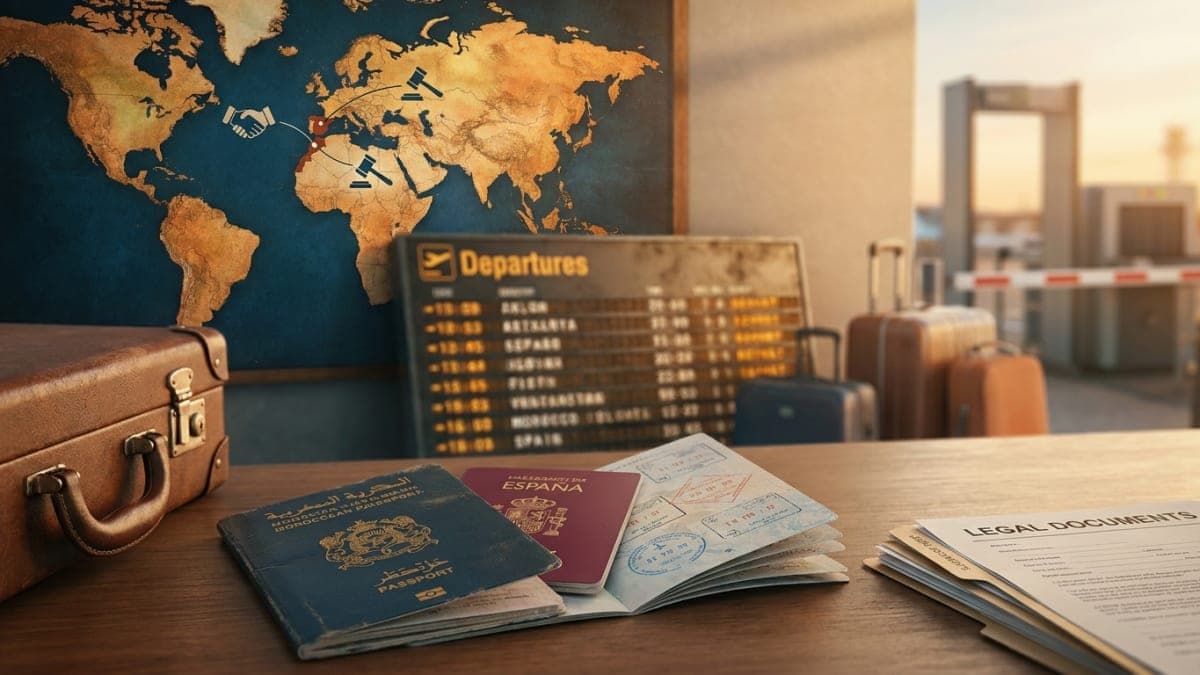
Introduction: 42,114 Moroccans naturalised in Spain in 2025 — what that number really means
The figure is striking, but for lawyers and practitioners working between Morocco and Spain, it is not surprising. Morocco remains one of the largest foreign communities in Spain, and year after year, Moroccans are among the first nationalities obtaining Spanish nationality by residence. Behind the statistics, there are very concrete lives: families from Tetouan settled in Madrid for fifteen years, entrepreneurs from Agadir running small companies in Catalonia, second-generation children born in Andalusia, and mixed Moroccan-Spanish couples whose legal lives are split between two legal systems.
I have seen this from close range. In files prepared from Casablanca, Rabat, Tangier, Nador and Agadir, the same pattern appears again and again: the legal route exists, but the administrative path is often longer, stricter and more technical than applicants expect. One client originally from Tetouan waited seven years in total. Her file was rejected twice, not because she lacked residence or integration, but because of defects in the formal validation of Moroccan civil status documents. In clear terms, a file can be legally strong and still fail on paperwork.
That is why the expression “naturalisation espagnole marocains conditions droit” deserves a serious answer. The issue is not only Spanish law. Moroccan law also matters, especially on nationality loss, family status, inheritance, civil status registration and the practical management of two identities across borders. Anyone trying to obtain Spanish nationality as a Moroccan should understand both systems, not one in isolation.
This article is written for a broad audience: Moroccan families living in Spain, students, business owners, and also younger lawyers who need a clear map of the rules. The objective is simple: explain the legal conditions, the real costs, the usual delays, the risks of refusal, and the sensitive question everyone asks sooner or later — is double nationality Morocco-Spain possible?
A record that does not surprise legal practitioners
When official Spanish statistics show record levels of Moroccan naturalisations, some commentators speak as if it were a sudden phenomenon. It is not. It reflects long-term settlement. Many Moroccan nationals completed ten years of legal residence years ago but only filed when their paperwork, employment situation or language exams were ready. Others benefited from the one-year route through marriage to a Spanish citizen. Some are children born in Spain to Moroccan parents who later regularised their status through reduced residence requirements.
So the number is not just about immigration. It says something deeper about rootedness, social integration and legal permanence.
Why this article matters for families as much as for jurists
For a family, nationality is about stability: voting rights, a stronger passport, easier travel, better protection from irregularity risks, and often a sense of closure after years of residence. For a jurist, nationality is a technical field governed by statutes, regulations, registry practice and case law. Both dimensions matter. A badly prepared file can delay a family project by years. A misunderstood rule on Moroccan nationality can later create complications in inheritance or family disputes before Moroccan courts.
Attention, though: naturalisation is not automatic after ten years. Residence is only one condition among several. That misunderstanding causes many disappointments.
The legal framework: Spanish law, Moroccan law and cross-border realities
The Spanish Civil Code: Articles 21 to 26
The legal basis for Spanish nationality by residence is found in the Spanish Civil Code, especially Articles 21 to 26. The central provision is Article 22 of the Código Civil, which sets the standard residence requirement at ten years for foreign nationals who do not benefit from reduced periods.
Article 22.1 of the Spanish Civil Code: Spanish nationality by residence requires ten years of residence. Shorter periods apply in specific cases expressly listed by law.
For Moroccans, the default rule is ten years. Unlike nationals of many Latin American countries, Andorra, the Philippines, Equatorial Guinea, Portugal or Sephardic origin applicants under specific historical regimes, Moroccan nationals do not benefit from the two-year residence shortcut. That is a crucial point in any discussion of Spanish nationality by 10 years residence for Moroccans.
The reduced periods remain relevant in other situations. Article 22.2.a provides a one-year period for a person born in Spain. Article 22.2.d grants a one-year period to the spouse of a Spanish national, provided the marriage still exists and there is no legal or factual separation at the time of application.
Article 22.2.d of the Spanish Civil Code: one year of legal residence is sufficient for the person who, at the time of application, has been married to a Spaniard for one year and is not legally or de facto separated.
The Moroccan Nationality Code: the Dahir of 6 September 1958 and the 2007 reform
On the Moroccan side, the foundational text is the Dahir n°1-58-250 of 21 safar 1378 (6 September 1958) forming the Moroccan Nationality Code. The major reform introduced by Law n°62-06, published in Bulletin Officiel n°5513 of 2 April 2007, notably allowed transmission of Moroccan nationality by the mother under broader conditions. That reform changed the legal landscape for many children of Moroccan women born abroad.
But for adults seeking Spanish naturalisation, the sensitive provision is Article 19 of the Moroccan Nationality Code.
Article 19 of the Moroccan Nationality Code: a Moroccan adult who voluntarily acquires a foreign nationality may lose Moroccan nationality.
The text is clear in principle. Practice is much less clear. Morocco does not operate an automatic, systematic and efficient deprivation mechanism each time a Moroccan acquires another nationality. In everyday administrative reality, many naturalised Moroccans continue to hold Moroccan identity documents, renew passports and use Moroccan civil status services without difficulty. That does not transform tolerance into a full legal guarantee. It simply means law and practice do not always move at the same speed.
Double nationality: legal theory versus administrative practice
This is where many articles become simplistic. They say either “double nationality is forbidden” or “double nationality is fine.” The truth is more nuanced. Under Moroccan law, voluntary acquisition of a foreign nationality may trigger loss of Moroccan nationality. Under Spanish law, the naturalisation oath generally includes a declaration of renunciation of previous nationality, pursuant to Article 23 of the Spanish Civil Code, except in cases where the law recognises retention arrangements.
Article 23 of the Spanish Civil Code: for the validity of acquisition of Spanish nationality, the applicant must, where required, declare renunciation of previous nationality and swear or promise fidelity to the King and obedience to the Constitution and laws.
Concretely, however, many Moroccan nationals naturalised in Spain continue to function as dual nationals in practice. Moroccan authorities generally treat them as Moroccan when they are in Morocco. Spain treats them as Spanish once naturalisation is completed. That coexistence works most of the time, but it can become complicated in litigation involving succession, marriage, divorce, child custody or real estate in Morocco.
In my practice, I give the same warning every time: never take steps suggesting formal abandonment of Moroccan nationality before your Spanish naturalisation is fully granted and documented. Two minutes of administrative haste can create years of confusion.
Condition no. 1 — Legal and continuous residence: unpacking the ten-year rule
What does “legal, continuous and immediately prior residence” actually mean?
For a Moroccan applicant, the first gate is residence. Not any residence: legal residence, continuous residence and residence immediately preceding the application. A person who has physically lived in Spain for ten years but spent part of that period without valid residence status may face problems. A person who accumulated long absences may also face objections.
The Spanish administration and courts do not assess continuity in a mechanical way only, but in practice, absences matter enormously. Short trips to Morocco for family visits are usually not fatal. Long stays, especially repeated ones, can raise doubts as to whether the center of life truly remained in Spain. Some administrative practices tolerate limited absences under six months in a given year, but there is no universal safe harbor that guarantees acceptance in every registry or every file.
This is one of the most litigated issues in Spanish naturalisation applications by Moroccans. Families from Nador or Oujda with strong ties across the Strait often travel frequently. Workers with seasonal or fragmented employment histories may struggle to show stable residence. Students who later changed status to work authorization sometimes discover, too late, that not all periods are counted in the same way by every authority.
The interruptions that can ruin a strong file
Here is where applicants are often caught off guard. A residence card renewal gap, an undocumented departure, a period under a different legal status, or a delay in registration can create what officials call a break in continuity. Some Registros Civiles and administrative units are more rigid than others. That is an uncomfortable reality every practitioner knows.
Particular caution is needed when the applicant first entered Spain as a student and later switched to work residence. Depending on the period and the administrative interpretation applied, there may be disputes over what counts fully for nationality residence. Likewise, frontier workers linked to the Nador-Melilla area often assume they have residence equivalent to settlement in mainland Spain. Often they do not.
How to prove continuity in practice
The best evidence is not one document but a coherent trail. The historical certificate of registration (certificado histórico de empadronamiento) is a core document and usually free, though municipal delays vary. But it should be supported by employment contracts, social security records, tax filings such as IRPF, bank statements, rental contracts, school records for children, and health registration evidence.
In clear terms, if the administration doubts your continuity, you need to show Spain was your real base of life, not just your formal address. Applicants who prepare this continuity file early are in a much better position than those who discover the issue after a refusal.
Condition no. 2 — DELE A2 and CCSE: the language and civic integration tests
The legal basis: Real Decreto 1004/2015
Since the reform introduced by Real Decreto 1004/2015 of 6 November 2015, applicants for Spanish nationality by residence generally need to prove integration through two tests administered by the Instituto Cervantes: the DELE A2 Spanish language exam and the CCSE test on constitutional and sociocultural knowledge of Spain.
That means the condition is not only residence. It is also language and civic integration. This matters greatly for applicants searching for conditions langue culture espagnole naturalisation.
The DELE A2: accessible, but not to be underestimated
The DELE A2 corresponds to a basic user level under the Common European Framework. For many Moroccans who have lived and worked in Spain for years, it is manageable. But manageable does not mean automatic. Reading, listening, writing and speaking all matter, and stress causes many avoidable failures.
Fees usually range around 150 to 180 euros, depending on the center and session. Moroccan applicants may take the exam in Spain or in Morocco through Instituto Cervantes centers in Casablanca, Rabat, Tangier, Fez and Marrakech. That can be useful for people preparing documents before final settlement, even though the nationality application itself still requires residence in Spain.
The CCSE: where overconfidence causes trouble
The CCSE exam costs around 85 euros. It covers the Constitution, institutions, territory, society and culture. Many otherwise strong applicants fail because they treat it as common sense. It is not. Questions about autonomous communities, constitutional bodies or electoral basics can trip up even highly educated candidates.
I remember a client from Casablanca, an engineer, perfectly fluent in Spanish, who failed the CCSE twice. Not because of language, but because he dismissed the constitutional component as secondary. That is a classic error.
Exemptions and special cases
Some applicants may be exempted, especially minors, certain persons with disabilities, or in narrowly defined situations recognised by the administration. But exemptions are not informal favors; they must be legally grounded and properly documented. Applicants over 65 sometimes assume automatic exemption. That is not always how practice works. The request must be framed correctly.
As a matter of strategy, it is wise to start exam preparation three to six months before filing. Summer sessions fill quickly, and waiting until the file is otherwise ready often delays everything.
Condition no. 3 — Good civic conduct and a clean criminal record
The Spanish requirement of “buena conducta cívica”
Residence and exams are not enough. The applicant must also show good civic conduct. This notion appears in Article 21.2 of the Spanish Civil Code and remains one of the most discretionary elements in nationality practice.
Article 21.2 of the Spanish Civil Code: nationality may be granted where the applicant shows good civic conduct and a sufficient degree of integration into Spanish society.
The concept is broad. It includes criminal convictions, but not only criminal convictions. Serious tax debts, immigration fraud, recent irregularity issues or repeated serious administrative misconduct may affect the assessment. That said, proportionality matters. Old or minor incidents should not automatically destroy a file.
Moroccan documents: good conduct certificate and criminal record
From Morocco, applicants commonly need a criminal record extract and, in some situations, certificates relating to conduct or local administrative status. The Moroccan criminal record is usually obtained through the competent court registry or relevant judicial channel. Since Morocco’s accession to the Hague Apostille Convention, effective 15 August 2015 and reflected in Bulletin Officiel n°6390, Moroccan public documents intended for Spain generally require apostille rather than the old consular legalisation chain.
This is a major simplification, but only when the underlying document is clean. Older civil status records, especially before the 1990s, often contain spelling inconsistencies between Arabic and Latin script. Those discrepancies can become a serious obstacle once translated and compared with passports, residence cards or marriage certificates.
Grey areas: traffic fines, tax debts and old convictions
Not every administrative issue is fatal. Spanish administrative courts, including the Audiencia Nacional, have in multiple cases insisted on a global assessment of conduct rather than a mechanical rejection based on a single isolated incident. Minor traffic matters are not in the same category as violent offences, document fraud or sustained tax non-compliance.
Still, applicants should not minimize problems. If there is an old conviction, it is often essential to examine whether it has been cancelled, prescribed or legally rehabilitated before filing. If there are tax issues, they should be regularised first. A nationality file is not the place to hope the administration will overlook unresolved liabilities.
Special case: naturalisation through marriage to a Spanish citizen
The one-year route under Article 22.2.d
For many Moroccan applicants, the fastest lawful route is not ten years but one year of legal residence based on marriage to a Spanish citizen. The legal basis is Article 22.2.d of the Spanish Civil Code. However, the condition is stricter than people assume. The marriage must still exist at the time of application, and there must be no legal or de facto separation.
So yes, naturalisation in Spain through marriage to a Spanish citizen for a Moroccan spouse is possible, but it is not a shortcut without proof. The administration often checks the authenticity and continuity of family life carefully.
Is a Moroccan Islamic marriage recognised in Spain?
Yes, generally. A marriage celebrated in Morocco before Adouls under Moroccan family law can be recognised in Spain if it is validly registered in Moroccan civil status records and the supporting documents are properly apostilled and translated by a sworn translator recognised by the Spanish authorities.
The relevant Moroccan framework is the Moudawana, promulgated by Dahir n°1-04-22 of 3 February 2004, implementing Law n°70-03 on the Family Code. For cross-border couples, this matters because Spanish authorities are not evaluating the religious rite as such; they are evaluating whether there is a legally valid and properly documented marriage.
Proof of real cohabitation
This is where many files become fragile. A marriage certificate alone is rarely enough. The administration may expect evidence of real shared life: joint lease, shared bank account, municipal registration at the same address, joint tax return where applicable, utility bills, children’s records, correspondence and other proof of everyday cohabitation.
Couples who live apart for work reasons are especially exposed. A genuine marriage can still be questioned if the file does not explain why the spouses reside separately and how the relationship is maintained. In practice, parejas de hecho do not open the same nationality route as marriage. That distinction surprises many applicants.
Children born in Spain to Moroccan parents: do they automatically become Spanish?
No automatic jus soli in Spain
This is one of the most widespread misconceptions in the Moroccan community. Spain does not apply automatic birthright citizenship in the broad sense found in some other countries. A child born in Spain to two Moroccan parents does not automatically become Spanish merely because of birth on Spanish soil. In most cases, the child acquires Moroccan nationality by descent.
That means the answer to the question “nationalité espagnole enfants nés Espagne parents marocains” is usually: not automatically, but sometimes through later legal routes.
The one-year residence route for children born in Spain
Article 22.2.a of the Spanish Civil Code provides a reduced residence period of one year for a person born in Spanish territory. This is often the most practical route for children born in Spain to Moroccan parents. It is underused simply because many families assume either that nationality is automatic or that it is impossible.
In some situations, Article 17 of the Spanish Civil Code may also become relevant, especially in cases involving indeterminate filiation or where the child would otherwise be stateless. But for children of Moroccan parents, Moroccan nationality transmission usually excludes statelessness.
Why Moroccan consular registration still matters
Even where a future Spanish nationality route is considered, parents should register the child with the Moroccan consulate. This preserves the Moroccan civil status chain, facilitates travel to Morocco and reduces later complications involving passports, inheritance or family records. Delaying the registration is possible, but it often creates unnecessary administrative headaches.
For cross-border families, managing two civil status systems properly from birth is not bureaucracy for its own sake. It is preventive legal hygiene.
The nationality file: documents required and the common traps
Core documents for a Moroccan applicant
A standard naturalisation Spain file with required documents usually includes: a valid passport, residence card, full birth certificate, criminal record certificates, proof of legal residence, proof of integration through DELE and CCSE, and documents showing means of subsistence such as an employment contract, payslips, tax returns or self-employment records.
The official guidance is issued through the Spanish Ministry of Justice and the DGSJFP practice framework. In reality, the exact configuration depends on the applicant’s profile: salaried worker, self-employed person, student, retiree, spouse of a Spaniard or parent of Spanish children.
Apostille and sworn translation of Moroccan documents
Since 2015, Moroccan public documents destined for Spain generally require an apostille. They must then be translated into Spanish by a sworn translator accepted by the Spanish authorities. This point cannot be treated lightly. A translation done by a non-authorised person may be useless for nationality purposes.
The documents most commonly requiring apostille are the Moroccan birth certificate, marriage certificate where relevant, and criminal record extract. Applicants should also check consistency of names, dates and places across all documents before translating. A discrepancy that seems minor in Morocco can become a major obstacle in Spain.
For applicants needing help with document preparation, a technical resource such as Guide Apostille Documents Marocains is often more useful than generic immigration advice.
Financial and professional evidence
Spanish nationality by residence does not impose a single statutory income threshold in the same way some residence permits do, but financial stability still matters. Salaried workers usually provide recent payslips, employment contract and tax declarations. Self-employed applicants may need Modelo 100, Modelo 130, social security contribution records and proof of activity continuity.
In practice, officers want reassurance that the applicant is not only present in Spain but socially and economically integrated there.
How much does the process really cost?
The cost of Spanish naturalisation procedure for a Moroccan usually falls between 400 and 800 euros in direct expenses, excluding lawyer fees. That estimate commonly includes apostilles in Morocco, sworn translations in Spain, the DELE A2 exam, the CCSE exam and incidental administrative costs.
Apostille costs in Morocco vary by document and route, often in the range of 100 to 300 MAD per document once practical handling costs are counted. Sworn translations in Spain often range between 50 and 120 euros per document. If a specialised lawyer is instructed, fees may add 500 to 2,000 euros or more depending on complexity.
Delays, filing methods and the reality of the procedure in 2024-2025
Legal deadline versus real timeline
On paper, Spanish administrative law suggests a one-year decision horizon in nationality matters. In practice, the delay for Spanish naturalisation for Moroccan nationals is usually much longer. Two to four years remains a realistic range in many cases, even for files that appear straightforward.
This gap frustrates almost everyone. The Ministry’s announced timelines often function more as aspiration than reality. Practitioners know this; applicants discover it later.
Online filing and digital processing
Recent years brought stronger reliance on online filing through Spanish justice platforms. For many adult applicants with a valid NIE, digital submission is now the practical route. That has improved traceability, but not always speed. Some files move quickly; others stall for long periods despite complete digital submission.
What matters enormously is the file reference number. Once assigned, it should be preserved carefully because all follow-up depends on it.
Can silence mean approval?
In theory, administrative silence after the legal period raises the issue of silencio administrativo. In nationality matters, however, litigation and judicial interpretation have made this area more complex than applicants expect. It is dangerous to assume that lack of answer after one year means effective approval in practice. Often it does not.
Concretely: if the administration remains silent, legal advice may be needed before drawing conclusions or launching a judicial step.
Refusal of naturalisation: why files fail and what remedies exist
The most common reasons for refusal
When a Moroccan applicant faces a refusal of Spanish naturalisation, the usual reasons are familiar: interruptions in residence, doubts about good civic conduct, incomplete documentation, inconsistencies in civil status records, or insufficient proof of integration. Sometimes the refusal is legally understandable. Sometimes it is excessively formalistic.
I have seen refusals based on transliteration inconsistencies between Arabic and Latin spellings that could have been corrected earlier. I have also seen refusals based on continuity doubts where the applicant had substantial evidence but failed to organise it coherently.
The remedies: reposición and judicial review
There are generally two procedural avenues. First, a recurso de reposición before the Spanish Ministry of Justice, usually within one month from notification. Second, if necessary, a contentious-administrative appeal before the Audiencia Nacional, generally within two months of the refusal or the rejection of the prior remedy, depending on the procedural posture.
The written refusal decision is essential. Without a formal reasoned decision, it is much harder to challenge the administration effectively. Applicants should never rely on oral explanations or informal emails as if they were final legal acts.
Case law and proportionality
The Audiencia Nacional has repeatedly insisted that the assessment of buena conducta cívica must be global and proportionate. Old, isolated or minor incidents do not necessarily justify refusal. That does not mean every appeal will succeed, but it means there is space to argue where the administration has acted rigidly.
Once the case reaches contentious litigation, however, legal representation is no longer optional in any serious sense. It becomes necessary.
Applicants facing this stage often benefit from coordinated advice in both systems, especially where Moroccan civil status problems feed into the Spanish refusal. For related cross-border issues, resources such as Avocat Droit International Privé Maroc or Avocat Naturalisation et Nationalité Maroc can be relevant points of orientation.
Double nationality Morocco-Spain: the question everyone asks
What Moroccan law says
As noted earlier, Article 19 of the Moroccan Nationality Code points toward loss of Moroccan nationality upon voluntary acquisition of another nationality. That is the formal rule, and lawyers should not hide it. But law is not only text; it is also implementation.
What Spanish law requires
Spanish naturalisation generally includes an oath or promise and, for many applicants, a declaration of renunciation of prior nationality under Article 23 of the Spanish Civil Code. Yet this renunciation operates within Spanish law. Morocco does not automatically execute that declaration as an active deprivation decision every time.
The practical reality: tolerated duality, with limits
So, is double nationality Morocco-Spain possible? In practice, very often yes. In strict legal theory, the answer is more fragile. Most naturalised Moroccans continue to renew Moroccan passports, maintain Moroccan national identity cards, inherit in Morocco and appear before Moroccan authorities as Moroccans. This is an unofficial tolerance more than a perfectly harmonised legal status.
The risk is not usually at airport control. The risk appears in litigation: inheritance disputes over property in Tangier or Casablanca, divorce proceedings touching personal status, or disputes involving children. Moroccan courts may continue to treat the person as Moroccan for many purposes. That can be manageable, but only if the family understands it in advance.
For that reason, I usually advise clients to keep their Moroccan documentation active, maintain their consular registration where appropriate, and avoid creating unnecessary documentary ruptures between the two systems. For deeper background, a related resource such as Nationalité Marocaine : Acquisition et Perte is often useful.
Should you handle the file alone or hire a lawyer?
Simple profiles can often self-manage
If you have more than ten years of uninterrupted legal residence, no criminal issues, recent and legible Moroccan civil status documents, stable employment, and both DELE and CCSE already passed, a self-managed file is possible. It requires discipline, but not necessarily litigation-level legal support.
Complex profiles should not improvise
If there has been a prior refusal, a break in residence, an old conviction, a marriage recognition issue, inconsistent names across Moroccan records, or a cross-border inheritance concern, then professional advice is no luxury. It is risk management.
This is especially true for applicants navigating both Spanish nationality law and Moroccan family or nationality law at the same time. In those situations, the value of counsel is not only form-filling. It is legal translation between two systems that do not always speak the same language, even when the documents are correctly translated.
Depending on where the applicant’s family documents originate or where follow-up is needed, geographically focused support may also matter, whether through Avocat Droit de l'Immigration Casablanca, Avocat Droit de l'Immigration Rabat, Avocat Droit de l'Immigration Tanger or Avocat Droit de l'Immigration Nador.
Conclusion: long process, clear rules, avoidable mistakes
The record number of Moroccan naturalisations in Spain confirms something simple: the path is real, and thousands complete it successfully. But success usually comes to those who prepare the file as a legal case, not as a casual administrative formality.
For most Moroccan applicants, the key conditions remain the same. First, ten years of legal and continuous residence, unless a reduced period applies through birth in Spain, marriage or another specific category under Article 22 of the Spanish Civil Code. Second, success in the DELE A2 and CCSE tests unless a valid exemption applies under the framework of Real Decreto 1004/2015. Third, proof of good civic conduct and a file free from unresolved criminal, fiscal or documentary problems. Fourth, properly apostilled and translated Moroccan documents that are internally consistent.
The final point is perhaps the most practical. Many refusals are not caused by ineligibility, but by badly assembled proof. That is why anticipation matters. Gather civil status documents early. Check spellings. Keep evidence of residence year by year. Do not wait until the last month to think about DELE or CCSE. And if the file touches double nationality, family status or inheritance implications in Morocco, take advice before rather than after the problem appears.
In short: obtaining Spanish nationality as a Moroccan is absolutely possible, but it is never just a matter of counting to ten years. It is a legal process at the intersection of Spanish nationality law and Moroccan personal status law. The applicants who understand that from the beginning save time, money and, often, years of frustration.

