
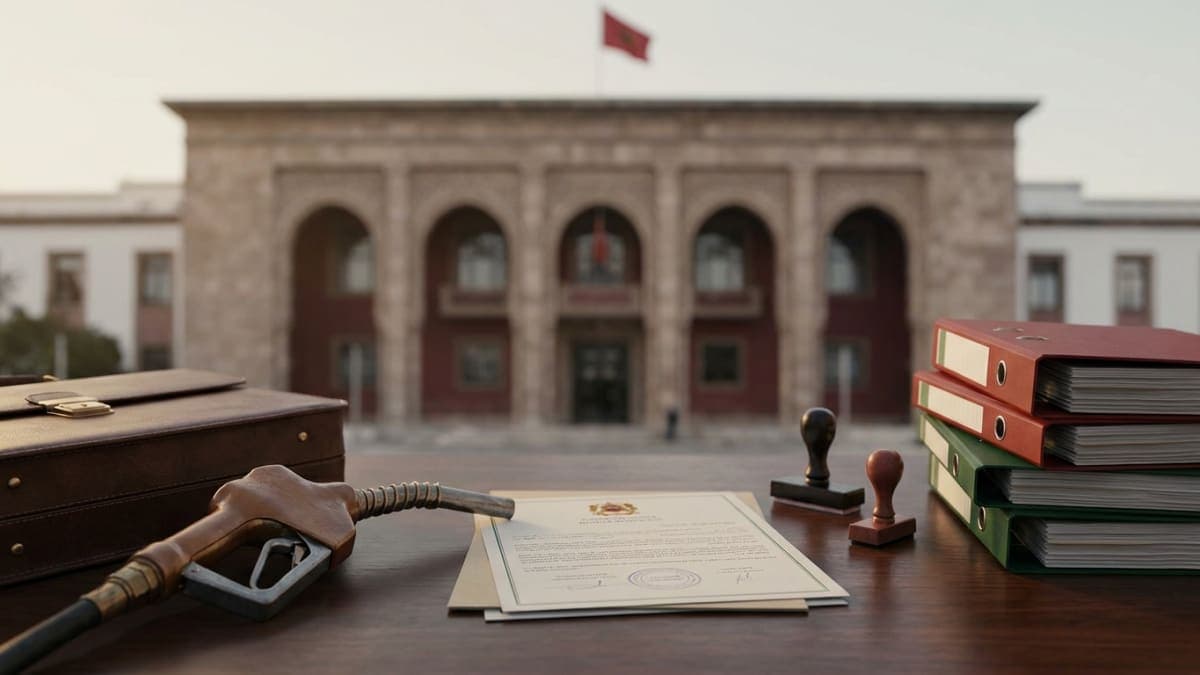
Introduction: When the price at the pump becomes a legal issue
A lawyer friend in Casablanca told me recently about a client who arrived at his office with six months of fuel receipts. Not one or two tickets — dozens of them, carefully kept. His question was simple, almost instinctive: why did pump prices seem to rise immediately whenever international oil prices increased, yet take far longer to come down when crude fell? The question was legitimate. The legal answer, however, is more complex.
Since the liberalisation of fuel prices in Morocco in 2015, many motorists, taxi drivers, delivery businesses and ordinary households have felt the same frustration. They compare stations. They track the dirham-dollar exchange rate. They read headlines about falling crude prices. Then they look at the display board outside a service station in Casablanca, Rabat, Fès or Agadir and wonder whether the market is really functioning as a competitive market should.
That frustration is not just political or economic. In some situations, it becomes a matter of competition law, consumer protection and access to remedies. Morocco’s Competition Council has itself published analyses drawing attention to what is often called asymmetric price transmission: when international prices rise, retail fuel prices increase very quickly; when international prices fall, the decrease at the pump is slower and less visible. Concretely, that pattern raises a serious question: are consumers simply facing a free market, or are they suffering from market behaviour that may breach Law No. 104-12 on freedom of prices and competition?
This is where the legal discussion starts. Not every high price is illegal. Not every parallel price movement proves collusion. But neither does market liberalisation give distributors a blank cheque. Moroccan law provides institutions, procedures and legal tools. The most important of them, in this field, is the Conseil de la concurrence, the Moroccan Competition Council.
In this article, I will explain what changed in 2015, what the law actually says, how the conseil de la concurrence maroc carburant framework works in practice, what rights consumers have, and what remedies are genuinely worth pursuing. I will also be frank about the limits. A lone consumer can file a complaint. Yes. But some strategies are far more realistic than others.
The liberalisation of fuel prices in Morocco: what the law promised
From state control to price freedom: the 2015 turning point
Before 2015, fuel prices in Morocco were not left entirely to market forces. The State intervened heavily through the Caisse de compensation, which helped cushion fluctuations in petroleum product prices. This system was costly for public finances, and successive governments moved toward reducing subsidies and transferring price formation to the market.
The legal turning point came with Decree No. 2-15-529 of 16 Ramadan 1436 (2 July 2015) relating to the prices of liquid petroleum products. In practical terms, this decree ended the administrative fixing of prices for certain petroleum products and confirmed a model based on liberalisation. The official promise was clear: competition between operators would regulate prices more efficiently than direct state control.
On paper, that logic is familiar. In a competitive market, distributors should adjust their margins to win customers. Prices should respond to international costs, exchange rates, logistics and local operating conditions. Consumers should benefit from rivalry between operators. In reality, many Moroccans felt the opposite. The market looked liberalised, but prices often appeared strangely aligned.
This is the central contradiction of the Moroccan fuel debate: libéralisation prix carburants Maroc was supposed to bring competition, but many consumers perceived an oligopoly instead.
What Decree No. 2-15-529 changed — and what it did not
The decree did not abolish all legal oversight. It removed direct price administration for the products concerned, but operators remained subject to general competition law, consumer law, and transparency obligations. Liberalisation never meant legal immunity.
That distinction matters. Many readers ask whether the 2015 liberalisation was itself illegal. The answer is straightforward: no. As a matter of formal legality, the decree was adopted within the framework of the government’s economic policy. The real legal issue lies elsewhere. It lies in whether companies in a liberalised market engaged in anticompetitive conduct, such as unlawful concerted practices or abuse of dominance.
In other words, you cannot seriously challenge the mere existence of a liberalised market years later. What you can challenge is the behaviour of operators inside that market.
The end of the Compensation Fund era: the beginning of abuses?
Let us be careful here. A price increase is not, by itself, proof of an illegal practice. Fuel distribution involves import costs, storage, transport, taxes, exchange-rate exposure and retail network expenses. But the structure of the Moroccan market deserves attention. A relatively small number of large operators dominate the sector: TotalEnergies Marketing Maroc, Afriquia (AKWA Group), Vivo Energy Maroc, Winxo, Petrom and a few others. That kind of market structure can create what lawyers and economists call an oligopoly.
And in an oligopoly, behaviour can become highly parallel even without a written agreement. Prices may move together. Margins may remain unusually stable. Competitors may react to each other quickly on the way up and much more slowly on the way down. In a Moroccan souk, if every seller raises the price of the same product almost instantly and all resist lowering it at the same time, people naturally suspect coordination. Competition law asks a more demanding question: can that suspicion be proved through evidence serious enough to justify intervention?
This is exactly why the fuel sector has remained under close scrutiny. Reports discussed in the Moroccan press, including coverage by Medias24 and Hespress FR, highlighted the Competition Council’s concerns about pricing patterns and margins. The debate is no longer merely emotional. It is legal, institutional and documented.
Article 6 of Law No. 104-12 prohibits concerted actions, agreements, express or tacit understandings or coalitions when they have the object or effect of preventing, restricting or distorting competition in a market.
That one provision is at the heart of the entente illicite carburant Maroc debate.
The Moroccan Competition Council and fuel prices: a watchdog with real powers
A constitutional institution, not a symbolic body
Many citizens still see the Competition Council as a technical body that publishes reports but changes little. That view is incomplete. Under Article 166 of the 2011 Constitution of the Kingdom of Morocco, the Competition Council is a constitutional institution responsible, among other things, for ensuring transparency and fairness in economic relations and regulating competition in markets.
Article 166 of the Constitution: the Competition Council is an independent administrative authority charged, within the framework of the organisation of free and fair competition, with ensuring transparency and equity in economic relations, notably through the analysis and regulation of competition in markets.
The institution was effectively reactivated after the constitutional reform and later developments in its composition and functioning. Under the presidency of Ahmed Rahhou, it became far more visible in public debate, especially on fuel pricing and concentration issues.
So, no, this is not a mere observatory. It can investigate. It can issue opinions. It can receive referrals. It can sanction. And in some sectors, the threat of intervention alone can change conduct.
The legal basis: Law No. 104-12 on freedom of prices and competition
The main legal framework is Law No. 104-12 relating to freedom of prices and competition, promulgated by Dahir No. 1-14-116 of 2 Ramadan 1435 (30 June 2014). This law is the backbone of Moroccan competition law.
Its logic is simple. Prices are in principle freely determined by market competition, but certain practices are prohibited because they undermine that competition. Two provisions matter especially in the fuel debate.
Article 6 of Law No. 104-12 prohibits concerted practices, agreements, tacit understandings and coalitions whose object or effect is to prevent, restrict or distort competition.
Article 7 of Law No. 104-12 prohibits the abusive exploitation by an undertaking or a group of undertakings of a dominant position on the domestic market or a substantial part of that market.
Article 6 is the route for cartel-type allegations. Article 7 is relevant when one asks whether a powerful operator is abusing market power. These are not the same thing. A cartel is about coordination between competitors. Abuse of dominance concerns the conduct of a dominant firm or dominant group.
What the fuel reports actually say
The Competition Council’s public work on the fuel sector has drawn attention to asymmetric price transmission. In plain English, this means retail prices react differently depending on whether international prices rise or fall. When import costs increase, pump prices may reflect that increase very quickly, sometimes within one or two days. When import costs decrease, the reduction at the pump can be delayed for much longer.
That phenomenon is not automatically illegal. Markets can react asymmetrically for lawful reasons: stock purchased at higher prices, logistical lag, tax structure, or inventory management. But when the pattern is widespread, persistent and remarkably parallel among major operators, the legal risk grows. At that stage, the Council may ask whether there is merely interdependent behaviour in an oligopoly or a tacit coordination prohibited by Article 6.
This is where many non-lawyers get lost. They look for a written agreement signed by distributors. Competition law does not always require that. In serious cases, a set of concordant indicators may suffice: aligned pricing behaviour, margin evolution, market concentration, communication patterns, structural barriers to entry, and the absence of plausible independent explanations.
That is why the phrase plainte prix essence Maroc should not be understood as a simple complaint about a number on a signboard. Legally, the complaint must help demonstrate an anticompetitive pattern.
Proving unlawful collusion is difficult — but not impossible
Let me say this plainly: consumers often assume that if all stations charge almost the same price, there must be an illegal agreement. Courts and competition authorities are more demanding. Similar prices can result from similar costs in a concentrated market. To move from suspicion to sanction, the Council needs a robust evidentiary basis.
Still, Moroccan law gives it powerful tools. It may investigate and, where an infringement is established, impose heavy financial penalties.
Article 40 of Law No. 104-12 allows the Competition Council to impose pecuniary sanctions that may reach up to 10% of the worldwide turnover excluding taxes of the undertaking or group concerned.
That is not a symbolic amount. For large petroleum groups, such a sanction could be substantial. The phrase amende entente pétrolière Maroc therefore refers to a real legal possibility, not a theoretical one.
A useful Moroccan precedent often mentioned by practitioners is the cement sector case, including Decision No. 36/CC/14 of the Competition Council. The markets are different, of course, but the lesson is the same: the institution can intervene against anticompetitive practices in concentrated sectors. So while there has not yet been a final definitive condemnation of a fuel cartel in Morocco, the legal framework for such action exists.
Editor’s note: at the time of writing, the Competition Council has not issued a final sanction decision establishing a fuel cartel in Morocco. If you read this later, check the latest decisions published on concurrence.ma.
Your rights as a Moroccan consumer facing unfair fuel pricing
Law No. 31-08: the consumer protection foundation
When readers ask me about droits consommateur Maroc carburant, I start with Law No. 31-08 enacting consumer protection measures, promulgated by Dahir No. 1-11-03 of 14 February 2011. This law is not a fuel price cap statute. It does not fix the retail price of diesel or gasoline. But it does protect consumers in important ways, especially through transparency and collective representation.
Article 3 of Law No. 31-08 recognizes the consumer’s right to information.
Article 5 of Law No. 31-08 requires price display and proper consumer information in sales to the public.
At a service station, this means prices must be clearly displayed. A station cannot hide the amount charged or mislead the public about the applicable price. That may sound basic, but transparency is often the first layer of consumer protection. Without it, no comparison is possible.
Law No. 31-08 also matters because it gives approved consumer associations a legal role. That becomes crucial when one individual’s economic harm is too small to justify a long and costly court case, but the collective harm to thousands of consumers is significant.
Law No. 104-12 protects market competition, which indirectly protects consumers
Some confusion is common here. Loi 104-12 protection consommateur Maroc is not a consumer code in the classic sense. It is a competition statute. It protects the market process. Yet when competition is distorted, consumers are among the first victims. They pay more, they face fewer choices, and they lose the benefit of real rivalry between suppliers.
So if you are trying to challenge suspicious fuel pricing, the legal route is often indirect. You do not attack the price merely because it feels high. You argue that the market behaviour behind the price may be anticompetitive. That is why referrals to the Competition Council are usually more relevant than ordinary consumer complaints alone.
Abusive price, excessive price, abuse of dominance: do not confuse them
This distinction is technical, but it matters. In public debate, people often say “abusive price” to mean “too expensive.” Legally, things are narrower. A high price is not unlawful simply because it is painful for consumers. To trigger competition law, one generally needs either an unlawful agreement between competitors under Article 6 or an abuse of dominant position under Article 7.
In other words, the phrase prix abusif carburant Maroc recours should be handled carefully. Moroccan law does not give every consumer a direct action merely because fuel seems overpriced. There must be a legal basis: misleading information, collusive practices, abuse of dominance, or a proven fault causing damage.
This is also why preserving evidence matters. Keep your fuel receipts. Photograph price boards with date and location. Compare stations on the same day. Save reference data from the Ministry of Energy. Alone, these elements do not prove an infringement. But together, they can support a credible referral.
Concrete remedies: who to contact, how, and what result to expect
1. Seizing the Competition Council: the most serious institutional route
Let us answer the practical question directly: can an individual personally seize the Competition Council regarding fuel prices in Morocco? Yes.
Article 23 of Law No. 104-12 allows the Council to be referred by a broad range of actors, including any natural or legal person with an interest. That means a citizen, an entrepreneur, a transport operator, or a consumer association may submit a referral.
Article 23 of Law No. 104-12: the Competition Council may be referred by the government, the standing committees of Parliament, courts, local authorities, chambers, professional organisations, trade unions, consumer associations, and any natural or legal person concerned.
This is one of the strongest answers to the query saisir conseil concurrence Maroc. The procedure is, in principle, free of charge. In practice, you send a written, reasoned referral to the Council’s headquarters in Rabat or use the online channels available on concurrence.ma. Your submission should be factual, not emotional. Mention the stations concerned, dates, observed prices, comparative evidence, and why you believe the conduct may reveal anticompetitive behaviour.
Be realistic, though. A single isolated complaint will rarely trigger a sector-wide sanction on its own. The Council looks for patterns, not anecdotes. Still, an individual referral can contribute to a broader evidentiary picture, especially if multiple complaints converge.
As for timing, expect no miracle. A preliminary review may take several months. If the matter is considered serious and complex, a full investigation can last much longer. Saying “three to six months minimum” is often more honest than promising a quick answer.
If a client asks me what to do first, my practical answer is this:
- If you have 10 minutes: file a factual report on chikaya.ma.
- If you have 1 hour: prepare a documented referral to the Competition Council.
- If you are ready for a long-term strategy: coordinate with an approved consumer association and build a collective file.
2. Reporting to the Ministry of Industry and Trade
The Ministry in charge of trade remains an important administrative actor, particularly through departments dealing with competition, prices and consumer protection. Even though the old framework under Dahir bearing Law No. 1-71-255 of 12 October 1971 on price control has been largely overtaken by modern competition law and liberalisation, administrative reporting still has value.
If your complaint concerns lack of price display, misleading station practices, abnormal local discrepancies or recurrent consumer issues, the Ministry’s services may be useful. This route will not replace a Competition Council referral in a cartel-type case, but it can create an official trace and sometimes prompt local controls or inspections.
In short, use this channel for operational consumer issues and as a complementary route. Do not expect it, by itself, to dismantle a sector-wide pricing practice.
3. Going through consumer associations: often the smartest option
For many people, this is the most efficient route. Morocco has approved consumer associations capable of assisting citizens, structuring complaints and, in some cases, bringing collective interests before the courts or authorities. Among the names often cited are the Fédération Nationale des Associations de Consommateurs (FNAC) and the Association Marocaine de Protection et d’Orientation du Consommateur (AMPOC), along with other approved regional associations.
The legal basis is important. Article 156 of Law No. 31-08 gives approved consumer associations standing to act in defense of consumers’ collective interests.
Article 156 of Law No. 31-08 allows duly recognized consumer protection associations to bring legal proceedings and exercise the rights recognized to the civil party, under the conditions laid down by law, concerning acts directly or indirectly harming the collective interest of consumers.
This is why the phrase association consommateurs Maroc plainte should be taken seriously. A complaint carried by an association has more institutional weight than a lone email from an angry motorist. Associations know how to frame facts, identify legal grounds, and communicate with regulators.
Practically, send a registered letter with acknowledgment of receipt. Set out the facts clearly. Attach evidence. Explain whether the issue concerns one station, one city, or a recurring national pattern. Ask expressly whether the association is willing to support a referral to the Competition Council or another collective action.
4. Civil court action: legally possible, often economically irrational
Can you sue a fuel company in court? Yes, in theory. In practice, I advise caution.
A civil action may be brought before the competent courts depending on the legal basis and the parties involved. If the dispute is commercial in nature and concerns a business claimant, the commercial courts may be relevant, especially in Casablanca or Rabat. For an ordinary consumer seeking damages, the route is more delicate and depends on the characterization of the claim.
The real obstacle is not formal admissibility. It is proof of individual damage. Suppose you consumed 1,500 liters in a year. Even if one argued that the competitive price should have been lower by a small amount per liter, your personal loss might remain modest compared with litigation costs. Lawyer’s fees for a first-instance case can easily range from 5,000 to 15,000 MAD, sometimes more depending on complexity, expertise and city. Proceedings may last 12 to 24 months, sometimes longer if there is an appeal.
That is why the query recours juridique prix carburant illégal must be answered honestly. A standalone individual damages action is usually not the most effective first move, unless the claimant is a large consumer such as a transport operator with substantial quantifiable loss.
5. Petition and public pressure: a political lever, not a judicial one
Article 15 of the Constitution recognizes the right to petition. Citizens can use petitions to bring public issues to the attention of public authorities under the applicable legal framework. This is not a substitute for a legal complaint, but it can generate parliamentary debate, media attention and institutional pressure.
For fuel pricing, a petition may be especially useful when the goal is reform: more transparency in margin data, stronger market monitoring, publication of comparative indicators, or changes in sector regulation. It is slower and less precise than litigation, but on politically sensitive pricing issues, it can amplify consumer concerns effectively.
Compensation for consumers harmed by anticompetitive practices: reality or mirage?
The principle: follow-on damages actions are possible
Many consumers ask a simple question: if the Competition Council eventually finds an illegal cartel or abuse, can drivers get their money back? Theoretically, yes.
The legal foundation in Moroccan civil law is the general rule of tort liability under the Dahir of Obligations and Contracts. The editorial brief refers to Article 1382 of the DOC as the basis for fault-based liability. In practical legal reasoning, the claimant must establish a fault, damage and causal link. A final decision by the Competition Council could significantly help on the fault element. That is what comparative lawyers call a follow-on action: civil damages litigation following an antitrust decision.
The principle is therefore sound. If an unlawful agreement inflated fuel prices, consumers or businesses who paid the inflated price may seek compensation.
The hard part: quantifying individual loss
This is where theory meets reality. To obtain compensation, a claimant must generally show the difference between the price actually paid and the price that would likely have prevailed in a competitive market. That counterfactual is difficult to prove. It often requires economic analysis, data series, expert reports and market modelling.
For a large transport company, this may be feasible. For an individual consumer filling up a family car, the litigation cost quickly exceeds the likely recovery. That is why indemnisation consommateur pratiques anticoncurrentielles Maroc remains, for now, more realistic in collective or institutional settings than in isolated personal claims.
Morocco does not yet have an American-style class action system for this type of claim. Consumer associations can represent collective interests, but the procedural architecture is not as developed as in some foreign jurisdictions. So yes, compensation is legally conceivable. No, it is not currently easy.
Comparative lessons: useful, but not directly applicable
In Europe, damages actions following antitrust decisions have become more structured, especially after Directive 2014/104/EU. South Africa has also developed competition enforcement in concentrated sectors. These examples are instructive, but they are not directly binding in Morocco.
What they do show is this: once an antitrust authority establishes an infringement clearly, private damages claims become more credible. That is why, from a strategic point of view, consumers should often focus first on building pressure for a strong institutional finding. Without that first step, civil compensation claims remain fragile.
Practical legal advice: what to do now if you suspect unfair fuel pricing
Build your own evidence file
If you suspect suspicious pricing, start with discipline, not outrage. Keep every fuel receipt. Make sure the ticket shows the date, station, quantity and price paid. Photograph station price boards with your phone, ideally with geolocation or timestamp. Compare several stations in the same area on the same day.
Then check the reference fuel price indicators published by the Ministry of Energy Transition and Sustainable Development on mem.gov.ma. These indicators are not binding price caps, but they are useful benchmarks. If there is a persistent and unexplained gap between reference trends and pump price behaviour, that may strengthen your file.
Use collective channels whenever possible
I say this frankly to clients: if your personal financial loss is small, do not rush into a costly individual lawsuit. Collective pressure is usually more effective. Contact an approved consumer association. Share your evidence. Ask whether similar complaints have already been received. If several consumers report the same pattern across multiple cities, the case becomes more credible.
You may also file through chikaya.ma to create an official complaint trail. This will not replace a legal referral, but it is useful and quick.
Choose the right lawyer if litigation becomes necessary
Not every lawyer handles competition law regularly. If you are considering a formal referral, a damages action, or a strategy involving a major operator, look for an avocat en droit de la concurrence à Casablanca or an avocat en droit de la concurrence à Rabat. Depending on the file, an avocat en droit de la consommation au Maroc or an avocat en droit commercial à Casablanca may also be relevant.
If you need a first assessment before taking any step, a consultation juridique en ligne Maroc can save time and money. Sometimes the best legal advice is simply this: do not start the wrong procedure.
Conclusion: law is a lever, but vigilance remains essential
Let us be clear. Since the libéralisation prix carburants Maroc in 2015, consumers no longer benefit from administratively fixed pump prices. That does not mean they are defenseless. Moroccan law offers several remedies: referral to the Competition Council, reporting to administrative authorities, action through approved consumer associations, and, in limited cases, civil litigation.
The most effective route, in practice, is usually not the isolated lawsuit of one driver against a petroleum company. It is the combination of evidence, collective mobilisation and institutional referral. If you suspect an entente illicite carburant Maroc, document the facts, compare prices, keep your receipts, and consider a coordinated complaint. The legal system moves slowly, yes. But it moves more effectively when citizens use the right tools.
The broader truth is uncomfortable. Liberalisation without strong oversight can leave consumers exposed. Yet Morocco is not without safeguards. The Constitution recognizes competition as a matter of public interest. Law No. 104-12 provides sanctions. Law No. 31-08 gives consumers and their associations a voice. The precedent of other concentrated sectors, including cement, shows that intervention is possible.
If you need practical help on comment porter plainte au Maroc, or want to understand the scope of protection du consommateur loi 31-08 Maroc, take advice early. On this issue, passivity helps nobody — except perhaps those who profit from a market that consumers are no longer watching closely.

