
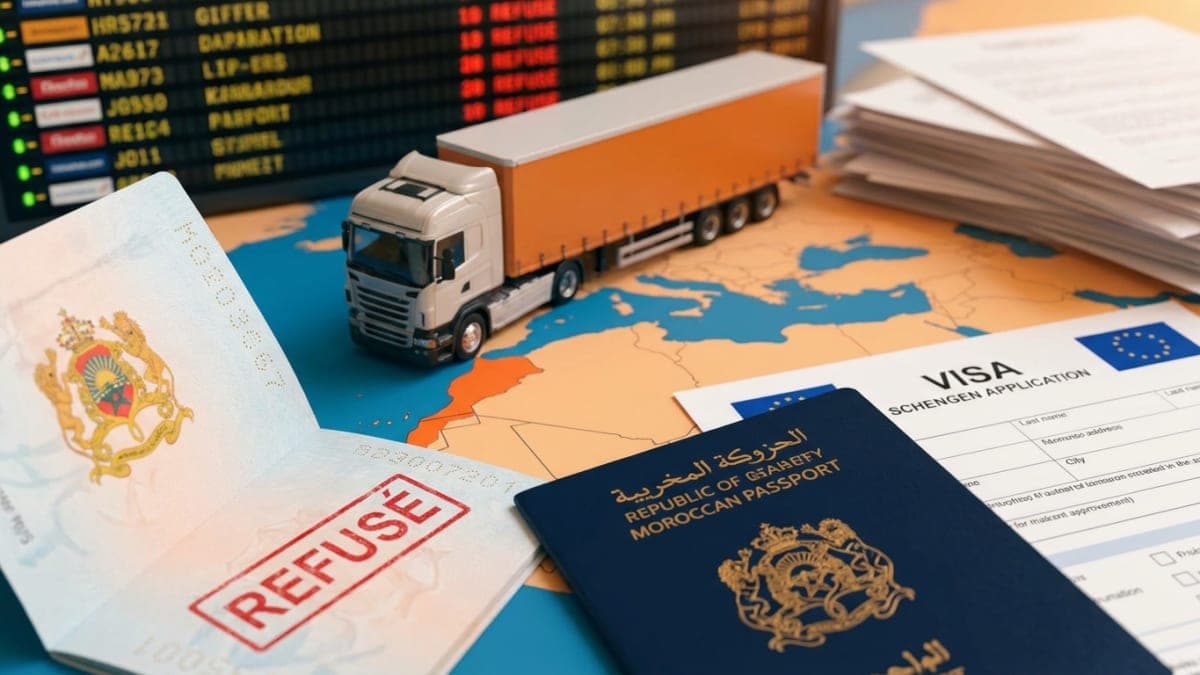
Introduction: When a Schengen visa refusal blocks the road to Europe
A Moroccan truck driver leaves Meknes for Tangier Med with a refrigerated trailer loaded with tomatoes. The buyer is in Spain. The export documents are ready, the CMR consignment note is issued, the delivery slot has been booked, and the cargo is perishable. Then the trip stops before it even begins: the driver’s Schengen professional visa has been refused. The truck waits. The tomatoes do not. A few days later, the contract collapses, the exporter claims losses, and the transport company faces a chain reaction that can easily exceed 120,000 MAD. This opening story is composite, but any lawyer dealing with droit du transport international routier Maroc Europe has seen versions of it.
That is the cruel paradox of Moroccan international road transport. Goods move under customs systems that have become increasingly organized — TIR carnets, CMR documentation, logistics platforms, export corridors through Tangier Med — yet the human link in the chain, the driver, remains exposed to a sovereign administrative decision taken by a foreign consulate. In plain English: the cargo may be ready for Europe, but the driver is not allowed to enter Schengen territory.
This matters far beyond one visa file. Morocco has a large ecosystem of international road haulage operators serving Europe, particularly for agricultural exports, agri-food, textiles, automotive components and industrial supplies. The sector is tightly connected to strategic parts of the national economy. When a refus visa Schengen chauffeur poids lourd Maroc occurs, the issue is not just individual. It affects delivery performance, contract reliability, customer confidence and, ultimately, the competitiveness of Moroccan exports.
Legally, the central question is simple to state but difficult to navigate: what rights does a Moroccan truck driver or road transport company have after a Schengen visa refusal? Can the refusal be challenged? Before whom? Within what deadline? At what cost? And if the mission is cancelled, who bears the financial burden — the driver, the employer, the shipper, or no one because the event qualifies as force majeure?
This article answers those questions from a Moroccan legal perspective while keeping one foot in European visa law. It is written for drivers, transport companies, exporters, students and practitioners. Concretely, we will look at the EU Visa Code, the judgment of the Court of Justice of the European Union in El Hassani, Moroccan transport law, the CMR Convention, the TIR framework, and the practical route from recours administratif visa Schengen Maroc to judicial remedies abroad. We will also address a hard truth that many discover too late: Moroccan courts cannot annul a refusal issued by a foreign consulate. That jurisdictional wall is real.
If you are a driver blocked after a refusal, an employer losing contracts, or a lawyer advising a haulage company, the legal tools do exist. They are imperfect, sometimes slow, often technical. But they exist. And used properly, they can make the difference between a dead-end refusal and a recoverable professional setback.
For readers looking for local legal support in transport matters, firms handling transport disputes in port and logistics corridors are often the first point of contact, particularly in Tangier where many operational blockages materialize. See, for example, Avocat droit du transport Tanger.
1. Understanding a Schengen visa refusal for Moroccan road transport professionals
The visas usually requested by Moroccan truck drivers
Most Moroccan truck drivers travelling for cross-border haulage to France, Spain, Belgium, the Netherlands or other Schengen states apply for a type C short-stay visa under a professional purpose. This distinction is essential. A tourist visa and a professional visa are not interchangeable in legal logic, even if both are formally short-stay visas within the Schengen system. For a driver engaged in remunerated transport activity, the correct category is the professional one. Using the wrong purpose can trigger suspicion, inconsistency findings, or direct refusal.
The main text is Regulation (EC) No 810/2009, the Visa Code. It governs the conditions and procedures for issuing visas for intended stays not exceeding 90 days in any 180-day period. For drivers with a stable record of lawful travel and a clear professional itinerary, some consulates may issue multiple-entry visas with a longer validity. In practice, this is often the most workable solution for regular hauliers on Morocco-Europe routes.
There is also the category of long-stay national visas, often referred to as type D, but that is usually not the relevant route for ordinary road haulage missions. A Moroccan truck driver performing rotating deliveries and returns is generally not seeking residence or long-term establishment in an EU state. He needs lawful, repeated, short professional access.
The most common reasons for refusal
Under Article 32 of the Visa Code, any refusal must be notified using the standard form and must state the reasons. That is not a courtesy. It is a legal obligation. The problem, of course, is that the stated reasons are often broad. Consulates frequently rely on grounds such as insufficient proof of the purpose and conditions of the intended stay, doubts about the applicant’s intention to leave the territory of the Member States before the expiry of the visa, insufficient means of subsistence, or concerns linked to prior visa use.
For truck drivers, the most frequent practical triggers are much more concrete. The file may be incomplete. The mission order may not match the CMR documentation. Salary slips may not align with bank statements. The employment contract may appear too recent. The employer may fail to provide a credible explanation of the transport circuit. Sometimes the driver has a good professional history but the company file is weak; sometimes the opposite is true.
Attention though: one of the most damaging mistakes is to submit a file that looks administratively clean but professionally incoherent. A driver claiming a regular Europe route without old visa copies, prior entry stamps, CMR records, employer letters, CNSS proof, and a clear logistics trail will often face distrust. Consular review is documentary. If the paper trail is thin, the refusal risk rises sharply.
The special case of TIR drivers and repeat visas
The Convention TIR of 1975 does not create a right to enter Schengen territory. That must be said clearly. A valid TIR carnet, by itself, is not a visa substitute and does not bind a consulate. Yet in real-world practice, a driver attached to a compliant operator using TIR procedures, and supported by structured international transport documents, presents a stronger professional profile than an applicant with vague travel plans.
That is why the phrase convention TIR visa chauffeur marocain appears so often in legal and industry discussions. Not because TIR grants entry rights, but because it helps demonstrate legitimacy, traceability and low irregular migration risk. If the company is known in the sector, registered properly, and can show repeated lawful freight operations, that can make a genuine difference.
Some consular posts have, over time, shown more openness to multiple-entry visas for professional drivers with a positive travel history. This is not an automatic entitlement. It is a matter of administrative assessment. Still, for transport companies operating regular routes, building that history is strategically vital.
What Schengen border law says — and what it does not say
The Schengen Borders Code deals with entry conditions and border control. It does not guarantee a visa to transport professionals merely because their cargo is commercially important. The law is built around state control of entry, not around economic urgency. In other words, a load of fresh produce does not create a legal shortcut.
That gap explains much of the frustration in the sector. A driver may be essential to a lawful supply chain and still be refused because the consulate is not convinced by the file. I have heard practitioners describe cases involving drivers with ten years of experience and dozens of prior missions who still received formula-based refusals. Whether one agrees with the assessment or not, the legal answer is the same: the refusal must be challenged using the available remedies, not ignored.
2. The Moroccan legal framework surrounding the international truck driver
Law No. 16-99 on road haulage of goods
On the Moroccan side, the activity is anchored in Law No. 16-99 relating to road transport of goods, published in the Bulletin Officiel No. 4800. This law structures the profession, access to the activity, operating conditions and compliance obligations for road transport operators. It matters in visa litigation because a consulate reviewing a professional file wants to see not just a driver but a lawful operator behind him.
The implementing framework, including Decree No. 2-99-1255, sets out conditions of operation. A visa application supported by a transport company that cannot properly document its regulatory standing is weakened from the outset. That is why the company’s legal hygiene is part of the driver’s visa strategy.
The CMR Convention and the legal identity of the mission
Morocco ratified the Convention on the Contract for the International Carriage of Goods by Road (CMR) by Dahir No. 1-73-34 of 26 January 1973. In practical terms, the CMR consignment note is not just an operational document. In a visa file, it is often one of the clearest proofs that the journey is real, specific and commercially grounded.
When discussing CMR transport routier Maroc droits chauffeur, one should be careful with terminology. The CMR primarily governs the transport contract and carrier liability, not immigration status. But it helps establish the legal and factual seriousness of the assignment. A professional visa file supported by a signed mission order, a coherent route, a CMR note, client details, and a timetable is far stronger than a generic employer letter saying only that the driver “may travel to Europe for business.”
The TIR Convention and accredited professional status
The TIR Convention of 1975, under the UN framework, facilitates customs transit for goods. Morocco is part of this system. Again, it does not create a visa right. But it contributes to the professional identity of the operator and the mission. In consular practice, a file showing regular TIR operations, recognized logistics channels and documented returns to Morocco can support the argument that the driver is a low-risk professional traveller.
That is why companies should never underestimate the evidentiary value of customs and logistics regularity. In visa disputes, professionalism must be proven, not asserted.
Moroccan Commercial Code and carrier liability
The Moroccan Code de commerce, enacted by Law No. 15-95, contains important provisions for transport liability. In the editorial brief supplied for this article, reference is made to Article 723 concerning carrier responsibility and Article 745 concerning compensation linked to transport activity. In practice, these provisions enter the discussion when a mission collapses after a visa refusal and the parties start asking: who bears the financial consequences?
That discussion is not only contractual. It may also involve labour questions if the driver has already been mobilized, travelled internally, or incurred mission-related expenses. When the employer and the shipper have drafted nothing about visa risk, disputes become messy very quickly.
The role of AMDL
The Agence Marocaine de Développement de la Logistique (AMDL), created by Law No. 59-09, occupies a practical place in these files. Its documentation can help prove that the company is a real logistics actor operating within the national framework. An AMDL attestation, especially when recent, can strengthen the credibility of a professional visa application.
There is also a broader policy dimension. AMDL, together with professional bodies such as the FNTR, contributes to sectoral advocacy. While there is no special Morocco-EU visa facilitation agreement specifically for truck drivers at this stage, pressure from organized industry actors remains one of the few realistic paths toward a more functional regime.
3. Challenging a Schengen visa refusal: the administrative route, step by step
Article 32 of the Visa Code: refusal must be reasoned
The starting point is Article 32 of Regulation (EC) No 810/2009. A refusal of a Schengen visa must be notified using the standard form and must include the reasons. The same article also states that applicants whose visas are refused have the right to appeal. The appeal is conducted against the Member State that has taken the final decision and in accordance with its national law.
Article 32 of the Visa Code: a visa shall be refused where the applicant fails to meet the required conditions, and the decision refusing a visa shall be notified by means of the standard form set out in Annex VI. Applicants who have been refused a visa shall have the right to appeal.
This is where many drivers and employers make their first mistake: they treat the refusal as final because the form looks definitive. It is not necessarily final. It is an adverse administrative decision open to challenge.
First step: the gracious appeal to the consulate
The first practical move is usually a gracious appeal — what many in practice call a recours gracieux visa Schengen ambassade or consular reconsideration request. In some countries and consular systems, the exact nomenclature differs, but the logic is the same: you ask the authority that refused the visa to review the decision in light of additional evidence or corrected information.
There is no uniform EU-wide deadline for all appeal stages because the appeal procedure follows the national law of the Member State concerned. However, as a matter of prudence, many practitioners recommend acting within 15 days of notification when possible, or at least without delay. Waiting too long weakens urgency and can complicate the file if the transport mission was time-sensitive.
The gracious appeal is generally free of charge. If drafted by the driver or employer, the direct cost may be zero. With a Moroccan lawyer’s assistance, realistic fees often range from 2,000 to 5,000 MAD, depending on complexity and whether the lawyer also restructures the evidence file. For readers seeking assistance in the economic capital where many visa and transport files are prepared, specialized counsel can be useful: Avocat droit du transport Casablanca.
The letter should be factual, not emotional. It should identify the refusal date, the application reference, the stated reasons, and the new or clarified evidence provided. For a truck driver, the supporting set should usually include the employment contract, the last three payslips, CNSS attestation, employer certificate, mission order with dates and destinations, CMR documentation, company registration extracts, transport insurance, prior visas and entry/exit history, TIR-related proof where applicable, and bank records consistent with declared income.
Concretely, the objective is to dismantle the refusal ground point by point. If the refusal says the purpose of the stay is insufficiently justified, respond with route documents, client details and transport contracts. If the refusal raises doubts about return intention, respond with employment seniority, family ties, property if any, CNSS continuity, prior lawful returns, and evidence of stable residence in Morocco.
Second step: hierarchical or formal appeal to the embassy or competent national authority
Depending on the Member State involved, the next step may be a hierarchical or formal administrative appeal to the embassy or to a designated national review authority. For French visa refusals, for example, the system has specific procedural channels under French law, and in some instances there are mandatory prior administrative review mechanisms before litigation. The exact route depends on the state that issued the refusal, so one must verify the applicable national procedure carefully.
This stage is also often free, but the value of legal drafting becomes higher because the file begins to move from documentary completion to legal argument. A poorly framed appeal repeating the same documents without addressing the refusal rationale usually fails. A targeted appeal may succeed, especially where the original refusal was based on insufficient evidence rather than serious security concerns.
Practitioners often estimate that a well-prepared administrative challenge can reverse the outcome in a meaningful minority of cases, especially where the issue was lack of proof of professional necessity or doubts regarding return guarantees. The key is simple: do not refile the same weak file and expect a different result.
If you have already received one refusal, do not submit the exact same file again. That is the most common and most expensive mistake. Add new evidence or obtain legal advice before any new application.
Third step: judicial remedy before the competent court in the Member State concerned
The decisive authority on the existence of an effective remedy is the Court of Justice of the European Union in El Hassani v. Minister Spraw Zagranicznych, Case C-403/16, judgment of 13 December 2017. The Court held that persons refused a Schengen visa must have access to an appeal procedure meeting the requirements of effective judicial protection.
CJEU, El Hassani, C-403/16, 13 December 2017: the appeal against a refusal of a visa must guarantee the applicant the possibility of a judicial remedy at a certain stage of the proceedings.
This is crucial. A consulate may refuse. An administrative review may fail. But the right to a judicial remedy must exist somewhere in the legal order of the Member State concerned. In practice, that means litigation before the competent administrative court of that state. For refusals connected to France, proceedings may fall within the French administrative justice system. Costs are significantly higher: legal fees commonly range from 1,500 to 5,000 euros, sometimes more depending on urgency and complexity. Timelines can vary from 6 to 18 months.
For a perishable goods mission, that timeline is obviously too long to save the original trip. Judicial remedy is therefore more about principle, future mobility, reputational correction of the file, and repeated visa access than about rescuing a shipment scheduled for next week.
The practical case of French consular refusals in Morocco
Because many Moroccan haulage routes involve France directly or indirectly, the phrase contestation refus visa consulat France Maroc is especially common. French-related refusals must be approached with precision because French administrative procedure has its own architecture. Drivers and companies should verify whether a prior administrative appeal is required before court litigation and whether the competent body is the commission handling visa refusal appeals or another authority depending on the period and procedure in force.
The broad lesson remains the same: preserve the refusal notice, respect deadlines, translate documents where necessary, and do not improvise once the case reaches foreign administrative litigation. At that stage, coordination between a Moroccan lawyer familiar with the transport file and a lawyer admitted in the relevant EU jurisdiction is often the most efficient approach.
Realistic timelines and costs
In day-to-day practice, a gracious appeal may take 4 to 8 weeks. A formal administrative review may take a similar or longer period. Judicial litigation is slower. The direct administrative stages are usually low-cost; the evidentiary work is what takes time. By contrast, court proceedings in Europe are expensive and uncertain.
That is why the first refusal must be treated seriously. The better the first appeal, the lower the chance that the matter escalates into a costly cross-border dispute.
4. Transport company liability after a visa refusal: who pays for the failed mission?
Can a visa refusal be force majeure under Moroccan law?
Moroccan law brings us to Article 268 of the Dahir forming the Code of Obligations and Contracts (DOC). This is the classic provision on force majeure.
Article 268 of the DOC: force majeure is any event which man cannot foresee, such as natural phenomena, and which he cannot prevent, and which makes performance impossible.
Can a Schengen visa refusal fit this definition? Sometimes yes, sometimes no. Everything depends on foreseeability, avoidability and contractual context. If the company accepted a transport mission while the driver’s visa was already uncertain, expired, or previously refused, the event may not be considered unforeseeable. In that case, invoking force majeure becomes difficult. On the other hand, a sudden refusal despite a historically regular visa pattern and a complete professional file may support a stronger force majeure argument.
Practitioners in Casablanca often report that courts and negotiators occasionally treat visa refusals as force majeure-like events in commercial disputes, especially where the refusal was genuinely external and unavoidable. But one must be careful: there is no blanket rule saying every visa refusal is force majeure. It is a fact-sensitive assessment.
The CMR Convention and carrier exoneration
Under the CMR Convention, Article 17, the carrier is generally liable for total or partial loss of the goods and for damage occurring between taking over the goods and delivery, as well as for delay. Yet the carrier may be exonerated if the loss, damage or delay was caused by circumstances which the carrier could not avoid and the consequences of which he was unable to prevent.
Here again, the same tension appears. If the carrier had no valid driver visa and still accepted the mission, the shipper may argue that the obstacle was avoidable and internal to the carrier’s organization. If, however, the refusal occurred unexpectedly after a diligent and timely visa application supported by proper documentation, the carrier has a stronger exoneration position.
This is the heart of the phrase responsabilité transporteur refus visa frontière. Liability does not arise automatically from failure to perform. It is filtered through contractual clauses, foreseeability, diligence and the allocation of administrative risk.
The contract is where many disputes could have been avoided
During a discussion with a colleague from the Casablanca Bar specializing in transport law, he told me that a very large share of visa-related liability disputes could have been avoided by one simple contractual clause. I agree. In fact, this is one of those painfully preventable problems.
A transport framework agreement should expressly state that the mission is conditional upon the availability of a valid professional visa for the designated driver, and that in the event of refusal, suspension or non-renewal of that visa, the mission may be postponed, reassigned or terminated without contractual penalty, except in case of proven fault by the carrier. Without such wording, parties tend to litigate on broad principles instead of clear allocation of risk.
A practical clause might read as follows: “Execution of any international road transport mission into Schengen territory is conditional upon the obtaining and maintenance of a valid professional visa by the assigned driver. In the event of refusal, withdrawal or expiry of the visa, the mission shall be suspended or terminated without penalty, save where the refusal results from fault, misrepresentation or negligence attributable to the carrier.”
This is not elegant drafting for the sake of elegance. It is money saved. One company in Fez reportedly lost a major citrus transport contract worth around 800,000 MAD because the framework agreement said nothing about visa contingency. Once the driver could not travel, the shipper treated the failure as pure contractual breach. The dispute that followed was far more expensive than proper drafting would have been.
What about the driver’s own compensation?
If the driver has already been mobilized, travelled domestically, or incurred costs for the mission, labour and commercial rules may justify reimbursement or compensation depending on the employment relationship, internal company policy and the applicable transport regime. The editorial brief refers to Article 745 of the Moroccan Commercial Code in relation to compensation linked to an unnecessary or aborted mission. In practice, employers should also review wage rules and sectoral norms, including the framework affecting transport remuneration and mission expenses.
Where the dispute spills into employment law — for example, if the employer seeks to penalize the driver for a refusal not caused by any misconduct — legal advice should be sought quickly. A driver should not automatically bear the cost of an administrative refusal that stems from documentary strategy, company organization or consular assessment beyond his control. Readers concerned with employer-employee consequences may also consult Avocat droit du travail Casablanca.
5. What can Moroccan courts do — and what can they not do?
The hard limit: Moroccan courts cannot annul a foreign consular refusal
This is one of the most frustrating points in practice. Under Law No. 41-90 establishing Administrative Courts, Moroccan administrative courts review Moroccan administrative action. They do not have jurisdiction to annul a visa refusal issued by France, Spain or any other foreign state through its consular authorities in Morocco.
As a Moroccan lawyer, one sometimes reaches this point with a client and has to say the uncomfortable truth plainly: the Tribunal Administratif in Rabat or Casablanca cannot cancel a Schengen visa refusal signed by a foreign consulate. That decision belongs to the legal order of the foreign state. It is one of those situations where the Moroccan jurist has his hands tied by the sovereignty of a third state.
So if the question is whether a Moroccan court can order the French consulate in Casablanca to issue a visa, the answer is no.
What Moroccan courts can still hear
That said, Moroccan courts may still become relevant in related disputes. If a Moroccan administration failed to issue a necessary supporting document on time — for example, an AMDL-related attestation or another professional document required for the file — and that failure caused demonstrable loss, an action against the Moroccan administration may be conceivable before the competent Tribunal Administratif, under the ordinary rules of administrative liability.
Similarly, if the visa refusal triggers a private-law dispute between the transport company and the shipper, or between the employer and the driver, Moroccan commercial or labour courts may have jurisdiction depending on the contract and the parties. The visa refusal itself remains foreign; its contractual or economic consequences may still be litigated in Morocco.
For businesses exploring such public-law avenues, local counsel in administrative litigation can help assess whether a claim is viable: Avocat droit administratif Maroc. In Rabat, where many administrative bodies are located, this is particularly relevant: Avocat droit du transport Rabat.
Alternative channels: the Médiateur du Royaume and institutional advocacy
The Médiateur du Royaume, governed by Dahir No. 1-11-25 of 17 March 2011, cannot overturn a foreign visa refusal either. But the institution can intervene to facilitate dealings with Moroccan administrations where a citizen or company faces maladministration, delay or documentary blockage. In some cases, that practical administrative support matters more than abstract legal theory.
The Constitution of 2011, notably Articles 25 and 28 as referenced in the editorial materials, is sometimes invoked in broader discussions about freedom, rights and professional mobility. One should be legally cautious here: the Constitution does not create an enforceable right against a foreign state to obtain a Schengen visa. But it does support public-policy arguments for better state support of Moroccan professionals whose economic activity depends on international circulation.
Collective action through professional bodies
In reality, structural change is more likely to come from organized sector pressure than from individual lawsuits. The FNTR and other professional actors have a key role in documenting the economic damage caused by repeated visa obstacles and in pushing for practical facilitation measures, especially for certified professional drivers and TIR operators.
There have been repeated calls, especially since 2022 and 2023, for multi-entry professional visa arrangements for accredited drivers. No binding bilateral Morocco-EU regime specifically tailored to truck drivers has yet emerged. But the demand is legally understandable and economically justified.
6. Practical advice to maximize approval chances and defend a professional visa file
Build a file that looks like a transport file, not a generic travel file
A driver applying for a visa Schengen professionnel transport routier should submit a file reflecting the reality of his profession. That means, beyond passport and form, a proper professional package: valid passport with sufficient remaining validity, C+E driving licence, digital driver card, employment contract, the last three payslips, recent CNSS attestation, employer certificate, company registration documents, recent AMDL attestation, mission order, CMR documents, transport insurance, and where possible prior visa copies and entry/exit evidence.
If the company works under TIR procedures, include evidence of that ecosystem. If the driver has conducted past Europe missions, document them. Consulates are persuaded by continuity and coherence.
Understand the risk profile logic
First-time applicants are reviewed more strictly. That is normal. For them, the file should be maximal. A driver with a positive travel history, regular returns, stable employment and repeat missions has a stronger profile and may progressively gain access to longer validity or multiple-entry visas. But that progression is earned administratively. It does not happen by default.
One fatal error is to apply under tourism when the true purpose is professional haulage. Another is inconsistency between declared salary and actual bank flows. Another still is careless form completion — wrong addresses, vague host details, contradictory dates. These are not minor imperfections. In practice, they can destroy credibility.
When to instruct a lawyer
If the first refusal is based on a serious concern such as doubts about return intention, or if there is already a second refusal, legal assistance becomes highly advisable. The same is true when the refusal threatens a significant commercial relationship or when the company needs to coordinate transport-law consequences with visa-law remedies.
In Morocco, assistance on the first administrative stage may cost roughly 2,000 to 8,000 MAD depending on complexity and whether the lawyer is only drafting the appeal or also restructuring the whole evidentiary strategy. For mixed visa and immigration support, specialized counsel can be useful: Avocat droit des étrangers et visa Maroc. Where the dispute intersects with contracts and international freight business, commercial counsel may also be necessary: Avocat droit commercial international Maroc.
The professional cover letter is underrated
Many files fail because the explanatory letter is generic. A strong cover letter should identify the company, the transport route, the client or partner in Europe, the type of goods transported, the expected dates, the driver’s seniority, prior missions, and the reasons why this driver, specifically, is assigned to the mission. If the driver has complied with prior visas, say so. If he has family, property or durable ties in Morocco, mention them where relevant to address return concerns.
In clear terms: the consulate should finish reading the letter understanding exactly why the journey is real, temporary and professionally necessary.
Processing times and strategic timing
Processing times vary by consulate and season. For France-related applications filed from Morocco, practitioners often observe average processing around 15 working days, with longer delays — 30 to 45 days or more — during peak periods. Transport companies should therefore stop planning Europe-bound missions on the assumption that a fresh visa can be obtained at the last minute. Operational planning and visa planning must be aligned.
This may sound obvious, but in practice it is ignored too often. A visa file is not a warehouse release note. It cannot be improvised two days before loading.
Conclusion: The law offers remedies, but the system still leaves Moroccan hauliers exposed
Where does this leave Moroccan truck drivers and road hauliers facing a Schengen refusal? The current legal map is clear enough. First, there is an administrative challenge: the gracious appeal, usually free, often worth attempting immediately, with possible legal fees from 0 to 3,000 or 5,000 MAD depending on assistance. Second, there may be a hierarchical or formal administrative review under the law of the Member State concerned, also generally low-cost. Third, there is the judicial remedy in that Member State, recognized in principle by the CJEU in El Hassani, but far more expensive — commonly 1,500 to 5,000 euros — and too slow to rescue an urgent shipment.
On the Moroccan side, the law helps with adjacent issues: contract drafting, allocation of transport risk, labour consequences, and possible claims against Moroccan administrative failures where they exist. But it does not solve the central sovereignty problem. A foreign state decides entry. Moroccan courts cannot rewrite that decision.
That is why this topic is larger than individual litigation. It raises a policy issue for a country whose exports to Europe depend heavily on reliable road logistics. A more rational bilateral or Euro-Mediterranean facilitation mechanism for accredited professional drivers — especially those with clean TIR and compliance records — would not be a privilege. It would be an economic necessity.
Until such reform arrives, the best protection remains legal discipline: complete visa files, coherent evidence, rapid appeals, proper contract clauses, and early advice from counsel who understand both transport law and visa law. If you are facing a visa professionnel refusé recours juridique Maroc situation, act quickly. The refusal may be sovereign, but your response should not be passive.
