
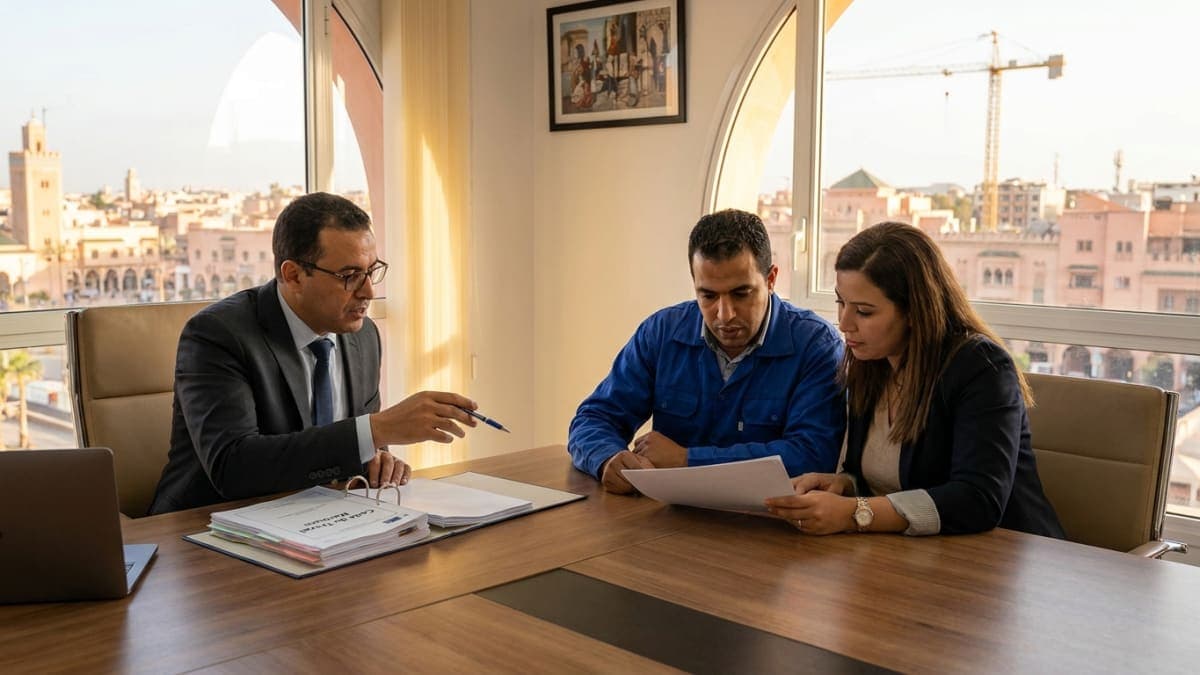
Introduction: Why building caretakers’ rights are suddenly back in the spotlight in Morocco
In 2024, the status of the building caretaker in Morocco is no longer a quiet, informal matter handled between a syndic and a porter’s lodge. It has become a real legal issue. The news hook is easy to identify: the article published by Challenge on caretakers being “restored in their rights” triggered a wave of questions from syndics, co-owners, landlords and, of course, caretakers themselves. Concretely, many people discovered that what had long been treated as a practical arrangement — a man living on site, opening the gate, receiving parcels, watching the entrance, cleaning common areas, dealing with late-night calls — is very often a fully-fledged employment relationship governed by Moroccan Labour Code Law No. 65-99.
The reason this debate matters is simple. Across Casablanca, Rabat, Marrakech, Tangier, Fès and many mid-sized cities, thousands of caretakers still work without a written contract, are paid partly in cash, are not declared to the CNSS, and live in a cramped service room presented as if it replaced salary. Legally, that is a risky arrangement. Socially, it is often unfair. And judicially, Moroccan courts are becoming less indulgent.
One practical example often cited by labour practitioners in Casablanca involved a syndic condemned in 2022 after the verbal dismissal of a caretaker who had served the building for around 12 years. The court treated the termination as abusive, ordered payment of notice compensation, dismissal indemnity, unused paid leave and damages. The amount, once all items were added, was far higher than what a regularized employment file would have cost over the years. That is exactly why this subject now concerns not only employees, but also syndicates of co-owners, property managers and landlords.
This article answers the central question directly: Does Moroccan labour law fully apply to building caretakers? In most cases, yes. And once that answer is accepted, a whole chain of legal consequences follows: contract rules, minimum wage, overtime, weekly rest, paid leave, CNSS registration, dismissal procedure, compensation and the legal fate of the staff accommodation.
The case law shift: social courts are looking at reality, not labels
The current trend in Moroccan labour litigation is clear. Judges do not stop at the title used by the parties. Calling someone “guardian”, “concierge”, “doorkeeper”, “service provider” or even “helper” does not settle the matter. What matters is the factual situation: who gives instructions, who controls the work, who sets the schedule, who benefits from the service and who can sanction the worker. In labour law, facts are king.
Who should read this?
This text is written for several audiences at once. First, caretakers who want to know whether they have enforceable rights even without a written contract. Second, syndics and boards of co-owners who need to understand their obligations toward a building caretaker in Morocco. Third, students, junior lawyers and entrepreneurs who want a practical reading of the code du travail marocain articles gardien. The goal is not abstract theory. It is to explain what the law actually means on the ground.
Legal status of a building caretaker in Morocco: employee or independent contractor?
The decisive legal test: subordination
The starting point is article 6 of the Moroccan Labour Code. It protects the employee relationship whenever there is work performed for another person in return for remuneration under a relationship of subordination. In plain English, if the caretaker receives instructions, follows imposed schedules and is subject to supervision, the Labour Code generally applies.
Article 6 of Law No. 65-99 recognizes the employee relationship through the performance of work under the authority and control of an employer in return for remuneration.
This is where many disputes begin. A building may say: “He is not an employee; he just stays there and keeps an eye on the entrance.” But if the caretaker must open the building at fixed hours, clean common areas, receive deliveries, answer to the syndic, remain available at night and report incidents, the legal picture changes. Those are classic indicators of lien de subordination, the core test used by Moroccan labour courts.
Attention toutefois: not every person physically present in a building is automatically an employee. A genuine external contractor can exist — for example, a security company that sends rotating guards under its own management, or a cleaning company with its own staff and hierarchy. But where the “caretaker” is tied directly to the building, paid monthly, housed on the premises and instructed by the syndic or owner, reclassification as an employee is often straightforward.
Co-owners’ syndicate or single owner: who is the employer?
That question matters enormously in practice. Under Law No. 18-00 on co-ownership of built property, promulgated by Dahir No. 1-02-298 of 3 October 2002, the syndicat des copropriétaires has legal personality. This means the syndicate of co-owners can hire staff, pay wages, bear social charges and appear in court. If the caretaker works for a residential building subject to co-ownership rules, the legal employer is often the syndicate itself, represented by the syndic.
Where a building belongs to a single owner, the employer is simply that owner — whether an individual, a family property structure or a company. The distinction is not academic. It affects who signs the contract, who declares the employee to the CNSS, who appears before the labour inspector and who pays if the court orders compensation.
For that reason, one practical recommendation should be adopted from the first general assembly: the minutes should clearly identify who is mandated to hire and manage the caretaker, on what salary, and under what reporting line. A vague arrangement creates litigation later, especially when a syndic changes.
The special case of the live-in caretaker
One of the most persistent misconceptions in Morocco is this: because the caretaker is housed on site, he is somehow outside ordinary labour law. That is legally wrong. A logement de fonction gardien immeuble maroc does not cancel employee status. It is usually an advantage in kind, not a substitute for all labour rights.
Moroccan social courts regularly look past the housing argument. If the room is provided because the employee must remain close to the building for service reasons, the accommodation is accessory to the job. It does not erase the right to wages, paid leave, CNSS, notice or dismissal compensation. In fact, the presence of staff accommodation often strengthens the argument that the person is integrated into the employer’s organization.
The caretaker’s employment contract: legal requirements and common traps
Fixed-term or indefinite-term contract?
The key rule is found in article 16 of the Labour Code: where no valid written fixed-term contract exists, the relationship is presumed to be an indefinite-term contract (CDI). This is crucial for the contrat travail gardien immeuble maroc. Many caretakers are hired informally with phrases such as “for the duration of renovation works” or “for now, until the building is fully occupied.” If nothing clear and lawful is written, the law tends to treat the arrangement as a CDI.
Article 16 of the Labour Code: the fixed-term contract is exceptional and must meet legal conditions; in the absence of a valid written framework, the employment relationship is generally treated as open-ended.
Concretely, if a caretaker starts working, remains for months or years, receives monthly pay and performs ordinary recurring duties, the employer will have great difficulty later arguing that the relationship was temporary. This is one of the most common traps seen in practice.
What should the contract contain?
Even though Moroccan labour law protects employees without a written contract, a written contract remains strongly advisable. Articles 33 to 37 of the Labour Code, read together with general labour principles, require clarity on the identity of the parties, the nature of the work, the place of work, remuneration, working time and, where relevant, probation and accommodation conditions.
A proper caretaker contract should identify the employer precisely — for example, “Syndicat des copropriétaires de l’immeuble X, represented by its syndic.” It should describe the tasks: surveillance of common areas, reception of visitors and parcels, cleaning of common spaces if applicable, minor reporting duties, waste management, opening and closing of access points. It should also specify the schedule. This point is vital. A contract that simply says “permanent presence required” invites litigation over overtime and night duty.
The contract should further state the monthly gross wage, any housing benefit in kind, weekly rest day, paid leave entitlement, CNSS registration, notice periods, and the conditions for vacating staff housing at the end of employment. In Casablanca practice, lawyers usually charge roughly 800 to 1,500 MAD to draft a compliant model contract for a building caretaker. Frankly, that is modest compared with the cost of a labour dispute that can exceed 50,000 MAD once indemnities and arrears accumulate.
Internal regulations: not always mandatory, but often necessary
Articles 138 to 141 of the Labour Code govern internal workplace regulations. Strictly speaking, a formal règlement intérieur gardien immeuble maroc is mandatory above certain staffing thresholds. But even where there is only one caretaker, it is wise to formalize service rules. Why? Because many disputes are not about whether the caretaker works, but about how he is expected to work.
A short written service charter can define reception hours, cleaning tasks, parcel handling, emergency calls, key custody, visitor reporting, night incidents and use of the lodge or service room. It can also state what is not required. That last part is often overlooked. A caretaker is not automatically a 24/7 on-call worker without compensation.
Hiring formalities: CNSS and labour administration
From the social security angle, the employer must affiliate the employee to the CNSS without delay. The legal basis remains the Dahir bearing Law No. 1-72-184 of 27 July 1972 relating to the social security regime. In practice, employers should regularize the file within the first days of employment and certainly not wait until a dispute arises.
The labour administration may also intervene through the territorially competent labour inspectorate, usually attached to the regional or provincial delegation of the Ministry of Employment. Keeping the hiring file orderly from day one — contract, CNSS declaration, wage slips, attendance record — is the easiest way to avoid later evidentiary battles.
Minimum wage and remuneration of a building caretaker in Morocco
The applicable SMIG in 2024
For a building caretaker in the non-agricultural sector, the legal benchmark in 2024 is the SMIG of 3,111.39 MAD gross per month for 191 hours, under Decree No. 2-23-335 of 29 June 2023. This is the figure most readers search when typing gardien immeuble maroc salaire minimum. It is not optional. If the caretaker is an employee under the Labour Code, the employer cannot lawfully pay less on the theory that “housing makes up the difference.”
Decree No. 2-23-335 of 29 June 2023: the statutory minimum wage in the non-agricultural sector was raised to 3,111.39 MAD gross monthly.
The legal monthly working time reference comes from article 184 of the Labour Code, which sets the normal duration of work in non-agricultural activities at 44 hours per week. That is how the 191-hour monthly benchmark is commonly derived for payroll purposes.
Can staff housing count as salary?
Yes, but only partially and carefully. The accommodation can be treated as an advantage in kind. Its value may be considered in payroll and sometimes in the calculation of certain entitlements. But a crucial limit remains: the caretaker must receive an actual cash wage. Housing alone cannot lawfully replace the minimum wage. That is a frequent violation, and Moroccan labour courts tend to sanction it firmly.
When no collective agreement specifically governs the sector — and currently there is no specific collective agreement for residential building caretakers in Morocco — courts often assess the value of the housing benefit according to local market value, the actual condition of the room and the factual utility of the lodging. A tiny, poorly ventilated room in a basement is not equivalent to proper rent-free accommodation in the ordinary market.
In practice, employers should avoid creative accounting. The safer approach is simple: pay at least the legal wage in money, then state separately the housing benefit as an additional advantage in kind.
Overtime: the hidden issue in caretaker litigation
This is where many cases become expensive. Articles 196 to 202 of the Labour Code regulate overtime. Where the employee works beyond the legal duration, the extra hours must be paid with statutory increases. Daytime overtime generally attracts a 25% increase, and night work or work in less favorable periods may trigger 50% or more depending on the circumstances and timing. Article 201 is regularly cited regarding the increase applicable to work performed at night.
For caretakers, the legal difficulty is not only active work but also standby presence. A syndic may say: “He was there, but he was not constantly working.” Courts often respond differently when the employee cannot freely use his time because he must stay available on site, open the door, answer incidents or monitor access. In that context, standby can become compensable working time or at least generate overtime consequences.
Labour practitioners in Rabat-Agdal still mention a 2021 dispute in which a co-ownership syndicate was ordered to pay several years of undeclared overtime to a caretaker whose weekly presence effectively reached around 60 hours. The lesson is practical: if the building needs broad coverage, it should organize shifts, replacement, or explicit compensation. It should not rely on permanent informal availability.
Paid leave, weekly rest and public holidays
Paid annual leave: what the caretaker earns
The rule is found in article 231 of the Labour Code: every employee acquires 1.5 working days of paid leave per month of effective service. After a full year, that amounts to 18 working days. Under article 232, the entitlement increases after five years of service in the same undertaking, reaching 2 working days per month, or 24 days per year.
Article 231: 1.5 working days of paid leave for each month of effective service.
Article 232: after five years of service, paid leave is increased to 2 working days per month.
This is a core element of congés payés gardien immeuble maroc. The leave indemnity is generally calculated on the basis of 1/24 of the total annual gross remuneration, including benefits in kind that can be valued. In other words, if the caretaker receives salary plus housing advantage, both may matter in the calculation.
Weekly rest is not optional
Article 205 of the Labour Code grants employees a minimum weekly rest of 24 consecutive hours. For live-in caretakers, this is often ignored in practice. Yet the legal rule remains. If the building requires continuous coverage, the employer must organize a replacement or another lawful arrangement. A common practical solution in Casablanca is to hire a stand-in caretaker for the weekly rest day, often at around 150 to 200 MAD per day, depending on the tasks and neighborhood.
Putting this in the contract avoids later conflict. If there is no replacement system and the caretaker works every day for months, the employer accumulates exposure for weekly rest violations and potentially overtime.
Public holidays and work on holidays
Moroccan employees in the private sector benefit from legal public holidays under the Dahir of 14 March 1963, as amended. These include major national and religious holidays such as Eid Al-Fitr, Eid Al-Adha, the Throne Day and others officially recognized. A caretaker does not lose this protection because he lives in the building.
If the caretaker works on a legal holiday, compensation rules apply. In practice, work performed on a public holiday should be offset by increased pay or compensatory arrangements consistent with labour law. Many practitioners use the benchmark of a 100% increase of the daily wage for holiday work where no substitute rest is granted, though the exact payroll treatment must be aligned with the applicable legal and factual framework.
Social protection and CNSS: the employer’s obligations
CNSS registration is mandatory from the start
The legal basis is the Dahir bearing Law No. 1-72-184 relating to the social security regime. Any employee in the private sector must be declared to the Caisse Nationale de Sécurité Sociale. For a caretaker, that means the employer — whether a co-owners’ syndicate or a private owner — must open and maintain the CNSS file, declare wages and pay contributions.
The practical issue is widespread non-compliance. Many caretakers discover after years of service that no CNSS contributions were paid on their behalf. Legally, that does not deprive them of rights. On the contrary, the failure is attributable to the employer. The employee may seek recognition of the employment relationship, regularization of contributions and judicial compensation where appropriate.
Contribution rates and sanctions
Contribution rates evolve, but in practice employers should budget roughly the equivalent of a significant payroll surcharge on top of gross salary, including social contributions and mandatory coverage. The editorial benchmark often used in practice places the employer’s burden at around 21.09% and the employee share at around 6.29%, subject to the applicable ceilings and current CNSS schedules. Because rates and bases can change, the prudent approach is always to verify the latest official CNSS grid.
As for sanctions, the CNSS legislation provides penalties for non-affiliation and non-declaration. The exposure usually includes fines and retroactive regularization. In practice, employers may face a back-payment period commonly discussed as up to four years for CNSS recovery actions, though labour claims and documentary issues can extend the practical financial impact. The central point is simple: delaying declaration rarely saves money in the long run.
AMO, health coverage and accidents at work
Once declared, the caretaker may benefit from health coverage through the compulsory health insurance mechanisms managed within the private-sector social system. If not declared, he remains exposed and often relies on precarious alternatives. That is one reason why the keyword protection sociale gardien immeuble CNSS maroc matters beyond technical compliance: it is about access to healthcare, family benefits and future pension rights.
Accidents at work are another blind spot. A caretaker can slip while cleaning stairs, be injured while handling waste, or suffer an assault at the gate. The employer must react promptly, make the appropriate declarations and preserve the employee’s rights. Where a co-ownership syndicate is the employer, the syndicate bears that responsibility, not merely the individual co-owner who happens to be on the board.
Staff accommodation: rights, duties and legal traps
Is staff housing legally mandatory?
No provision of the Labour Code imposes staff accommodation for building caretakers as a universal rule. In practice, however, many buildings provide a room because the service is organized around physical presence on site. The law does not require it, but the market often expects it. That gap between law and practice is exactly where disputes arise.
When accommodation is provided, it should be described clearly in the contract: location, condition, whether utilities are covered, whether family occupation is allowed, and what happens when the employment ends. Silence on this issue is dangerous.
Minimum living conditions and employer responsibility
Articles 281 to 296 of the Labour Code deal broadly with hygiene, safety and occupational conditions. Even if these provisions were not drafted specifically for caretakers’ lodgings, they reinforce an obvious principle: an employer cannot house an employee in dangerous or indecent conditions. Running water, electricity, basic sanitation and a minimally habitable space are not luxuries.
In litigation, photos, videos, witness statements and bailiff reports can all matter. Moroccan judges are increasingly receptive to factual proof showing that the “benefit in kind” was in reality a substandard room with no real rental value.
What happens to the accommodation when the contract ends?
This is one of the most sensitive issues in practice. The general principle is that a caretaker who occupies the premises because of his job loses the right to that accommodation when the employment ends. The housing is accessory to the employment, not an ordinary lease governed by Law No. 67-12 on leases of premises for residential or professional use.
But attention: that does not authorize brutal eviction. The employer cannot lawfully cut water, cut electricity, remove the door, change the locks or physically expel the former caretaker by force. Moroccan courts treat such conduct as voie de fait. In a Marrakech dispute often discussed by practitioners, a syndicate that attempted this kind of pressure after termination ended up facing additional liability.
The sound legal approach is to provide in the contract a reasonable departure period after termination. If there is no clause, courts often grant a practical delay — commonly between 30 and 90 days, depending on family circumstances, length of service and the condition of the dismissal. If the former caretaker refuses to leave, the employer should seek a judicial order rather than self-help.
Dismissal of a building caretaker: procedure, compensation and fatal mistakes
Grounds for dismissal: serious misconduct versus ordinary termination
Articles 35 to 57 of the Labour Code govern termination of employment. Article 39 lists forms of serious misconduct that may justify dismissal without notice or dismissal indemnity. These include, for example, serious violence, grave insubordination, disclosure of professional secrets in certain contexts, and unjustified abandonment of post where legally characterized.
But employers should be careful. Not every disagreement, absence or complaint by residents amounts to serious misconduct. Courts examine the facts strictly. A caretaker accused vaguely of “not being reliable” or “not smiling enough” cannot lawfully be dismissed for gross misconduct on that basis alone.
The mandatory procedure under article 62
This is where many dismissals collapse. Article 62 of the Labour Code requires a prior hearing procedure. The employee must be summoned, heard and allowed to defend himself, usually with a representative or delegate where applicable. The employer must then notify the decision within the legal time frame. The editorial brief rightly highlights the practical sequence often used: registered letter with acknowledgment of receipt, hearing within a short legal period, and notification within 48 hours after the hearing.
Article 62 of the Labour Code: before any disciplinary dismissal, the employee must be heard so that the facts can be discussed in an adversarial manner; procedural formalities are not cosmetic, they are mandatory.
The first fatal mistake is verbal dismissal. In Moroccan labour litigation, it is devastating for the employer. Once the caretaker is told informally “do not come back,” the court is very likely to treat the dismissal as abusive if no lawful procedure can be proved. The second fatal mistake is procedural sloppiness: no hearing, no signed minutes, no proper notification, no proof of dates. Even where some misconduct existed, procedural defects can still generate compensation.
How to calculate the legal dismissal indemnity
The benchmark is article 53 of the Labour Code. It sets the dismissal indemnity by reference to hours of wage per year of service:
- 96 hours of wage for each of the first 5 years;
- 144 hours of wage for each year from the 6th to the 10th year;
- 192 hours of wage for each year beyond 10 years.
Let us take a concrete example using the 2024 SMIG. Monthly gross wage: 3,111.39 MAD. On a 191-hour basis, the hourly wage is approximately 16.29 MAD.
Now imagine a caretaker with 7 years of service. The calculation is as follows:
For the first 5 years: 5 × 96 hours × 16.29 MAD = 7,819.20 MAD approximately.
For years 6 and 7: 2 × 144 hours × 16.29 MAD = 4,691.52 MAD approximately.
Total legal dismissal indemnity under article 53: about 12,510.72 MAD.
If the caretaker has 8 years of service, the second bracket becomes 3 × 144 × 16.29 = 7,037.28 MAD, added to 7,819.20 MAD, for a total of about 14,856.48 MAD.
And that is only one item. The employer may also owe notice compensation under article 43, plus payment for unused annual leave, unpaid wages, overtime, and potentially damages for abusive dismissal.
Notice periods and abusive dismissal
Article 43 provides the legal notice framework, commonly summarized as 8 days for less than one year of service, 1 month from 1 to 5 years, and 2 months beyond 5 years, subject to category-specific nuances and any more favorable provisions. If no lawful serious misconduct exists, the caretaker is entitled to notice or payment in lieu.
As for abusive dismissal, article 41 of the Labour Code is frequently invoked in practice. Moroccan courts may award substantial damages, and practitioners often speak of exposure that can reach the equivalent of up to 36 months of salary depending on the legal basis retained and the circumstances of the case. The exact amount remains judicially assessed, but the risk is real.
One more point matters: the limitation period. Under article 397 of the Labour Code, labour claims are subject to time limits, and many practitioners cite a two-year period from termination for key actions. Waiting too long can weaken the case, even where the merits are strong.
The obligations of the co-owners’ syndicate as employer
Law No. 18-00 and payroll budgeting
Because the co-owners’ syndicate has legal personality, it must behave like a real employer. That means the annual budget should include the caretaker’s gross salary, employer social charges, replacement cost for rest days and holidays, and any severance reserve if the building depends heavily on one long-serving employee. In practice, the total employer cost often reaches roughly 25% to 26% above gross salary once social charges and related obligations are factored in.
The remuneration of the caretaker falls within the common charges of the building. It should therefore be presented transparently to the general assembly. Hiding salary costs off the books is not only poor governance; it is a legal hazard.
The syndic’s personal exposure
The syndic acts in the name of the syndicate, but that does not always shield him personally. Where there is serious management fault — for example, knowingly failing to declare the caretaker to the CNSS, dismissing him without any mandate or procedural compliance, or using unlawful pressure to remove him from staff housing — the syndic may face personal civil exposure. This is why many professionals now seek advice from an avocat spécialisé en droit immobilier au Maroc together with labour counsel.
General assembly approval and practical governance
Can the syndic dismiss the caretaker without a general assembly vote? The cautious answer is: it depends on the co-ownership rules and the mandate given to the syndic. In urgent cases involving alleged serious misconduct, the syndic may act swiftly to protect the building, but should report to the assembly. For an ordinary dismissal, a clear resolution is far safer. A dismissal launched without a solid mandate can create internal disputes on top of labour liability.
As a matter of good practice, the building should keep a monthly attendance and service record signed or countersigned. This simple document can become decisive in overtime disputes.
Remedies: what can a caretaker do if his rights are violated?
The labour inspectorate: the first free step
Articles 530 to 549 of the Labour Code organize the role of the labour inspectorate. The labour inspector can record violations, attempt conciliation and guide the parties. For a caretaker whose wages have not been paid, whose CNSS file does not exist, or who has been verbally dismissed, the labour inspectorate is often the first practical stop.
The procedure is accessible. The caretaker can go to the competent regional or provincial delegation with any available proof: messages from the syndic, bank transfers, witnesses, photos of the lodge, copies of building keys, delivery logs, or residents’ statements. These steps are explained in more detail in our page on démarches auprès de l'inspection du travail au Maroc.
Litigation before the social chamber of the court of first instance
If conciliation fails, the dispute goes before the social chamber of the Tribunal de première instance. In Morocco, labour cases usually begin with a conciliation attempt, then move into adversarial litigation if no agreement is reached. Depending on the city, a first-instance labour case may take roughly 6 to 18 months. Casablanca tends to be slower because of volume; smaller jurisdictions may move faster.
The good news for employees is that salary claims can benefit from provisional enforcement in appropriate cases. In other words, the caretaker may recover some amounts without waiting for a final appeal outcome. For strategic advice, many litigants choose to consult an avocat spécialisé en droit du travail à Casablanca, a consulter un avocat en droit du travail à Rabat, or an avocat en droit social à Marrakech depending on the court seized.
Legal aid, unions and evidence
Low-income employees may seek legal aid under the applicable Moroccan rules on judicial assistance. Trade unions such as the UMT, CDT and FDT also remain active in major cities and can provide orientation or support. One practical point should be stressed: keep evidence. WhatsApp messages, SMS, photos, witness testimony, payment receipts and building access records can all become valuable. Moroccan courts have become increasingly open to this kind of factual proof in labour disputes.
Conclusion: what recent legal developments change in concrete terms
So, what does Moroccan law really say about building caretakers? In clear terms, this: if there is subordination, there is employment. And if there is employment, the caretaker is entitled to the core protections of the Labour Code. The five rights most frequently violated remain the same across files: written contract, CNSS registration, lawful wage, overtime compensation, and proper dismissal procedure. Add to that a sixth issue that is especially sensitive for live-in staff: decent accommodation and a lawful exit process when the contract ends.
The judicial trend is moving toward stronger protection, not weaker. Courts are less willing than before to accept informal arrangements disguised as neighborhood custom. For employers, especially syndicats de copropriété, the message is practical: voluntary regularization is almost always cheaper than litigation. Draft a compliant contract. Declare the employee to the CNSS. Pay at least the SMIG. Organize rest days. Record working time honestly. Follow article 62 before any dismissal. And never try to solve a housing dispute by brute force.
For caretakers, the message is equally important: the absence of a written contract does not erase your rights. Often, it reinforces your case. If your salary has been unpaid for months, if you have never been declared to the CNSS, or if you were dismissed verbally after years of service, there are remedies. Start with a written notice, contact the labour inspectorate, and if needed bring the case before the social chamber of the competent court.
If the situation is already contentious, legal advice is worth seeking quickly — whether from an expert on recours pour licenciement abusif au Maroc, a practitioner handling affiliation CNSS et droits des salariés, or counsel who can rédiger un contrat de travail conforme au droit marocain. And if you are outside the main metropolitan hubs, local support also matters: an avocat droit du travail à Tanger or an avocat droit du travail à Fès will know the practice of the local labour courts.
In the end, this subject is not just about payroll. It is about legal dignity in everyday urban life. The caretaker is often the first person residents see in the morning and the last one still on duty at night. Moroccan labour law does not treat that role as invisible. Neither should employers.

