
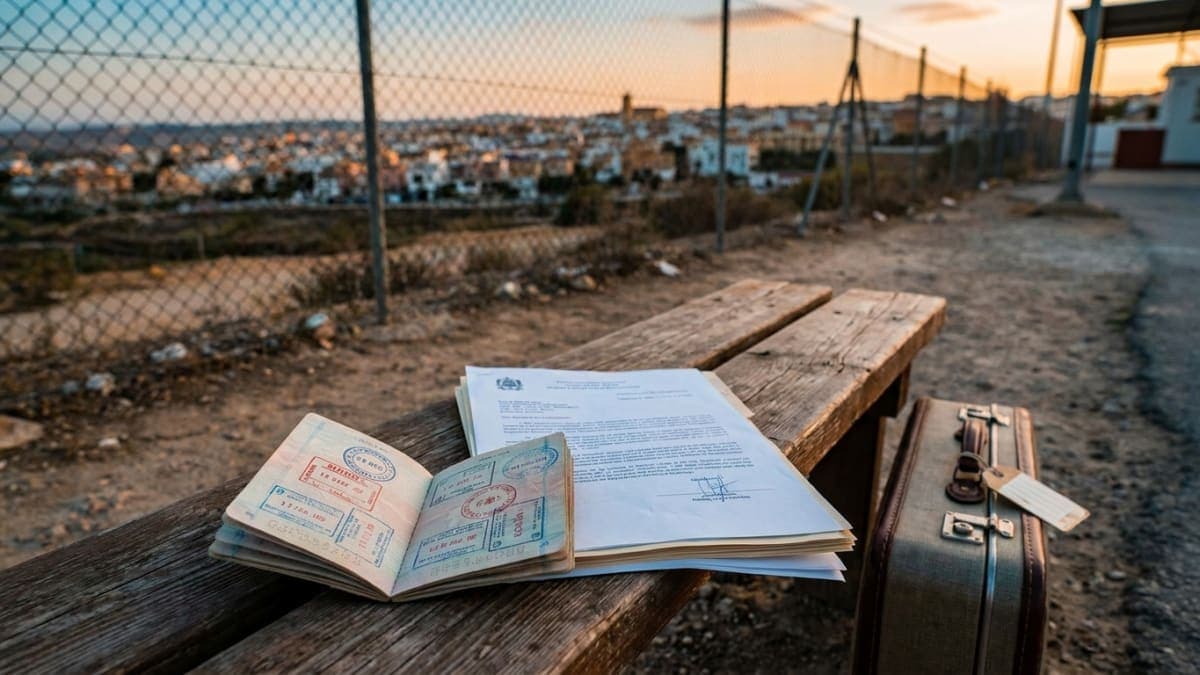
Between Morocco and Spain, children are rights-holders—not immigration files
Every year, Moroccan children attempt the journey towards Spain by sea, through border crossings or by hiding under trucks and inside port infrastructure. Some reach mainland Andalusia. Others are intercepted in Ceuta or Melilla, the two Spanish-administered cities known in Morocco as Sebta and Melilla. Behind the expression unaccompanied minor lies a more difficult reality: adolescents travelling without a parent, children who have broken contact with their families, victims of trafficking, young people escaping domestic violence and, in many cases, minors driven by poverty and an idealised image of Europe.
The May 2021 Ceuta crisis exposed the legal and human stakes with particular brutality. Around 8,000 people entered Ceuta over a very short period, including a substantial number of children. Subsequent attempts to return groups of minors to Morocco triggered litigation, criticism from the Spanish Defensor del Pueblo, and interventions by child-protection organisations. Spanish courts ultimately made the central point unmistakable: political understandings between Madrid and Rabat cannot replace the individual procedure required for each child.
The debate remains highly sensitive. Moroccan trade-union and civil-society voices, including the Organisation Démocratique du Travail, have opposed collective or accelerated returns from Sebta where no genuine best-interests assessment is carried out. That position is not merely political. It is firmly grounded in the UN Convention on the Rights of the Child, Spanish immigration law and the bilateral framework itself.
Concretely, an unaccompanied Moroccan child intercepted in Ceuta cannot lawfully be treated as an adult irregular migrant and pushed back across the border. The child must be identified, placed under protection, heard in an age-appropriate manner and assisted by professionals. Any eventual return must be individualised, safe and compatible with the child’s best interests.
The essential rule: irregular entry does not cancel childhood. A child may have crossed a border without authorisation, but remains entitled to protection, education, healthcare, legal assistance and an individual decision.
The Strait of Gibraltar as a legal border
A minor travelling unaccompanied across the Strait of Gibraltar moves between two legal systems, but also within a dense network of international obligations. Moroccan family law determines identity, parental representation, guardianship and kafala. Spanish law governs immediate protection once the child is on Spanish territory. European Union law and international conventions restrict removal and require effective remedies.
The texts say one thing; the terrain sometimes says another. Families often receive fragmented information. One authority says that the child is in a protection centre, another says the age is uncertain, while the consulate may still be waiting for identification documents. Those who handle these cases in emergency conditions know that the first days matter enormously.
Who legally qualifies as an unaccompanied minor?
Moroccan law: majority at 18, but no complete migration status
Under Article 209 of the Moroccan Family Code, or Moudawwana, the age of legal majority is 18 complete Gregorian years. This corresponds to Article 1 of the UN Convention on the Rights of the Child, which defines a child as every human being below 18 unless majority is attained earlier under the applicable law.
Morocco’s principal immigration statute is Law No. 02-03 on the entry and residence of foreign nationals, irregular emigration and immigration, promulgated by Dahir No. 1-03-196 of 11 November 2003. A recurring citation error should be corrected here: Dahir No. 1-02-172 of 13 June 2002 concerns Law No. 15-01 on the kafala of abandoned children, not Law No. 02-03.
Law No. 02-03 contains certain safeguards relevant to minors, particularly in removal and detention matters, but it does not establish a coherent statutory status for an unaccompanied foreign minor in Morocco. Nor does it organise, in sufficient detail, the protection of Moroccan children returning from Europe. This legislative gap complicates the protection of migrant children in Morocco and leaves much of the practical response to prosecutors, juvenile judges, local authorities, Entraide Nationale and associations.
The Spanish and European definition
European legislation generally describes an unaccompanied minor as a person under 18 who enters the territory of a Member State without an adult responsible for him or her, or who is left unaccompanied after entering. This approach appears, among other instruments, in Article 2(e) of Directive 2013/33/EU.
Spain uses the administrative expression menor extranjero no acompañado, commonly abbreviated as MENA, although many child-rights organisations avoid the acronym because it has acquired a stigmatising political meaning. The decisive questions are simple: is the person under 18, and is a legally responsible adult effectively accompanying and protecting the child?
A telephone number for a parent in Tangier does not mean the child is accompanied in Ceuta. Nor does the existence of relatives in Madrid automatically remove the child from public protection. Spanish authorities must verify the relationship, the adult’s legal capacity and whether placement with that person is safe.
Harraga minors: irregular movement does not extinguish protection
The word harraga is commonly used in North Africa for people who migrate without the required documents. Legally, however, a harraga minor under international law remains a child. The administrative irregularity of the journey cannot justify punishment, arbitrary detention or summary removal.
Moroccan Law No. 02-03 criminalises aspects of unauthorised emigration, particularly under Article 50. Applying punitive migration logic to a child nevertheless remains subject to juvenile justice guarantees, the child’s age, vulnerability and best interests. In practice, protection should take precedence over prosecution.
When age is disputed
If reliable Moroccan civil-status documents establish that the person is under 18, those documents should not be casually displaced by a medical estimate. In Spain, age-determination procedures operate under Article 35 of Organic Law 4/2000 and the implementing framework of Royal Decree 557/2011. The Public Prosecutor’s Office plays a central role where age cannot be established with certainty.
Bone X-rays and dental examinations remain controversial. They produce ranges, not exact birthdays, and margins of error can be significant, particularly for adolescents aged 16 or 17. The UN Committee on the Rights of the Child has repeatedly criticised overreliance on medical tests and insists on a multidisciplinary assessment, procedural safeguards and the benefit of the doubt.
The international framework binding Morocco and Spain
The Convention on the Rights of the Child
Morocco ratified the Convention on the Rights of the Child in 1993. Spain is also bound by it. Its most frequently cited provision is Article 3(1):
“In all actions concerning children, whether undertaken by public or private social welfare institutions, courts of law, administrative authorities or legislative bodies, the best interests of the child shall be a primary consideration.”
This obligation is not a diplomatic slogan. Before returning a Moroccan child, the authorities must investigate the child’s family situation, safety, health, schooling, exposure to violence or exploitation and the actual reception arrangements in Morocco. A form stating that the family has been located is not enough if nobody has assessed whether returning to that family would expose the child to abuse, homelessness or renewed trafficking.
Article 12 protects the child’s right to be heard. Article 22 concerns children seeking refugee status. Article 37 prohibits arbitrary deprivation of liberty and requires detention to be used only as a last resort and for the shortest appropriate period. Article 20 protects children deprived of their family environment.
The 1996 Hague Child Protection Convention
Contrary to a claim sometimes repeated in commentary, Morocco is a party to the 1996 Hague Convention on Jurisdiction, Applicable Law, Recognition, Enforcement and Co-operation in Respect of Parental Responsibility and Measures for the Protection of Children. Spain is also bound by it. The Convention can facilitate cooperation and recognition of protective measures across borders.
It does not, however, convert Moroccan kafala into Spanish adoption. Nor does it eliminate the need to examine the exact legal effects of a Moroccan guardianship or kafala order. Recognition, parental responsibility, immigration status and nationality remain distinct questions.
The 2007 Morocco–Spain agreement on unaccompanied minors
The bilateral agreement signed on 6 March 2007 addresses prevention, protection and the concerted return of unaccompanied minors. It entered into force after the completion of the relevant procedures and was published in Spain’s official gazette. Its logic rests on cooperation between the two states: identification, exchange of information, family tracing, protection in Spain and, where appropriate, assisted return and reintegration in Morocco.
In theory, the agreement does not authorise collective expulsions. A lawful process requires several stages:
- Identification of the child and verification of age and nationality.
- Immediate child-protection measures in Spain.
- Notification and consular cooperation with Moroccan authorities.
- Family tracing and a genuine assessment of the proposed reception environment.
- An individual determination that return serves the child’s best interests.
- An appealable decision, with legal assistance and an opportunity for the child to be heard.
- A safe, accompanied transfer and effective follow-up in Morocco.
The weakness of the agreement lies less in its vocabulary than in its enforcement. It contains no sufficiently robust independent monitoring mechanism. Civil-society organisations have therefore warned that the phrase concerted return can become a polite label for forced return. The ODT’s opposition to accelerated removals should be understood in that context: protection cannot be presumed merely because two governments agree.
The Franco-Moroccan judicial conventions
The Franco-Moroccan judicial cooperation instruments are sometimes invoked in family cases involving custody, service of documents or recognition of judgments. They do not govern returns from Spain and should not be presented as a legal basis for Spanish action. Their relevance is comparative and indirect: they show how bilateral judicial cooperation can support cross-border family protection when procedures for recognition and enforcement are clearly defined.
Rights of an unaccompanied Moroccan minor in Spain
Immediate protection and public guardianship
Article 35 of Spanish Organic Law 4/2000 is the central immigration provision. When the security services encounter an undocumented person whose minority cannot be established with certainty, the case must be referred to the Public Prosecutor so that age can be determined. If the person is a minor, child-protection services must intervene.
In Ceuta or Melilla, the autonomous city’s competent child-protection authority assumes responsibility. In Andalusia, this role is exercised through the regional child-protection system of the Junta de Andalucía. Under the Spanish Civil Code, a minor in a situation of abandonment may come under public guardianship by operation of law. This is not criminal detention; it is a protective measure, although restrictive conditions can in practice resemble confinement and may be challenged.
The child is entitled to identity documentation, healthcare, education, interpretation, contact with family where safe, and legal information. The authorities must also examine trafficking indicators. A child controlled by an adult smuggling network should not be treated merely as an immigration offender.
Can Spain immediately return the child to Morocco?
No—not lawfully through an automatic pushback. Article 35 does permit repatriation after an individual procedure, but the stated purpose must be family reunification or placement with appropriate Moroccan protection services, and only where the child’s best interests are respected.
The attempted return of dozens of children from Ceuta in August 2021 became a defining case. Spanish courts suspended aspects of the operation because the children had not received the required individual procedures. In Judgment 36/2023, the Spanish Constitutional Court held that the failure to carry out the legally required individual process violated the minors’ right to effective judicial protection. The Spanish Supreme Court, in its February 2024 ruling concerning the Ceuta returns, likewise confirmed that the collective handling of the minors had not complied with the governing legal safeguards.
These cases matter because they reject the argument that the 2007 bilateral agreement is self-executing authority for a bus transfer. It is not. Spanish domestic procedure, judicial review and the best-interests principle remain fully applicable.
A return is not lawful merely because Morocco agrees to receive the child. Spain must first establish, child by child, that the proposed return is legal, safe and in that particular child’s best interests.
Non-refoulement and protection against danger
Article 33 of the 1951 Refugee Convention prohibits returning a refugee to a territory where life or freedom would be threatened for a Convention reason. Article 19 of the EU Charter of Fundamental Rights prohibits collective expulsions and protects against removal to a serious risk of torture or inhuman or degrading treatment.
Not every Moroccan minor qualifies as a refugee. Poverty, unemployment or the hope of studying in Europe do not, by themselves, establish persecution. But a child threatened because of political activity, religion, sexual orientation, gender identity, family-based violence, forced marriage, trafficking or membership of a particular social group may have a protection claim. Each case must be examined on its own evidence.
Education, healthcare and family contact
A child in Spain has a right to basic education regardless of immigration status. Minors also have access to healthcare through the Spanish public health system. Protection centres must facilitate appropriate communication with family unless contact would expose the child to danger or interfere with a trafficking investigation.
Families should keep a written record of every attempted call, the name of the centre, officials contacted and any refusal of communication. In cross-border cases, small factual details later become crucial evidence.
Asylum procedure for an isolated minor in Spain
Can a Moroccan child apply for asylum?
Yes. Spanish Law 12/2009 regulates asylum and subsidiary protection, while Article 48 addresses unaccompanied minors and other vulnerable persons. The child’s legal representative should assist with the claim, but urgent protection concerns must not be ignored merely because formal guardianship is still being arranged.
The application may be initiated through the competent police authorities or asylum services, with involvement from the Oficina de Asilo y Refugio. In Ceuta and Melilla, practical access can be slow, making early intervention by a lawyer essential. The statutory framework envisages resolution within six months in the ordinary procedure, but real cases frequently remain pending for a year or longer.
Refugee status versus subsidiary protection
Refugee status requires a well-founded fear of persecution linked to race, religion, nationality, political opinion or membership of a particular social group. Subsidiary protection may apply where the refugee definition is not met but return would expose the child to a real risk of serious harm.
A weak application based only on economic hardship can damage credibility. The lawyer should explore the child’s history carefully and without coaching: domestic abuse, street exploitation, trafficking, threats, sexual violence, forced criminal activity and psychological vulnerability may be legally relevant. The child must be interviewed in a language he or she genuinely understands.
If your child calls from Ceuta or Melilla: ask for the exact name of the centre, the child’s registration number, the name of the educator or police unit, whether an age test has been ordered, and whether any paper has been signed. Do not tell the child to invent an asylum story. Contact a Spanish lawyer and the Moroccan consular service immediately, ideally within the first 48 to 72 hours.
Legal costs and legal aid in Spain
Private fees for a cross-border child-protection or asylum case may range roughly from €1,500 to €4,000, depending on hearings, appeals and travel. These figures are market estimates, not regulated tariffs. A child without resources may qualify for Spanish legal aid and assistance through the relevant bar association. NGOs such as CEAR, ACCEM, Save the Children and specialised local organisations may also provide orientation, subject to capacity.
Lawful repatriation to Morocco and the reality after return
What a legal return should look like
A lawful repatriation of an unaccompanied minor to Morocco requires more than nationality confirmation. Spanish authorities should hear the child, obtain a social assessment, locate and assess the family, consult child-protection authorities and issue an individual decision open to challenge. The transfer should be accompanied and the receiving person or institution clearly identified.
Parents are not entitled to demand automatic return if credible evidence suggests that returning home would endanger the child. Conversely, public guardianship in Spain should not be prolonged merely because administrative departments fail to exchange documents.
Reception structures in Morocco
Morocco’s Entraide Nationale, created by the Dahir of 26 October 1972, participates in social assistance and may be involved in reception and referral. Establishments providing social protection are regulated by Law No. 14-05 on the conditions for opening and managing social welfare institutions. Prosecutors, juvenile courts, local authorities and associations may also intervene.
Yet capacity differs sharply from one region to another. Tangier has more migration-focused civil-society experience than many inland provinces, but sustained psychological, educational and family support is still inconsistent. A child returned after months in Spain may be handed to relatives without any serious plan addressing school reintegration, debt to smugglers, violence or the risk of another crossing.
Practitioners in northern Morocco have described cases in which a family received only a last-minute telephone call before the child’s arrival. Whether every reported account can be independently verified is another matter, but the recurring pattern is credible: administrative transfer is treated as the end of the file when it should mark the start of reintegration work.
What to do after an irregular return
If a child has been sent back without an individual procedure, first secure medical and psychological care. Record the date, location, transport method, names or descriptions of officials, documents signed, injuries, missing belongings and anything the child remembers. Preserve screenshots and call logs.
A Spanish lawyer can examine urgent remedies, administrative litigation, constitutional protection and, after exhaustion of effective domestic remedies, a possible application to the European Court of Human Rights. In Morocco, organisations such as GADEM and migration-support associations can help document the return and direct the family to services. Complaints should be based on verifiable facts, not only public statements.
The Moroccan lawyer’s role in a Spain-based case
What counsel in Morocco can do
A Moroccan lawyer cannot represent the child before a Spanish court unless also authorised to practise there. The lawyer can nevertheless perform essential work: obtain civil-status records, establish parentage or legal representation, prepare notarised powers of attorney, contact consular authorities, seize the competent Moroccan court and coordinate with Spanish counsel.
The family should normally gather:
- a recent full or summary birth certificate;
- the family record book;
- copies of the parents’ national identity cards;
- proof of residence and contact details;
- school and medical records where relevant;
- any police report concerning disappearance;
- the kafala judgment and implementation documents, if applicable;
- evidence concerning violence, threats or family vulnerability.
Under Article 54 of the Family Code, the state, public prosecution and other competent bodies have responsibilities concerning the protection of children’s rights. Questions of legal representation and testamentary or court-appointed guardianship are addressed in Articles 229 and following. Depending on the case, an application may be filed before the family section of the competent court of first instance, while the Public Prosecutor may be alerted where the child is in danger.
Cross-border coordination
The effective model is a two-lawyer team: a Moroccan lawyer for identity, family law and local judicial documents, and a Spanish lawyer for guardianship, immigration, asylum and appeals. A lawyer specialising in immigration law in Tangier may coordinate with counsel in Ceuta, while a family lawyer in Tétouan handling kafala matters can obtain an urgently reasoned order from the Moroccan family court.
In one type of case repeatedly seen by practitioners, a child under Moroccan kafala arrives with photographs of the judgment on a telephone but no certified copy, apostille or proof that the kafil may exercise the relevant protective powers abroad. Spanish services then classify the child as unaccompanied while verification takes place. Weeks are lost over a problem that proper documentary preparation could have reduced.
Fees, timeframes and legal aid in Morocco
Fees of approximately 3,000 to 8,000 Moroccan dirhams are common for document preparation and initial cross-border coordination, but complex litigation may cost more. There is no universal tariff for this work; fees should be agreed in writing, including translation, apostille, bailiff and travel expenses.
Obtaining civil-status documents may take days where records are digitised and considerably longer where corrections are required. A court application can take several weeks or months. Consular verification commonly adds further delay. Any promise of a guaranteed result within 48 hours should be treated with caution.
Moroccan judicial assistance is not accurately summarised as being created solely by Law No. 42-10. The system rests on older judicial-assistance rules, procedural provisions and the legislation governing the legal profession. Eligibility and practical availability should be checked with the competent court’s legal-aid office and the local bar. Families may consult information on accessing legal aid in Morocco.
Kafala in Spain: protection without filiation
What Moroccan kafala does—and does not do
Moroccan kafala for abandoned children is governed principally by Law No. 15-01, promulgated by Dahir No. 1-02-172 of 13 June 2002. It creates a duty to care for, educate and protect a child. It does not create adoptive filiation, does not erase the child’s original lineage and does not automatically confer the kafil’s surname or nationality.
This distinction matters because Spain’s legal categories of parenthood, guardianship, foster care and adoption do not correspond perfectly to kafala. Spanish authorities may recognise protective effects without treating the kafil as an adoptive parent.
European and Spanish recognition
In Case C-129/18, SM v Entry Clearance Officer, the Court of Justice of the European Union held that a child placed under Algerian kafala was not automatically a direct descendant for EU free-movement law, but could fall within the category of another family member whose entry and residence must be facilitated after a detailed examination of the child’s best interests. Although the case concerned Algerian kafala and UK proceedings, its reasoning is highly relevant to European treatment of kafala.
Spanish courts and consulates examine Moroccan kafala according to the legal purpose involved. Recognition for residence or family reunification is possible in appropriate circumstances, but it is not automatic and does not transform kafala into adoption. Claims about a single Spanish Supreme Court judgment supposedly granting general recognition should therefore be treated cautiously: outcomes depend on the immigration route, authenticity of the order, actual dependency and best interests.
Practical precautions
Before travel or a visa application, obtain a complete certified copy of the kafala judgment, proof of enforceability, authorisations concerning travel and residence, and any subsequent guardianship orders. Documents intended for Spain should generally be apostilled where applicable and translated by a sworn translator accepted by Spanish authorities.
If a child under kafala reaches Spain alone, Spanish services may still consider the child unaccompanied until the kafil’s legal authority and ability to assume care are verified. A specific Moroccan judicial order can be far more useful than a general certificate. Families dealing with this issue should consult a detailed resource on Moroccan kafala and international recognition.
Reception centres in Ceuta and Melilla
Child-protection centres are not CETIs
The CETI, or Temporary Stay Centre for Immigrants, is designed primarily for adult migrants and families in the migration system. An identified unaccompanied child should be referred to a dedicated child-protection resource, not housed indefinitely in an adult reception environment.
Ceuta and Melilla have repeatedly faced sharp fluctuations in arrivals. Official and oversight reports during 2021–2023 described overcrowding and pressure on staffing, schooling and mental-health support. Exact occupancy changes rapidly, so figures such as roughly 300 minors at a given point in Ceuta should be read as a snapshot, not a permanent capacity figure.
The Defensor del Pueblo has monitored age assessment, reception conditions, documentation and the consequences of overcrowding. Amnesty International and child-rights organisations have also criticised inadequate safeguards and the risk that emergency facilities become long-term accommodation.
Rights inside the centre
The child must receive safe accommodation, adequate food, healthcare, education, interpretation and information about legal status. Discipline cannot amount to degrading treatment or arbitrary isolation. Staff must assess mental health, trafficking indicators and exposure to violence.
The child should be able to communicate with family, a lawyer and relevant protection bodies. The Moroccan consulate can assist with nationality and civil-status verification, but it cannot override Spanish guardianship or order removal from Spanish territory. Spain remains responsible for the child while the child is under its jurisdiction.
What families should do in the first 48 hours
- Confirm the location. Obtain the centre’s full name, address, telephone number and the child’s reference number.
- Ask whether minority is accepted. If age is disputed, immediately send the birth certificate, passport or national identity documents through counsel.
- Do not sign blindly. Parents should request a translation of any declaration or consent form relating to return.
- Contact Spanish counsel. The lawyer should verify guardianship, age proceedings, asylum screening and any planned repatriation.
- Notify Moroccan consular services. Provide accurate identity documents, but request that no return occur without an individual best-interests assessment.
- Document vulnerabilities. Send school records, medical reports and evidence of family circumstances to the lawyer, not through informal social-media channels.
- Preserve communication. Keep call logs, messages and names of every authority contacted.
Attention, however: parents should not pressure the child to disappear from the centre or travel clandestinely to another city. Doing so can expose the child to trafficking, exploitation and loss of contact with legal assistance.
What must change in Morocco–Spain cooperation?
Morocco needs a specific and coherent statutory framework for unaccompanied children, both Moroccan children returning from abroad and foreign children found on Moroccan territory. Law No. 02-03 was not designed as a modern child-protection code. The country also needs stronger coordination between prosecutors, family courts, Entraide Nationale, education services, health authorities and civil society.
The 2007 bilateral agreement should be supplemented by binding procedural guarantees: independent representation for each child, written best-interests decisions, access to the file, suspensive appeals, verified reception plans and monitoring for at least several months after return. Aggregate statistics on proposed, suspended and completed returns should be published.
Spain, for its part, must resist the temptation to manage pressure in Ceuta and Melilla through improvised emergency returns. The Constitutional Court and Supreme Court have already made the legal position clear. Border pressure does not suspend the rule of law.
A permanent Morocco–Spain family mediation and child-protection mechanism would be more useful than periodic diplomatic announcements. It should include bilingual social workers, consular representatives, independent lawyers and child-protection specialists. The child’s own views must be recorded—not presumed.
Conclusion: the child comes before the border
An unaccompanied Moroccan minor in Spain cannot legally be reduced to an irregular entry statistic. The child is protected by Spanish law, Moroccan family law, European guarantees and the Convention on the Rights of the Child. Immediate pushback is unlawful; repatriation requires an individual process, effective legal safeguards and a return plan genuinely serving the child’s interests.
For families, speed and accuracy matter. Gather documents, identify the centre, contact both Moroccan and Spanish counsel, and challenge any attempt to substitute collective arrangements for an individual decision. For lawyers and associations, these cases demand cross-border cooperation and intellectual honesty. Sometimes return is the safest outcome. Sometimes it plainly is not.
The governing principle is neither Moroccan nor Spanish. It is universal: the best interests of the child must come before migration control, diplomatic convenience and the politics of the border.

