
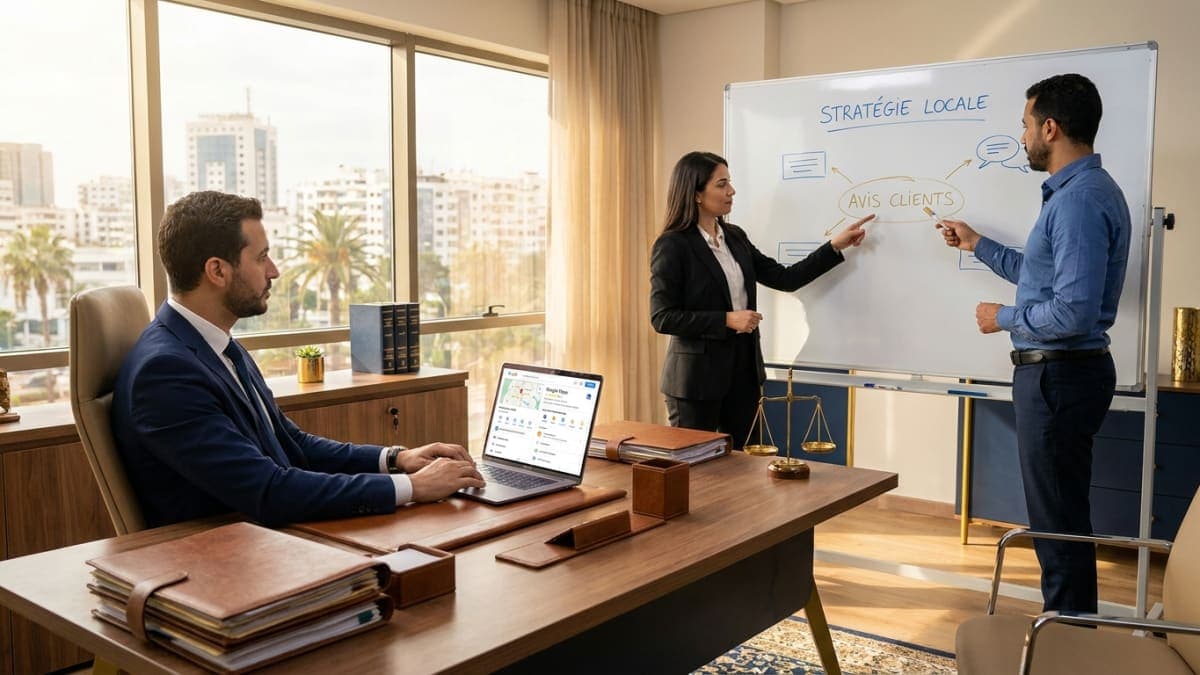
Does your law firm really exist on Google?
A colleague at the Casablanca Bar once discovered his digital invisibility almost by accident. After an appointment, a client told him: “Maître, I had difficulty finding your office on Google Maps.” We searched together. His firm, established for more than fifteen years and located a few streets from the Commercial Court, was nowhere near the first results. A younger competitor with a complete profile, recent photographs and several client reviews occupied the prominent positions.
This is now a familiar scene. Before making a telephone call, a litigant will search for “family lawyer Rabat”, “criminal lawyer Tangier” or “Google Maps lawyer Casablanca”. Even when the enquiry originates from a recommendation, the prospective client often verifies the lawyer's address, practice areas, opening hours and reputation online. The recommendation opens the door; Google confirms—or weakens—the initial confidence.
Two complementary tools deserve to be distinguished. A Google Business Profile, formerly Google My Business, controls much of what appears in Google Search and Google Maps. A specialist directory offers a different form of visibility, organised around the profession itself. For example, the lawyer space on AvocatLib allows a Moroccan practitioner to present a verified profile by city, Bar and practice area, with direct contact and online appointment functions. One tool does not replace the other.
Everything discussed below must remain within the boundaries of Law No. 28-08 governing the legal profession, the Unified Internal Regulations of Moroccan Bars and the decisions of your own Bar Council. Visibility is not, by itself, solicitation. The difficulty lies in the wording, the method and the promises made. A factual profile is professional information; aggressive canvassing, comparative advertising or a guaranteed outcome is something entirely different.
The field reality: online invisibility has a commercial cost
No serious colleague would reduce the profession to a Google ranking. Our work is built on competence, independence, confidentiality and trust. Yet rent, staff salaries, CNSS-related obligations, software, travel and tax charges continue whether or not a cabinet is visible. Leaving an incorrect address or an unclaimed profile online is therefore not professional restraint. It is poor management of public information about the firm.
What prospective clients check before calling
In practice, users look for consistency. Does the name correspond to the sign outside the office? Is the lawyer registered with the stated Bar? Does the telephone number work? Are the office hours credible? Do the practice areas correspond to the user's problem? Client reviews then provide secondary reassurance, particularly when they discuss punctuality, clarity and responsiveness rather than the confidential merits of a case.
1. The ethical framework under Law No. 28-08
Article 36: professional information is not commercial promotion
Law No. 28-08 was promulgated by Dahir No. 1-08-101 of 20 October 2008 and published in Official Bulletin No. 5680 of 6 November 2008. Article 36 is the central statutory reference when considering a lawyer's communication and electronic presence. It must be read with the applicable professional rules and the supervisory powers of the Bâtonnier and Bar Council.
Article 36 of Law No. 28-08: the provision governing professional communication does not create a general right to commercial advertising. Its practical effect is to permit controlled, dignified professional information while excluding methods inconsistent with the honour and traditions of the profession.
A Google Business Profile can ordinarily remain on the lawful side of that distinction when it gives functional information: the lawyer's professional name, Bar membership, office address, telephone number, opening hours, languages and genuine areas of practice. In clear terms, it tells the public who you are, where you practise and how you may be contacted.
Problems begin with expressions such as “the best lawyer in Casablanca”, “100% success”, “divorce guaranteed in one month” or “lower fees than other firms”. These statements are unverifiable, comparative or result-oriented. They sit uneasily with the dignity of the profession and may amount to prohibited commercial promotion. Paying a third party to send unsolicited WhatsApp messages or call accident victims would be more serious still: that is active solicitation, not local SEO for a Moroccan law firm.
The Unified Internal Regulations and the role of the Bar Council
The Unified Internal Regulations of Moroccan Bars add the professional detail that a Google help page cannot provide. They must also be read alongside local decisions and established practice. Casablanca, Rabat, Tangier, Marrakech, Fez, Agadir and Oujda do not operate outside the national statute, but a Bar Council may assess a new communication method through its own disciplinary practice.
Where the wording, use of a trade name, photographs, sponsored placement or review campaign creates doubt, write to the Bâtonnier or seek guidance from your Conseil de l'Ordre. The Association des Barreaux d'Avocats du Maroc, commonly referred to as the ABAM, is a useful institutional reference, but it does not replace the authority of the Bar to which you belong.
The red lines: solicitation, comparison and promises
A useful internal test is straightforward. Would the same information appear appropriate on the firm's letterhead or at the entrance to the office? A neutral statement that you practise commercial law and debt recovery before the courts of Casablanca is informational. A message targeted at a named company immediately after learning that it has been sued is solicitation. A phrase comparing your win rate or fees with another colleague's practice is comparative advertising.
Client reviews introduce a grey area. A lawyer may explain, discreetly and without pressure, that a review function exists. The lawyer should not purchase reviews, draft praise for the client, organise a competition, or offer a fee reduction in return. The ethical character of the process depends as much on the method as on the published words.
2. Creating and optimising a Google Business Profile for a Moroccan lawyer
Step 1: create or claim the establishment profile
Start from Google's official Business Profile interface and search for the exact professional name already shown on Maps. Do not create a duplicate before checking whether Google or a previous employee has generated an existing listing. If it exists, use the ownership request procedure. If not, create the profile and enter the real office address.
The business name should be the name genuinely used by the firm. Do not add a sequence of keywords such as “Lawyer Casablanca Divorce Criminal Business Best Attorney” unless those words form part of the lawful, established name—which, in practice, they should not. Google's own rules prohibit unnecessary additions, and the result would hardly satisfy professional dignity.
Choose the most accurate primary category, normally the local equivalent of Lawyer, Attorney or an available specialist category. The primary category influences searches and Google Maps display, so a litigation practice should not select a category merely because it appears commercially attractive. Secondary categories may be added only where they describe real services.
Step 2: complete every field strategically
Google currently limits the business description to approximately 750 characters. Use that space to write naturally, not to stack keywords. A sound description might read:
“Law firm registered with the Casablanca Bar, advising and representing businesses in commercial disputes, debt recovery and contract matters. The firm acts before the courts of Casablanca and provides consultations in Arabic and French, by appointment.”
This wording integrates the city, Bar and practice areas while remaining factual. It is far more credible than repeating “business lawyer Casablanca” ten times. Google may disregard artificial language, and a prospective client certainly will.
Check the displayed telephone number from another device. Add the firm's website, if any, and use a professional email address on the firm's domain. At the same time, you may create your profile on AvocatLib so that your Bar membership and practice areas appear in a structured legal directory. This creates another coherent point of reference rather than leaving Google as the sole source of information about the firm.
Step 3: photographs, hours and practical attributes
Add a clear photograph of the façade or building entrance. It helps clients locate the office and may support Google's verification process. Interior photographs should show a clean reception area or meeting room without exposing files, client names, hearing notices, court documents or computer screens. A formal portrait is acceptable; photographs from a family dinner or beach holiday plainly are not.
Opening hours require attention. Update them during Ramadan, summer judicial recess periods and national holidays. If consultations are strictly by appointment, say so. Attributes such as wheelchair accessibility, appointment availability and languages spoken can be useful. Arabic, French, English, Darija and, where genuinely available, Amazigh may determine whether a hesitant client makes contact.
A lawyer who frequently appears before the Commercial Court of Casablanca or the Court of Appeal of Rabat should not create fictitious branches in those cities. A service area is not a substitute for a real office. Virtual offices, borrowed addresses and multiple keyword-oriented listings expose the profile to suspension and may create a professional issue with the Bar.
Step 4: verification and realistic timing
Google determines the verification method. Depending on the profile, it may offer a telephone call, email, recorded video, live video or postal card. Telephone or video verification can take minutes once accepted. Postal verification commonly requires approximately five to fourteen days, although Moroccan delivery and Google's internal review may extend that period.
For video verification, be prepared to show the street, permanent signage, access to the premises and evidence that you manage the establishment. Avoid filming confidential material. A new profile may appear within a few days, but completion and verification do not guarantee immediate Local Pack placement. In a competitive market such as Casablanca or Rabat, four to eight weeks is a reasonable observation period, not a promised ranking deadline.
3. Google client reviews: value, method and ethical precautions
Why reviews matter to a law firm
Google explains that local results are primarily influenced by relevance, distance and prominence. Review count and score may contribute to prominence, alongside links, citations and general web presence. A firm with twelve authentic reviews and a strong 4.8 rating may therefore appear more reassuring—and sometimes more visible—than a firm with none. It will not automatically outrank every older practice, because proximity, category, query relevance and website authority also matter.
The more practical point is human. A litigant cannot evaluate your legal submissions before instructing you. He or she can understand whether previous clients found the explanations clear, appointments punctual and communication professional. These are legitimate trust indicators, provided reviews remain authentic.
How to obtain client reviews ethically
The least intrusive moment is the administrative closure of a file. When sending the final statement, returning documents or confirming the end of the mandate, you may mention that the firm has a Google review page and that an honest review can help other people assess its service. Say it once. Do not chase the client repeatedly and do not condition any service on publication.
A small QR code on a closing letter can lead directly to the review page. The accompanying sentence should remain neutral: “If you wish, you may share your experience of the firm's service through this link. Please avoid including confidential details about your matter.” This is information, not pressure.
Never offer a discount, gift, expedited service or other consideration. Do not ask only those clients whom you expect to award five stars, and never use staff or relatives to manufacture reviews. Apart from Google's prohibition of fake engagement, such conduct would be difficult to reconcile with Article 36 and professional dignity.
A complementary channel may also be useful. Clients can submit feedback through a structured professional profile on AvocatLib, where reviews are connected to the legal directory environment. Whether feedback appears on Google or another platform, the same ethical discipline applies: no consideration, no scripting and no disclosure of the case.
What a client review should and should not contain
A client may legitimately discuss reception, punctuality, accessibility, clarity of fee explanations and the overall quality of communication. The client controls his or her own words, but the firm can encourage discretion. Names of opposing parties, minor children, criminal allegations, medical details, settlement figures and extracts from correspondence should stay offline.
The lawyer's obligation is stricter than the client's discretion. Even where a client publicly discloses the entire history, that does not release the lawyer from professional secrecy. Nor does an inaccurate account create a right to publish the missing confidential facts in self-defence.
Responding to positive reviews
Keep the response brief: “Thank you for taking the time to share your feedback. We appreciate your confidence in the firm.” Avoid confirming that the reviewer was a client, identifying the type of case or celebrating a specific outcome. A generic response may appear restrained, but that restraint is precisely what professional secrecy requires.
4. Managing negative, false or abusive reviews
A negative review is not necessarily a disaster
A Marrakech colleague once received a one-star review after an unfavourable judgment. His first instinct was to answer point by point: the evidence produced, adjournments, the court's reasoning and the client's unpaid invoices. Fortunately, he waited. The next morning he published a neutral response proposing a direct discussion without confirming the existence or nature of the file. Several months later, a new client specifically mentioned that measured reply as a reason for trusting him.
A page containing only perfect praise can look artificial. One critical review followed by a calm, professional answer often says more about the lawyer's judgement than twenty formulaic five-star comments.
The four-stage response protocol
- Acknowledge the feedback without accepting the alleged facts. Do not write that the client is correct, but do not dismiss the concern aggressively.
- Express regret about the experience, not an unadmitted fault. “We regret that your experience did not meet your expectations” is different from admitting negligence.
- Recall a general professional commitment. Refer to clarity, availability or diligent handling in general terms.
- Move the exchange offline. Offer a telephone call or appointment through the firm's normal contact details.
“We acknowledge your comment and regret that your experience did not meet your expectations. Professional secrecy prevents us from discussing any individual situation publicly. Our firm remains committed to clear communication and diligent handling of every mandate. We invite you to contact the office directly so that the matter may be examined confidentially.”
Article 34: professional secrecy continues online
Article 34 of Law No. 28-08 establishes the lawyer's obligation of professional secrecy. That obligation applies to files, consultations, correspondence and information obtained through the professional relationship; a public review does not suspend it.
Do not identify the proceedings, the opposing party, the advice given, the amount of fees or the reason for withdrawal. Even the phrase “you were never our client” deserves caution: depending on the circumstances, it may reveal information about who did or did not consult the firm. When the response is sensitive, have another colleague read it before publication.
When a review is fake, defamatory or abusive
First preserve evidence: screenshots, profile URL, publication date, reviewer name and any associated exchanges. Then use Google's reporting function and select the most accurate ground, such as fake engagement, conflict of interest, harassment or prohibited personal information. A concise factual report is more effective than an emotional complaint.
If removal is refused and the author can be identified, a formal notice may request withdrawal and preservation of evidence. Litigation requires more care than the phrase “sue for defamation” suggests. Articles 442 and 443 of the Moroccan Penal Code define defamation and insult and address publicity mechanisms, while Articles 444 to 447 contain related rules and qualifications. Public statements may also engage Law No. 88-13 on Press and Publishing, including its provisions on defamation, depending on the author, medium and legal characterisation.
Territorial jurisdiction, limitation periods, proof of authorship and the special procedural rules must be checked before filing before the competent court of first instance. A criminal complaint is not automatically the best first step. In many cases, a documented removal request and a carefully drafted formal notice achieve more with less reputational exposure.
Specialist directories can reduce, though never eliminate, this risk. Profiles on AvocatLib benefit from platform moderation of reviews, unlike the more open Google environment where an unidentified account may post immediately. That does not justify suppressing genuine criticism; it provides a channel for examining obvious abuse.
5. Local SEO for Moroccan lawyers beyond Google Maps
Relevance, distance and prominence
Relevance asks whether the profile corresponds to the search. A completed “commercial lawyer” profile is more relevant to a commercial debt query than a generic listing. Distance measures the relationship between the searcher and the verified location. You cannot ethically or technically optimise your way around geography with fictitious offices. Prominence reflects what Google can establish about the practice from reviews, links, references and general online authority.
This explains why the Google Business Profile is only one component of local SEO for a lawyer in Morocco. A useful website, consistent professional directory entries, press references and genuine educational content reinforce one another.
NAP consistency: name, address and telephone
Audit the firm's NAP—name, address and telephone—across Google, the website, email footer, professional directories and social profiles. Use the same spelling and format whenever possible. “Boulevard Zerktouni” on one page, “Bd Zerktouni” on another and an old landline elsewhere can make the entity harder to reconcile, especially after an office move.
Consistency matters even more where Arabic and Latin transliterations differ. Choose stable versions while respecting the firm's legal identity. If the office relocates, update the website and major directory profiles before or at the same time as Google. Do not create a second profile simply because the address changed.
Professional directories as additional trust signals
A profile on a structured Moroccan legal directory such as AvocatLib can add a verified citation organised by city, Bar and practice area. It also gives litigants another way to confirm professional identity and request an appointment. The value is not a guaranteed ranking; it is the creation of a coherent, profession-specific reference that complements the firm's website, Google Business, LinkedIn and word-of-mouth referrals.
Consider a commercial lawyer registered in Fez. The lawyer maintains an accurate Google profile, a matching directory entry and publishes one careful monthly article about a practical local issue—for example, commercial lease disputes or enforcement before the competent courts. Each channel performs a different function: Maps establishes location, the directory confirms professional context and the article demonstrates legal understanding without promising a result.
Google Business publications and local content
Business Profile updates can address changes in opening hours, a general legislative development, a conference or an educational article. Avoid commenting on pending matters or publishing photographs taken inside a courtroom without checking applicable rules. A post such as “Key procedural points following a reform to commercial enforcement” is educational; “Contact us now to win your recovery case” is promotional and result-oriented.
One useful publication per month is sufficient for most small practices. Accuracy matters more than frequency. Cite official texts from the SGG, DGI, Ministry of Justice or relevant institution, and correct outdated posts when the law changes.
6. Fifteen actions to improve the firm's visibility this week
Five priorities that can be started in under two hours
- Create or claim the Google Business Profile. Check for duplicates before opening a new listing.
- Audit the NAP. Compare Google, the website, letterhead, email footer and existing directories.
- Add professional photographs and correct hours. Remove images exposing documents or clients.
- Write a factual 750-character description. Mention the Bar, city, languages and genuine practice areas naturally.
- Complete a verified profile on AvocatLib. Treat city-and-speciality directory visibility as a complementary foundation, not as a substitute for Google.
Five actions for the rest of the week
- Create a direct review link and QR code. Place it discreetly on a closing document, with a confidentiality reminder.
- Draft the first Google Business update. Choose a general legal development or practical office announcement.
- List the main professional citations. Identify incorrect, duplicate or obsolete directory entries.
- Review the website. Confirm that it states the correct Bar, office details and actual areas of practice.
- Create a Google Alert for the firm's name. Include common spelling variants to monitor the lawyer's digital reputation in Morocco.
Five long-term habits
- Reply to reviews within 48 hours where reasonably possible. Urgent anger is not a reason for an urgent answer; obtain a second reading first.
- Publish one useful profile update each month. Maintain a restrained editorial calendar.
- Update special hours before Ramadan, public holidays and summer recess.
- Ask a colleague to search the firm's name from another device. Personalised search results may conceal what the public actually sees.
- Conduct an annual digital ethics audit. Review descriptions, photographs, reviews, directory entries and Bar requirements.
7. Frequently asked questions
Is a Google Business Profile compatible with Moroccan lawyers' ethics?
Generally, yes, when it remains factual professional information under Article 36 of Law No. 28-08 and the applicable Bar rules. Name, Bar membership, office address, languages, hours and genuine practice areas are functional information. Solicitation, comparative claims and guarantees of results remain outside the acceptable line. Consult your Bar Council when a proposed communication goes beyond these basics.
How should a lawyer answer a negative Google review?
Acknowledge the comment, express regret that expectations were not met, recall the firm's general professional commitment and propose a confidential direct discussion. Do not confirm the matter or reveal the litigation, advice, correspondence or fees. Article 34 professional secrecy applies fully to public responses.
Why does my law firm not appear on Google Maps?
The profile may be unverified, suspended, duplicated or associated with inconsistent address information. Claim the correct listing, complete the required verification and align the firm's name, address and telephone across the website and directories. Allow several days for ordinary display and longer for competitive local searches.
Are there useful alternatives to Google for a Moroccan lawyer?
Yes. A professional website, LinkedIn, institutional references and specialist directories all create additional points of contact. The AvocatLib space for Moroccan lawyers provides a practical option for a profile structured by city, Bar and practice area, with direct contact and appointment tools. The strongest approach normally combines these channels rather than depending on a single platform.
Should VAT on legal fees appear on the Google profile?
No. The Business Profile is not the proper place to explain the taxation of fees. Legal services are generally subject to the standard 20% VAT rate under the current Moroccan General Tax Code, notably the rate rules in Article 98, subject to the practitioner's applicable tax position and future Finance Law amendments. VAT belongs in the fee arrangement and compliant invoices, not in keyword-oriented profile text.
Conclusion: online visibility is a legitimate cabinet investment
Digital visibility is no longer reserved for large Casablanca business firms. A sole practitioner in Agadir, Oujda, Fez or Tangier can maintain an accurate Google listing, collect authentic feedback with restraint and publish useful legal information without turning professional communication into canvassing.
Trust remains the true engine of legal search visibility. A coherent profile, genuine reviews, measured replies and strict observance of Article 34 and Article 36 build a reputation slowly but durably. No tool removes the need for competence, professional judgement or the confidence created in the first consultation.
If you wish to complement Google with a verified profile organised by city and practice area, you can register your Moroccan law practice on AvocatLib. Approach it as you would any sound cabinet investment: verify every statement, keep the information current and let professional credibility—not exaggerated promises—do the work.