
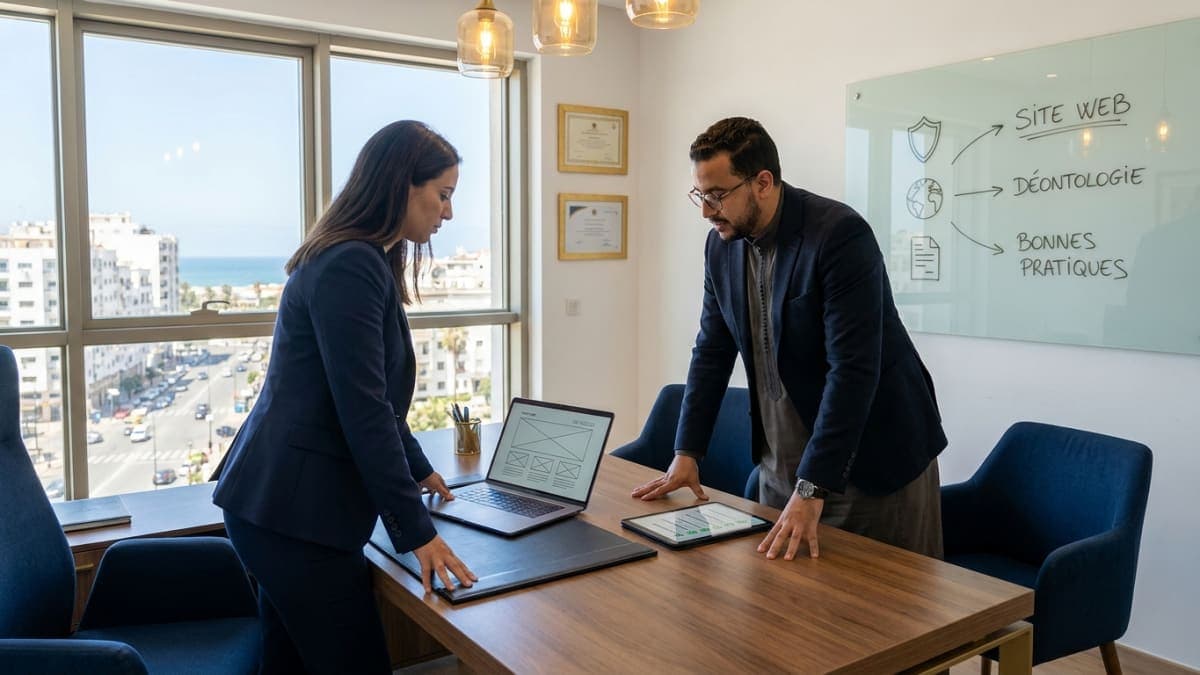
Law firm websites in Morocco: between professional caution and commercial necessity
An invisible law firm no longer exists in the eyes of prospective clients
A young colleague admitted to the Casablanca Bar in 2022 recently described a frustrating situation. His technical work was sound, his office was properly established and he had already handled several demanding commercial disputes before the Casablanca Commercial Court. Yet prospective clients regularly instructed another lawyer whose experience was more limited. The reason was not legal expertise. When clients searched online, they found the other lawyer's clear website, office address, practice areas and professional profile. Our colleague's name, by contrast, led almost nowhere.
This is now part of the daily reality of legal practice in Morocco. A company director looking for counsel rarely relies exclusively on a personal introduction. A spouse facing divorce may search for “family lawyer Casablanca”, while an employer will type “employment lawyer Rabat” or “labour dispute lawyer Tangier”. Before calling, people verify. They look for a coherent identity, a physical address, a Bar affiliation and some evidence that the lawyer actually works in the relevant field.
The difficulty is familiar to every Moroccan practitioner: Law No. 28-08 regulating the legal profession strictly restricts solicitation and advertising, but it does not require lawyers to disappear from the internet. The essential distinction is between commercial promotion designed to attract clients and sober professional information enabling the public to identify and contact a lawyer.
A law firm website in Morocco can therefore be lawful and useful, provided it is factual, dignified and consistent with the rules adopted by the lawyer's Bar. Existing channels can also support that presence. For example, the AvocatLib lawyer space is structured around verified professional information, location, practice areas and direct contact rather than comparative claims or promises of success. That type of profile can complement a firm website while its organic visibility is still developing.
What this article will give you in practical terms
We will examine the professional advertising rules under Law No. 28-08, the role of the Bâtonnier and the Bar Council, the legal notices that should appear on a Moroccan lawyer's website, CNDP formalities, domain names, contact forms, editorial content and ethical SEO. We will also address sensitive areas such as client reviews, Google Ads, social media and online appointment booking. Where Moroccan Bar doctrine is not uniform or no published disciplinary decision settles the issue, that uncertainty will be stated plainly.
What Law No. 28-08 says about advertising and online communication
Article 36: the starting point for every digital project
Law No. 28-08 was promulgated by Dahir No. 1-08-101 of 20 October 2008 and published in Official Bulletin No. 5680 of 6 November 2008. For a website project, Article 36 is the central provision. It prohibits lawyers from soliciting clients and from engaging in advertising, while preserving the forms of professional communication accepted by the profession and its internal rules.
Practical effect of Article 36 of Law No. 28-08: a lawyer may make objective professional information available to the public, but must not turn that information into personalised solicitation, comparative advertising or a promise that an instruction will produce a particular result.
The line is not always mathematical. A page stating “Member of the Rabat Bar, practising in employment law and commercial litigation” is informational. A banner saying “The best employment lawyer in Rabat — 95% success rate — call now” is plainly promotional, unverifiable and incompatible with the dignity of the profession.
What should be treated as prohibited
The safest interpretation of Article 36 excludes direct approaches to persons known or presumed to need legal assistance. Buying a database of company directors and emailing them an offer for debt-recovery services would be solicitation. Sending targeted messages to people who posted about a divorce or criminal charge on Facebook would be even more problematic. So would using an intermediary who is paid for referring files.
Comparative language is equally dangerous. Expressions such as “number one firm”, “better than traditional firms”, “fastest divorce lawyer” or “the leading criminal lawyer in Marrakech” imply a comparison that cannot be objectively established. They expose the lawyer not only to criticism from colleagues but also to a complaint before the Bâtonnier.
Price-led messages also require restraint. Stating the basis on which fees are calculated can be legitimate transparency. Advertising a “discount divorce package”, a “free consultation this week” or an “unbeatable fixed fee”, however, gives legal services the appearance of an ordinary retail promotion. That is precisely the impression the professional rules seek to avoid.
What remains permissible: sober professional information
A properly drafted institutional website may identify the lawyer or professional structure, the relevant Bar, office address, languages of work, academic background, areas of practice, telephone number and professional email address. It may also contain carefully written legal articles. The content must inform rather than exert commercial pressure.
The profession's Unified Internal Regulations, adopted under the aegis of the Association des Barreaux des Avocats du Maroc, must be read together with Law No. 28-08 and with any current circular or internal position adopted by the lawyer's own Bar. Versions and local practices can evolve. Before launch, obtain the current text from the Secretariat of the Council rather than relying on an old copy circulating online.
Registration in a verified professional directory such as AvocatLib follows the same informational logic when the published elements remain objective: name, Bar affiliation, city, practice areas and contact details, without client testimonials, rankings or guaranteed outcomes. The platform does not replace your own ethical review, but its restrained format reduces the temptation to use sales language.
The Bâtonnier, the Bar Council and disciplinary exposure
Articles 62 to 72 of Law No. 28-08 organise the disciplinary framework applicable to lawyers. Depending on the alleged breach and the procedure followed, disciplinary consequences may range from a warning or reprimand to temporary suspension and removal from the roll. A website is public, persistent and easy to preserve by screenshot; an ill-considered claim can therefore become straightforward evidence in disciplinary proceedings.
There is no need to dramatise the risk, but there is also no reason to improvise. Send the draft URL or a PDF version of the main pages to the Secretariat of your Council and ask whether a prior communication, declaration or approval practice applies locally. The Bars of Casablanca, Rabat, Marrakech, Fès, Tangier, Agadir, Oujda and Meknès may not all handle digital communication in exactly the same administrative manner. You can consult the list of Moroccan Bars before contacting the competent office.
Trainee lawyers must be particularly precise. Article 15 of Law No. 28-08 governs the traineeship, which is ordinarily a three-year period, subject to the statutory rules governing its calculation and any extensions. A trainee's website must clearly display the status of avocat stagiaire, avoid suggesting the existence of an independent structure where none exists, and be discussed beforehand with the supervising lawyer and the Bar Council.
Mandatory legal and data-protection requirements
Legal notices for a Moroccan lawyer's professional website
Moroccan legislation does not provide a single page entitled “mandatory notices for lawyers' websites”. The required information results from several overlapping sources: professional transparency duties, Law No. 09-08 on personal data, the rules governing electronic transactions and, where a genuine distance-service relationship is offered, Law No. 31-08 on consumer-protection measures.
At minimum, the legal-notice page should state the lawyer's full professional name, professional capacity, Bar of registration, roll or registration number, office address, professional telephone number and email address. If the practice is organised through a professional civil structure, give its exact legal name and the identifiers that legally apply to it. The site publisher, hosting provider and a reliable contact for technical or privacy questions should also be identified.
Article 29 of Law No. 31-08 contains pre-contractual information requirements for distance offers to consumers. Its application to every aspect of the lawyer-client relationship requires nuance because legal representation remains governed by special professional rules. Nevertheless, if your website allows a user to purchase a defined consultation remotely, transparency concerning identity, contact information, price, tax, performance and payment conditions becomes essential. Likewise, Article 65-4 of the Dahir forming the Code of Obligations and Contracts, introduced through the legal framework for electronic exchange, governs information accompanying an electronic offer.
Do not copy the general terms and conditions of an online shop. A lawyer's engagement raises questions of conflicts, identification, scope of instruction, fee agreement, professional secrecy and termination that a generic e-commerce template does not address.
CNDP compliance under Law No. 09-08
A contact form collecting a visitor's name, email address, telephone number and message processes personal data. The relevant text is Law No. 09-08 on the protection of individuals with regard to the processing of personal data, promulgated by Dahir No. 1-09-15 of 18 February 2009.
Article 12 of Law No. 09-08 establishes the principle of prior declaration for processing operations that are not subject to a different statutory regime. Processing involving sensitive data, national identity information or other specially protected categories may require prior authorisation rather than a simple declaration, particularly under Article 21. Transfers to hosting or software providers outside Morocco must also be analysed under the provisions governing international data transfers; using an overseas provider does not remove the Moroccan controller's responsibility.
Your privacy notice should identify the controller, purposes of collection, mandatory and optional fields, recipients, retention period, security approach and the procedure for exercising access, rectification and opposition rights. The notice must also identify any cookies used for audience measurement, embedded video, appointment scheduling or advertising.
Confidentiality warning: information entered by a visitor before conflicts have been checked and an instruction accepted should not be treated as an invitation to send a complete case file. Ask only for what is needed to arrange initial contact.
In practice, a restrained form containing “name”, “telephone or email”, “general subject” and “preferred appointment time” is safer than a large box inviting the user to narrate criminal allegations, medical history or family disputes. The CNDP provides declaration and authorisation procedures through cndp.ma. Processing times vary according to completeness and classification, so no firm should advertise an assumed approval deadline before receiving the relevant receipt or decision.
Domain name, hosting and digital identity
A Moroccan domain name is usually a sensible choice: cabinet-name.ma or name-avocat.ma immediately establishes geographic relevance. The .ma domain is administered within the framework supervised by the ANRT and registered through accredited providers. Market prices commonly range from approximately 150 to 300 MAD per year, although premium services, restoration and agency management can cost more. Straightforward registrations are often processed within a few working days, but availability and documentary checks may extend that period.
A reliable shared-hosting package usually costs between 500 and 1,500 MAD per year in Morocco. Local hosting may improve latency and simplify some operational discussions, but it does not automatically establish CNDP compliance. Conversely, international hosting is not automatically unlawful. You must know where data are stored, who can access backups, how incidents are handled and whether an international transfer is legally supportable.
Use HTTPS from the first day. A valid TLS certificate protects data in transit and avoids the browser's “not secure” warning. Since Google has used HTTPS as a ranking signal for years, there is no serious technical or professional justification for launching a contact-enabled website over plain HTTP.
The professional title must be accurate. The relevant criminal-law provision on unlawful use of titles is Article 381 of the Moroccan Criminal Code; Article 488, sometimes mistakenly cited in online summaries, concerns an entirely different subject. A trainee, legal consultant or foreign practitioner must not create confusion as to admission to a Moroccan Bar.
Contact forms and online appointments
Online booking is compatible with a sober professional website when it merely offers available time slots. The confirmation should say that the appointment does not constitute acceptance of an instruction, that a conflict check remains necessary and that fees will be addressed transparently before substantive work begins. Do not promise immediate representation through an automated message.
A cautious alternative is to route first contact through a structured professional profile on AvocatLib, alongside your office telephone and website. The objective is not to outsource professional judgment, but to keep initial contact organised while avoiding a form that encourages visitors to disclose an entire confidential file before the cabinet has accepted the matter.
Editorial content: what a Moroccan law firm may publish
The “About” page: restrained but not anonymous
Professional sobriety does not require a colourless biography. You may mention your university education, date or year of admission, postgraduate qualifications, teaching activities, recognised publications and working languages. In family and criminal matters, stating that consultations can be conducted in Arabic, French, English or Darija can be genuinely useful information.
Every statement must be verifiable. Avoid ambiguous titles such as “international lawyer” unless the wording accurately reflects admission and practice rights. Membership of a foreign association is not equivalent to admission to a foreign Bar. Likewise, a correspondence arrangement in Marrakech does not justify presenting a permanent Marrakech office if there is no actual establishment there.
Practice areas without unsupported specialisation claims
Use descriptive phrases: “The firm advises and represents clients in commercial litigation, employment law and company law” or “The practice includes family, inheritance and real-estate disputes.” Avoid claiming to be a “certified specialist” unless that designation is formally recognised and you satisfy the relevant conditions.
A separate page may be created for each genuine field of practice. A commercial-litigation page can explain jurisdiction before the commercial courts, procedural stages, evidence and enforcement without forecasting the outcome of a particular file. A property-law page may discuss title verification at the Conservation Foncière, preliminary agreements, mortgages and disputes concerning registered land. Employment content can address the Labour Code, CNSS exposure and proceedings before the labour chamber of the competent Court of First Instance.
Legal articles: educate without giving disguised guarantees
A serious legal blog is one of the safest forms of digital positioning. It demonstrates method rather than claiming superiority. Useful subjects include amendments to company law, the practical effects of Law No. 19-20 amending Law No. 17-95 on public limited companies, procedural developments before the commercial courts, or carefully updated commentary on the reform of the Family Code.
Each article should carry a publication date, an update date and a disclaimer explaining that general information is not a legal opinion on the reader's case. Cite legislation accurately and link to the General Secretariat of the Government or another official source. If you discuss a Court of Cassation judgment, give the chamber, decision number and date only after checking an official report or reliable legal database. Published Moroccan disciplinary jurisprudence concerning lawyers' websites remains limited, so one should not invent a settled line of authority where none is publicly accessible.
Content that should remain off the site
Article 48 of Law No. 28-08 protects professional secrecy. This obligation makes client stories particularly hazardous. Even an anonymised account may allow identification in a small city, a family dispute, a high-profile criminal matter or a transaction known within an industry.
Do not publish statements such as “we won 90% of our cases”, “our firm secured the largest compensation in the region”, “Casablanca's number one divorce team” or “free consultation for the first 20 callers”. They combine unverifiable claims, comparative promotion, disclosure risk and commercial pressure.
Named client testimonials should generally be avoided. Written consent does not necessarily resolve the professional-secrecy and dignity issues, because the lawyer remains responsible for the way the matter is presented. Logos of corporate clients create similar concerns unless their use is both authorised and professionally appropriate.
Before publication, ask a senior colleague who did not draft the site to read it as a disciplinary complainant might. Better still, send sensitive pages to the competent ethics commission or Bar Secretariat. A short review before launch is cheaper than withdrawing indexed pages after an objection.
SEO for Moroccan lawyers: a practical and ethical strategy
Understand what potential clients actually search for
Users rarely search for “lawyer” alone. Search intent combines a legal need with geography: “divorce lawyer Casablanca”, “employment lawyer Rabat”, “criminal lawyer Tangier”, “company lawyer Marrakech” or “French-speaking lawyer Agadir”. Your website should respond to those needs factually, without pretending that every searcher should instruct you.
Create one substantial page for each real practice area and a clear office-location page. Do not manufacture dozens of pages merely by replacing city names. If you are admitted in Casablanca and have no office or established activity in Fès, a page entitled “Fès law firm” is misleading. Explain any genuine secondary office, correspondent relationship or territorial practice accurately.
Google Business Profile
A verified Google Business Profile is indispensable for local visibility. Use the exact professional name, actual address, current telephone number, opening hours and website URL. Photographs of the building entrance, reception area and meeting room can help visitors find the office, provided no client or file is visible.
Do not insert promotional slogans into the business name. “Cabinet El Mansouri — Best Criminal Lawyer Casablanca 24/7” breaches Google's naming rules and creates an obvious Article 36 concern. The same restraint applies to Google posts: publish an office move, a conference contribution or a new legal article, not urgency-driven messages designed to pressure vulnerable users.
Ethical backlinks and professional authority
Search engines assess whether reputable websites link to your pages. Appropriate sources include verified professional directories, Bar associations, university conference pages, chambers of commerce and established Moroccan legal or economic publications. Never buy hundreds of artificial links or exchange misleading recommendations with unrelated businesses.
A complete profile created through AvocatLib registration can provide a coherent thematic and geographic signal: the lawyer is presented by city and field of practice, with Bar information capable of verification. This should sit beside, not replace, your website, Google Business Profile, LinkedIn presence and professional referrals.
Budgets, VAT and realistic SEO timelines
For a sober, responsive website produced by a serious Moroccan provider, a realistic initial range is 3,000 to 8,000 MAD. A bespoke multilingual site with original photography, complex booking tools or substantial legal content may exceed that amount. Hosting commonly adds 500 to 1,500 MAD per year, while ongoing SEO support often ranges from 1,500 to 4,000 MAD per month.
Meaningful organic progress usually takes four to eight months, sometimes longer in competitive Casablanca practice areas. Anyone promising first position on Google within ten days should be treated with the same scepticism we apply to a procedural guarantee made without reading the file.
Since 1 January 2024, the applicable tax reforms have made the 20% VAT treatment of lawyers' fees a practical factor in fee presentation, subject to the rules and transitional mechanisms then in force. Digital suppliers established in Morocco will also generally invoice their services with the applicable VAT. Compare quotations on a tax-inclusive and tax-exclusive basis, and confirm the accounting treatment with the cabinet's accountant rather than copying a figure from a competitor's website.
Compliance checklist for launching a law firm website
Before launch
Obtain the current communication rules and any digital circular issued by your Bar. If necessary, write to the Bâtonnier or the Secretariat of the Council with a draft of the relevant pages.
Verify every title, admission date, office address and practice-area statement. Trainees must clearly state their status and consult their supervising lawyer.
Map the data collected through contact forms, analytics, cookies, appointment software, email marketing tools and server logs. Determine whether a CNDP declaration, authorisation or transfer analysis is required.
Draft legal notices, a privacy policy and a short contact-form warning. Do not rely on a European GDPR template that ignores Law No. 09-08 and the Moroccan regulator.
Reserve the domain name and confirm that the provider registers it in the correct holder's name. The cabinet should retain control of the domain, hosting account and administrator credentials.
Create an interim professional presence through an AvocatLib profile while the website is being designed and indexed. This avoids rushing the site merely because the firm is not yet visible online.
At launch
Check the Bar name, roll number, office address, professional email, telephone number, publisher and hosting information.
Enable HTTPS, secure administrator accounts with multi-factor authentication and remove unused plugins or test pages.
Test the privacy notice, cookie mechanism and every contact form. Ensure that messages reach a controlled professional mailbox rather than a developer's address.
Submit the XML sitemap through Google Search Console and verify that confidential documents, draft pages and client uploads cannot be indexed.
Create or claim the Google Business Profile using the same name, address and telephone data appearing on the website.
Read the mobile version carefully. Many Moroccan users will access the site through a telephone and may switch between Arabic and French pages.
After launch
Update the site whenever the office moves, a telephone number changes, a partner joins or a practice area is discontinued. Review older legal articles at least annually and immediately after material legislative reform. An obsolete article on family procedure or company law can damage trust more than having no article at all.
Keep software, backups and security certificates current. Define a retention period for contact requests that did not become instructions. Access should be limited to staff who need the information, with particular care for trainees, external reception services and freelance technical providers.
Monitor Google reviews, but answer with restraint. “Thank you for your comment” is usually enough. Never respond, “We could not help because you concealed your previous conviction” or “Your case was lost because you failed to pay the expert.” Professional secrecy is not waived merely because a dissatisfied person posts publicly.
Digital communication beyond the website
LinkedIn: generally the most compatible platform
LinkedIn lends itself to professional commentary, conference announcements, legislative updates and links to substantive articles. Use it to explain a reform or share a publication, not to approach individuals because their posts suggest a legal difficulty. Private messaging does not neutralise Article 36; personalised solicitation remains solicitation when performed through a social network.
Facebook, Instagram, video and paid advertising
Facebook and Instagram can host sober institutional information, but their advertising tools create greater risk. Targeting people by location, relationship status, financial difficulty or interest in criminal-law content resembles commercial prospecting. “Boosting” a message such as “Are you facing divorce? Contact us today” would be difficult to reconcile with the prohibition on solicitation.
The same caution applies to Google Ads. Moroccan Bar doctrine has not produced a single, uniformly published position resolving every form of paid search advertising. A purely factual advertisement may be defended as professional information, yet keyword bidding, behavioural targeting and conversion optimisation bear the features of commercial advertising. Until your own Council gives clear guidance, organic SEO is the safer course.
Short educational videos are increasingly used by business, property and family lawyers in Casablanca and Rabat. The format is not prohibited merely because it is a video. The problem lies in theatrical promises, disclosure of cases, sensational captions and repeated calls to act urgently. Treat every video as if it might be played during a Bar Council hearing.
Professional directories and messaging applications
Distinguish a verified lawyers' directory from a generic listing website that republishes names without checking Bar status. AvocatLib's professional presentation is based on verification of Bar registration and objective profile information, which is materially different from a ranking page built around paid comparisons or unverified reviews.
WhatsApp Business is widely used by Moroccan firms, especially for appointment logistics, but it should not become the default repository for evidence, identity documents and confidential consultations. Review device access, cloud backups, staff departures and cross-border storage. For sensitive files, use a properly secured document portal or another tool selected after a genuine confidentiality and data-protection assessment.
Conclusion: build visibility without compromising the profession
The right balance between ethics and online presence
Law No. 28-08 does not force Moroccan lawyers into digital silence. It prohibits solicitation and commercial advertising practices that compromise independence, dignity or public trust. A restrained website containing accurate professional information, useful legal analysis, compliant data processing and honest contact options falls on the permissible side of that distinction.
Our profession is changing. Family-law reform, increasingly sophisticated commercial litigation, the expansion of professional law-firm structures and the international activity of Casablanca and Rabat firms all make a credible digital identity more relevant. Visibility, however, must remain the consequence of useful information and consistent work—not comparative slogans or promises of victory.
Practical next steps
Start with three actions: obtain your Bar's current position, prepare a CNDP-compliant data map, and commission a technically simple website whose content you control. While development and SEO take their normal course, you can create your verified profile on AvocatLib to establish an objective presence by city and practice area. Then review the whole system every year with the same discipline you apply to a procedural timetable.
If a communication technique feels aggressive, personalised or difficult to defend before the Bâtonnier, do not publish it merely because a marketing agency says competitors are doing so. Between colleagues, our objective should remain straightforward: a profession that is visible, durable and worthy of the confidence placed in it.