

TARIK BEN LARBI
Cabinet Me. TARIK BEN LARBI•Tangier
Lawyer in Tangier, Morocco,
Business LawImmigration LawFamily Law+8
French · Arabic · English · +2
Direct contact only
Identify the appropriate professional, prepare the required documents and check the judicial, tax or land formalities applicable to your deed.
Yasmine El Khattabi
Senior Legal Editor
Need a Family Law lawyer?
Browse verified profiles near you
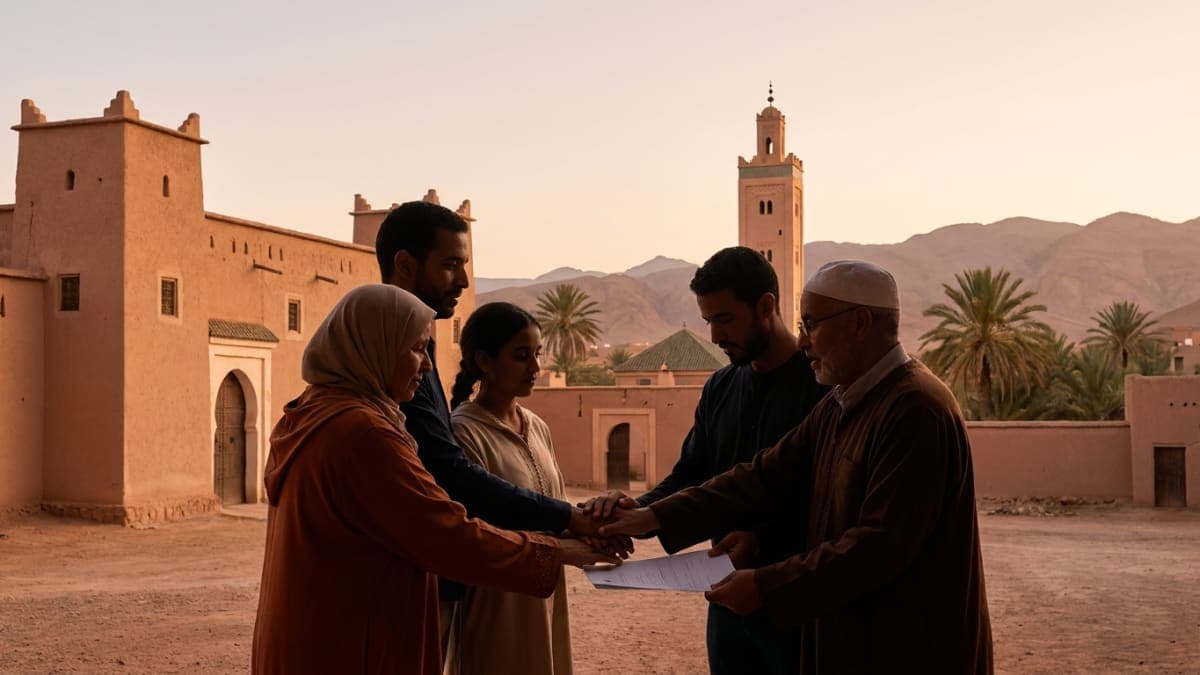
The search query “adoul Morocco deed procedure” covers very different processes: marriage, resumption of married life, khol’, power of attorney, gift, debt or inheritance. An adoul is a professional who receives declarations and testimony and records them in a deed in accordance with taoutiq formalities. An adoul does not act as a judge or settle disputes. In practice, deeds must normally be received by two adouls, under the institutional supervision of the Ministry of Justice and the judge in charge of taoutiq at the Court of First Instance.
The profession is primarily governed by Law No. 32-17 on the organisation of the adoul profession, promulgated by Dahir No. 1-18-23 of 22 February 2018. For family instruments, it operates alongside Law No. 70-03 establishing the Family Code, promulgated by Dahir No. 1-04-22 of 3 February 2004. Marriage, dissolution of marriage, parentage and inheritance are therefore governed by substantive rules that neither the parties nor the adouls may exclude through a private clause.
An adoul must not be confused with a notary governed by Law No. 32-09 on the organisation of the notarial profession. Both professions may receive instruments to which the law grants authentic status, but their powers, formalities and organisation differ. Adouls play a central role in marriage, certain divorce instruments and inheritance matters. Notaries are commonly involved in property sales, bank financing, companies and transactions requiring funds to be securely held or transferred.
Exercise caution regarding announcements about the Family Code reform discussed since 2024 and 2025. For this edition finalised in September 2026, no legislation promulgated and published in the Official Gazette has been treated as having replaced the articles cited in this guide; however, this position must be checked again on the date of your procedure. A policy direction, bill or ministerial announcement does not amend the law. Only the published legislation, its effective date and its transitional provisions determine the applicable rules.
Adouls primarily receive instruments relating to personal status. A marriage contract is processed in accordance with Articles 65 to 69 of the Family Code, after the file has been prepared and the family judge has intervened. Adouls also document certain authorised divorces and the resumption of married life, or رجعة. Under Article 124, resumption during the waiting period following a revocable divorce is received by two adouls, after which the judge must be informed immediately and summon the wife to notify her. If she objects, she may initiate discord proceedings.
They may also receive powers of attorney, acknowledgments of debt, gifts, inheritance deeds and amicable partitions. Each document remains subject to its own legal regime. A power of attorney does not transfer ownership, an acknowledgment of debt does not automatically create a mortgage, and an inheritance deed does not physically distribute the assets. In practice, the adouls identify the appearing parties, verify their legal capacity and receive their declarations. Judicial authorisation, a tax formality or land registration may nevertheless remain necessary after receipt.
Article 4 of Law No. 39-08 establishing the Code of Rights in Rem imposes, on pain of nullity, a prescribed form for instruments transferring ownership of immovable property or creating, transferring, modifying or extinguishing a right in rem. It requires an authentic instrument or an instrument with a certified date drafted by a lawyer accredited before the Court of Cassation, unless otherwise provided by a special provision. This legislation therefore does not designate adouls as the only competent professionals. An adoul deed may constitute an authentic instrument when it falls legally within their powers, but this classification does not guarantee its automatic registration.
For registered property, contact the Land Registry before choosing the form of the instrument, particularly in the event of a sale, mortgage, division of ownership rights or bank financing. The ANCFCC’s practices, documentary requirements and internal instructions may result in more restrictive review of certain adoul files. These instructions cannot amend the law, but they do affect the documents requested and the registration process in practice. Request confirmation tailored to the transaction, land title and competent Land Registry rather than assuming that every instrument will be accepted.
Lawyers at your service
Verified profiles, members of Moroccan bar associations — call or message them directly from their page
Lawyer in Tangier, Morocco,

A lawyer registered with the Casablanca Bar, I practise in advisory work and litigation for individuals and companies. I handle family law, real estate law, administrative law, commercial law, civil law and business law, providing rigorous and structured support at every stage of the case.

Lawyer at the Nador-Al Hoceïma Bar Lawyer at the Nador-Al Hoceïma Bar, Lawyer at the Nador Bar Association -representation, assistance and defence before the courts of the Kingdom of Morocco as well as before public administrations. Legal consultations and advice, with particular expertise in private law, especially in real estate, commercial, administrative and civil litigation
The procedure begins with a precise explanation of the transaction. Provide the parties’ identities, the nature of the deed, the amounts, the relevant assets and any applicable time limits. For property, provide the land title number, a recent ownership certificate and documents establishing the origin of the right. The adouls verify their powers, any potential incompatibilities and the legal capacity of the appearing parties. They must also tell you whether judicial authorisation, a tax certificate, a bank’s consent or an additional document is required before receipt.
On the day of the taoutiq session, the parties appear in person unless represented under a valid power of attorney appropriate to the deed. The adouls check the CINs, passports, stated capacities and consistency between names in Arabic and Latin script. They then receive the consent or testimony, depending on the nature of the instrument. Beware of forms prepared too hastily: have the dates, amounts in figures and words, identity numbers, ownership shares and land references checked again. A simple reversal of digits may prevent processing by the DGI or ANCFCC.
After receipt, the deed follows the process applicable to its nature. It may require review by the judge in charge of taoutiq, registration with the General Directorate of Taxes, filing with the registry of the Family Justice Division or registration with the Land Registry. Appearing before two adouls does not replace any of these procedures. Ask in writing who is responsible for each formality, what time frame is expected and which amounts are professional fees, taxes or expenses advanced on your behalf.
At the end, request a legible copy of the deed and the references for the completed review, registration and payments. For a marriage or divorce, check that it has been transmitted to the Civil Status Office in accordance with the Family Code and Law No. 36-21 on civil status. For registered property, obtain the new ownership certificate after registration. Possession of a signed copy does not, by itself, prove that all formalities required to make the deed effective against third parties have been completed.
The file is submitted to the Family Justice Division of the competent Court of First Instance. Article 65 of the Family Code provides in particular for an application for authorisation to draw up the deed, a birth certificate extract, an administrative certificate for each fiancé, a medical certificate and the authorisations required in specific cases. The list varies according to nationality, residence, occupation and marital status. A criminal record certificate is therefore not automatically required for all Moroccan couples; confirm the documents with the court registry.
The prospective spouses present their original CINs and, for a foreign national or MRE, their passport together with the requested consular supporting documents. A divorced person normally provides the final judgment and proof of its registration, while a widowed person provides their spouse’s death certificate. Foreign documents must be apostilled when the Hague Convention applies, or legalised in other cases, and then translated into Arabic if requested by the court registry. Resolve spelling discrepancies before filing rather than after the marriage.
Article 19 of the Family Code sets the capacity to marry at eighteen completed Gregorian years. Article 20 allows the family judge in charge of marriage to exceptionally authorise the marriage of a minor by a reasoned decision specifying the interest served and the grounds justifying authorisation. The judge may order a medical assessment or social inquiry. Polygamy is governed by Articles 40 to 46 and is subject to judicial review. The adouls cannot remedy the absence of a required authorisation through a declaration by the family or parents.
After the file has been approved, the two adouls receive the consent, record the dowry and draw up the contract with the particulars required under Article 67. Under Article 24, an adult woman exercises matrimonial guardianship herself; she may contract her marriage or delegate that power to her father or a close relative. The presence of a wali is therefore not a general requirement imposed on every adult woman. The spouses may also sign a separate document concerning property acquired during the marriage, in accordance with Article 49, after considering its property-related effects.
Mutual consent divorce and khul’ are often confused. Article 114 of the Family Code allows spouses to agree to end their marriage, with or without conditions, provided that those conditions do not contravene the Code or harm the children. Khul’, governed by Articles 115 to 120, involves agreed compensation in exchange for the divorce. In both cases, a private agreement or a single appointment before the adouls is insufficient: the court retains supervision over the dissolution.
The application is filed with the Family Justice Division. For the procedures concerned, Article 79 designates the court of the matrimonial home, the court of the wife’s domicile or the court of the place where the marriage was concluded, in the order stated in the provision. The court summons the parties, verifies the existence of the marriage and attempts reconciliation. It also examines the children’s circumstances, maintenance, custody, housing and financial commitments. Where one party resides abroad, service of summonses may take longer and duly authenticated documents may be required.
In khul’, the consideration may consist of returning the dowry or paying another agreed amount. Article 117 protects the wife where the khul’ results from coercion or harm attributable to the husband. Article 119 regulates the use of the children’s rights as compensation where the mother is insolvent. In practice, maintenance and the children’s other non-waivable rights must not become bargaining chips. The adouls record the approved conditions as part of the judicial process, but cannot validate a waiver that contravenes the law.
After the court grants authorization, the adouls document the divorce, and the case then returns to the judicial process for the decision and its transmission to the civil-status authorities. The process generally takes from a few weeks to several months, depending on hearings, attempts at service and the court’s caseload; there is no guaranteed uniform timeframe in practice. The waiting period, or iddah, is calculated according to the wife’s circumstances and the rules of the Code. For administrative purposes, use the final decision and the duly registered deed, not merely the agreement concluded between the spouses.
A power of attorney, or وكالة, allows the agent to act on behalf of the principal in accordance with Articles 879 et seq. of the Dahir establishing the Code of Obligations and Contracts. A general power of attorney primarily covers acts of administration, within the limits of its wording. The sale of real estate, creation of a mortgage, a gift or certain banking transactions generally require special authority. Specify the property, the limits of the authority, the price or the method for determining it, the power to receive payment and the formalities that the agent may complete.
An acknowledgment of debt must identify the creditor, the debtor, the amount in figures and words, the lawful basis of the obligation, the due date and the payment method. An authentic instrument benefits from the evidentiary force established by Articles 418 to 420 of the Code of Obligations and Contracts. This evidentiary force does not preclude every challenge and does not convert the debt into a security interest. If the creditor requests a mortgage, guarantee or specific enforcement mechanism, additional clauses and formalities must be considered before the deed is executed.
Gifts of real estate are governed by Articles 273 et seq. of the Code of Rights in Rem, enacted by Law No. 39-08. The donor’s ownership and legal capacity, the donee’s acceptance, and the conditions relating to possession and public registration must be verified. For registered property, registration with the ANCFCC is decisive for producing the real effect. The gift may also incur registration duties and land registration fees. The family relationship may alter the tax treatment but does not automatically exempt the transaction.
In inheritance matters, the rules of succession are set out primarily in Articles 321 et seq. of the Family Code. The adouls may draw up a certificate of inheritance based on the required civil-status documents and witness testimony, and may then execute an amicable distribution where all legally capable heirs agree. Heirs living abroad must be identified and validly represented if they do not appear in person. The presence of a minor or absent person, a debt, a disputed will or a disagreement may require court intervention before any final distribution.
The cost of a deed is not limited to the remuneration of the two adouls. The invoice may include copies, travel expenses, registration duties, taxes, certificates, translations, court registry filing fees and land registration fees. As a guide only, a straightforward marriage is sometimes quoted at between 500 and 1,500 dirhams and a straightforward power of attorney at between 300 and 800 dirhams. These 2026 ranges come from individual quotations and reports of actual practice, not public statistics. They precede verification of the applicable statutory fee schedule and are not binding.
For an acknowledgment of debt, quotations encountered often range from 400 to 1,000 dirhams. A certificate of inheritance, distribution or gift may be estimated at between 800 and 2,500 dirhams, and sometimes more where several assets, heirs, witnesses or journeys are involved. These amounts do not establish that professional fees are entirely unrestricted. Law No. 32-17 and its implementing legislation must be consulted to identify the statutory fee schedule in force. Before making any payment, seek confirmation from the adouls and, in case of doubt, from the court registry or local taoutiq service.
Duties payable to the DGI are separate from the adouls’ remuneration. Deeds falling within the scope of Articles 127 et seq. of the General Tax Code are subject, depending on their classification, to a fixed or proportional duty. For many deeds, Article 128 provides for a thirty-day deadline, but special timeframes and regimes also apply. A rate found on an outdated website is insufficient: the General Tax Code as updated by the 2026 Finance Law, the declared value, the nature of the right and the family relationship must be checked to calculate the exact amount.
A straightforward power of attorney may be completed within a few days when all documents are available. A marriage, khul’, gift of land or inheritance matter often takes several weeks, particularly where foreign documents are involved. A consular certificate may sometimes take four to six weeks during busy periods, but this estimate must be confirmed with the relevant consulate. ANCFCC processing times depend on the file and any irregularities identified. Insist on a receipt clearly itemizing professional fees, taxes advanced, copies, travel expenses, translation costs and any intermediary fees.
An adoul deed that has been duly executed and bears the required formalities constitutes an authentic instrument within the meaning of Articles 418 to 420 of the Code of Obligations and Contracts. It provides proof of findings made by the authorized professionals within the limits of their duties, while the parties’ declarations are subject to their own rules governing challenges. This evidentiary force does not mean that every deed immediately permits seizure or compulsory enforcement. Depending on the obligation, an enforcement clause, court application or enforcement proceedings before the competent court may still be required.
To use the deed abroad, ask the receiving authority whether it requires a recent original, certified copy, apostille, translation or transcription. According to the official status table for the Hague Convention maintained by the HCCH, the Convention of 5 October 1961 entered into force for Morocco on 14 August 2016, not in 2024. This date may also be verified with the Moroccan services responsible for apostilles. The apostille authenticates the origin of the seal or signature; it does not validate the deed’s content.
In France, Belgium or the Netherlands, the receiving authority checks, in particular, identity, formal validity, translation and compliance with its public policy. The authority may require transcription of a marriage or a specific procedure to recognize the effects of a divorce. Exequatur primarily concerns the recognition or enforcement of a foreign court decision; it should not automatically be requested for a straightforward power of attorney or marriage deed. Before repeating all formalities, request a written list of requirements from the relevant foreign authority.
The most common errors concern discrepancies in names between the CIN and birth certificate, omission of an heir, an overly general power of attorney, an incorrect land reference or failure to complete tax registration. A clerical error cannot be corrected by adding a handwritten note to the copy. The adouls may sometimes execute a corrective deed subject to the taoutiq process. Where the correction changes ownership, shares or a person’s rights, the Court of First Instance and, for a land title, the ANCFCC may need to intervene.
A lawyer can provide valuable assistance before a substantial gift, a distribution involving a minor, a secured debt, an international divorce or a bank-financed sale. The lawyer verifies the consequences of the transaction, prepares court applications and handles disputes. The adouls, for their part, receive and authenticate declarations falling within their authority. These roles are complementary, but neither guarantees that the deed will automatically be accepted by the judge, the DGI, the ANCFCC, a bank or a foreign authority.
Need a Family Law lawyer?
Browse verified profiles near you
Directory of specialized lawyers in Morocco
For an international marriage, khol’, inheritance, gift, sensitive power of attorney or real estate transaction, consult a lawyer practising in the relevant field on AvocatLib to verify the procedure, risks and effects of the deed.
Consult a lawyerUnderstand complaints, evidence and seizures to recover unpaid maintenance in Morocco in 2026.
22 min readFamilyConditions, court, documents, timelines and costs to change a child’s legal guardian in Morocco or unblock an urgent act.
26 min readFamilyIdentify the guardian, prepare the file, and secure the management or sale of a minor’s property in Morocco.
22 min readFamilyIdentify the minor’s guardian and prepare the procedure, documents, fees and appeals before the Moroccan courts.
24 min readFamilyDraft and execute a wasiyya in Morocco: disposable third, adouls, documents, costs, expatriates, real estate and disputes.
21 min readFamilyKafala conditions, documents, costs and steps in 2026 to prepare a complete application and anticipate its recognition abroad.
27 min read